
Taking the Message Back Into Communities
Sulma Arias was active in an evangelical church and home-schooling her children when a veteran community organizer visited Wichita, Kan., and changed her life path.
Shel Trapp, a co-founder of People’s Action, saw how Arias, who had immigrated to the United States from El Salvador at age 13, could help translate in Wichita’s Latino neighborhoods. He trained her in organizing, and her new career was born.
More than 20 years later, in 2022, Arias became the charity’s executive director. She credits Trapp for giving her a chance — despite her unconventional background. “If they had given up on me — ‘you’re too this or you’re too that’ — I’d never be where I am today.”

That experience helps her understand people who don’t think like she does, including the immigrants within her extended family who support President Trump.
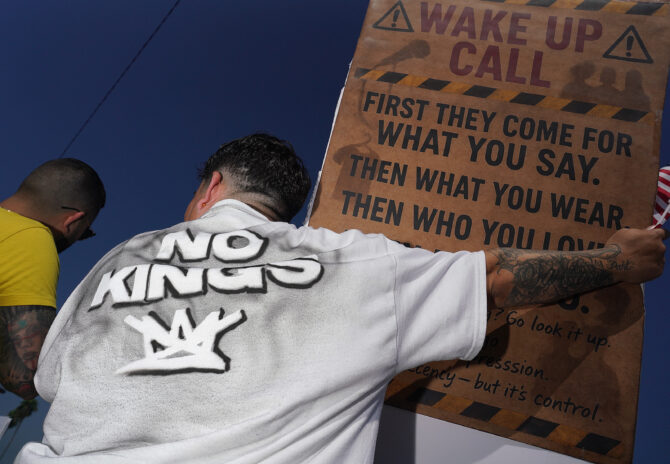
To be sure, Arias is an outspoken Trump critic. Her first op-ed of 2025 criticized his signing of the Laken Riley Act, which requires immigrants to be detained and subject to deportation if they’re accused of minor offenses. In June, she condemned Trump’s crackdown on protesters in Los Angeles.
But her understanding of people who think differently gives her conviction that many of Trump’s supporters can be won over through deep canvassing — the honest back-and-forth conversations that People’s Action conducted with more than 500,000 voters in four battleground states before the 2024 election.
Despite Trump’s election win, a randomized, controlled trial found that the deep canvassing approach shifted voters’ perceptions and laid the groundwork for a long-term progressive agenda. “We need to forget the left or right paradigm and actually be in conversations with people about what matters to them,” Arias says.
People’s Action, which took its current form in 2016 following the merger of nine grassroots organizing groups, now has 41 affiliates in 30 states that work with poor and working-class people on issues like housing, health care, and climate.
Its predecessor organizations advocated for important legislation affecting working people, including the Community Reinvestment Act, the Affordable Care Act, and the Dodd-Frank Financial Reform Act.
We need to forget the left or right paradigm and actually be in conversations with people about what matters to them.
Today organizers need to do better, Arias says. In 2023, she unveiled her vision for an “organizing revival” — in which organizing groups operating in silos begin to collaborate and progressive foundations get back to investing in grassroots groups. More than 20 organizations have participated in four regional meetings about the revival over the past year. The effort will culminate with a training for more than 1,000 organizers in Washington this fall.
“Sulma has drilled that into our minds,” says Ana Garcia-Ashley, executive director of the Gamaliel Foundation and a participant in the meetings. “We now realize that the last 40 years of siloing and competition in organizing has not served us well.”
Organizers also need to get away from the remote work that became necessary during the pandemic — and get back into communities to meet with people one-on-one, Arias says.
Trump promised a better economy, she says, but he hasn’t delivered — even for her. Arias’s husband recently lost his job, her eldest daughter struggles to pay back student loans, and her youngest daughter is still looking for an affordable apartment in Kansas, she says.
“We need to expose the crisis that this administration is creating in real people across the country so that we can begin to change things.”