October 29, 2009 | Read Time: 5 minutes
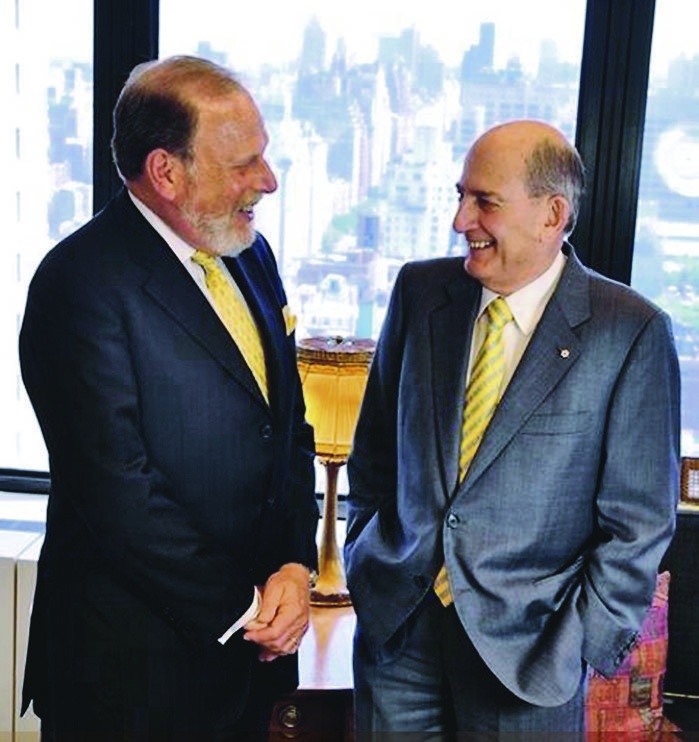
When Charles R. Bronfman met Jeffrey R. Solomon, the two men didn’t hit it off immediately
Mr. Bronfman, who was searching for a person to lead his foundations, found Mr. Solomon an imposing figure with a “Beefeater’s beard.” “I thought he was too elegant and serious,” says the 78-year-old billionaire.
But he eventually warmed to Mr. Solomon’s charms and offered him the job.
It was a fateful decision; it led to a 12-year partnership overseeing the $75-million Andrea and Charles Bronfman Philanthropies, where Mr. Solomon is chief executive and Mr. Bronfman is chairman. And it has led to a new book, The Art of Giving: Where the Soul Meets a Business Plan, to be published next month by John Wiley & Sons, with proceeds supporting the Bronfman funds.
Part memoir, part how-to guide for would-be donors, the book was written as a love letter, albeit one laced with some criticism, to the nonprofit world.
“In many ways, we saw this as a love story. And truth is a very important element in love,” Mr. Solomon says during an interview at his foundations’ headquarters on the east side of Manhattan.
“We weren’t out there to knock people,” adds Mr. Bronfman. “We were out there to try to help people become better philanthropists.”
And while the down economy has hurt giving, including their own, the two men argue their advice is sorely needed as donors struggle with fewer resources.
“Smart retreats win wars,” says Mr. Solomon. “So even if you have to cut back, cutting back with a strategy makes all the sense in the world.”
Despite their friendship, the two men came from very different worlds. Mr. Bronfman was born in Canada, and his family owned the Seagram beverage company; he helped oversee the corporation for a time and also started the Montreal Expos baseball team.
Mr. Solomon, 64, was the son of a New York butcher. After working at his family deli for several years, he took jobs with social-service and mental-health charities.
He was the chief operating officer at a large Jewish group before joining the Bronfman Philanthropies, which primarily support Jewish and Canadian causes.
‘Noses in, Fingers Out’
Sitting in Mr. Bronfman’s office, which is peppered with whimsical glass artwork, they explain that the core message of The Art of Giving is “purposeful” philanthropy, in which charitable projects and nonprofit leaders are rigorously examined.
“If you can’t measure the impact of your gift,” they write, “you should not make it.”
But they also warn against meddling, saying grant makers should be “noses in, fingers out.”
“Too often, foundations think that all wisdom comes with the money,” says Mr. Solomon. “The greatest wisdom is to have respect for those people who are actually on the ground doing the work.”
When asked if there’s any contradiction in being involved but hand’s off, Mr. Solomon says good philanthropy requires a balance between the two, just as it needs to balance passion with strategic thinking.
“If one looks at the progression of philanthropy, there were times when it was too much heart, and there were times when it was too much head,” he says. “Philanthropy 3.0 hopefully will be the blend.”
A Jeep or a BMW?
In the initial chapters of The Art of Giving, the authors offer mental exercises to help people find the right blend.
In one, they ask donors if their giving were a car, what type would it be? Someone answering Jeep, for instance, would indicate a penchant for a practical, stripped-down vehicle for giving, like a donor-advised fund.
Asked what type of charitable automobile he prefers, Mr. Bronfman responds: “An Israeli BMW” — that is, a well-engineered philanthropy with a Jewish heart.
Of course, that BMW hit a road bump this year.
Due to the recession, the Bronfman Philanthropies are decreasing their grant making by 35 percent, to about $11-million. They are not making new commitments and are stretching out some grant payments for longer periods of time, says Mr. Bronfman, whose wealth Forbes magazine estimates has declined from $2.4-billion in 2008 to $1.8-billion.
The organization is set to spend out its endowment and close in 2016, an end date Mr. Bronfman says he set because his children have opted to do other philanthropic work; it is a plan that the financial woes have made more challenging to complete.
“I used to say trying to guide a spend-down foundation was like trying to land on an aircraft carrier,” says Mr. Solomon. “This recession has made the aircraft carrier a rowboat.”
A ‘Selfish Endeavor’
Regardless of the recent economic difficulties, the Bronfman Philanthropies has a well-established track record in grant making. Since it opened in 1986, the Bronfman Philanthropies, which consist of three funds, has awarded more than $300-million and created such venerable groups as Taglit-Birthright Israel, a charity that has helped hundreds of thousands of young Jews visit Israel.
His personal fortune fuels the grant-making consortium, but Mr. Bronfman credits his late wife with giving it vision. It is her guidance he sorely misses.
In 2006 Andrea M. Bronfman, whom friends knew as Andy, was hit and killed by a New York taxi while walking the family dog. She was 60.
“She was my partner, my love, and for sure my greatest critic,” Mr. Bronfman says with a tearful smile.
Perhaps with Mrs. Bronfman in mind, the authors meditate on the meaning of philanthropy in the final pages of The Art of Giving. They put aside the practical advice and personal anecdotes to speak philosophically about what drives their charitable passion.
They reject the notion of “giving back” or altruism, instead arguing that philanthropic work offers a deep, transcendent joy that makes it an almost selfish endeavor.
And on the last page of their love letter to philanthropy, they say it can leave a legacy more important than any monument or memorial. They write: “In many faiths, our souls live on after our death, not as ghosts but as animating spirits that enliven the memories of our friends and defendants and make us, through them, immortal. And so does our philanthropy.”