Bigger Staff and Bolder Goals Turn Around a Quiet Hunger-Fighting Charity

By Debra E. Blum
Contributor
December 2, 2012 | Read Time: 8 minutes
Bill Shore took the stage in October at a convention of Arby’s fast-food franchise owners and managers to tell them exactly how Share Our Strength, his antihunger charity, spent the $1.7-million they raised last year on its behalf.
Arby’s had collected $1 from every customer who wanted to make a gift, offering donors a coupon they could use to get a discount on a return visit. The company provided $300,000 to make a total $2-million gift.
Mr. Shore told Arby’s leaders that they had helped pay for the charity’s No Kid Hungry campaign, which in 2008 announced its bold goal: to wipe out childhood hunger in America by 2015.
Among the accomplishments of the Arby’s gift, he told them: “In North Carolina this summer, we got 21,000 more kids enrolled at summer feeding sites.”
Showcasing such details pays off for Share Our Strength, says Kate Atwood, president of Arby’s Foundation, the company’s charitable arm.
“You can’t hear this about the difference we are making—the specific difference we are making on a very big issue—and not want to get on board.”
Now Share Our Strength is sharing its lessons for success with nonprofits of all sizes nationwide, saying its example proves that making big investments in staffing, advocacy, marketing, and fundraising can pay off with big advances in fulfilling a charity’s mission and helping attract more resources than the more cautious, incremental approach many charities take.
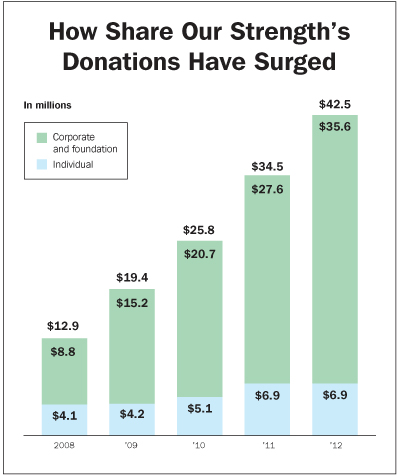
What makes the argument more compelling is that the charity managed to more than triple donations even though it started its bold campaign just as the recession took hold and many charities stumbled.
Setting a Goal Line
With a goal as audacious as ending childhood hunger, the charity decided its campaign needed an equally bold slogan, so it now uses the tag line No Kid Hungry on all of its materials.
But the campaign seeks to prove it is more than a slogan.
When the charity announced the drive, it also attached measuring sticks to it, such as counting the number of kids, state by state, who qualify for free school lunches but don’t get them and showing how the charity has closed the gap.
Share Our Strength says, for example, that its efforts in seven states led to an increase in 2011 of 1.9 million meals to kids participating in summer meals programs, compared with 2010.
Mr. Shore says the combination of ambition and accountability has attracted a growing number of donors and corporate supporters.
“In a competitive, crowded marketplace, we wanted to establish a specific goal line, demonstrate how and when you get across it, and then tie everything we do and say to that,” Mr. Shore says. “Once you stake out what success looks like, you inspire more support and more success.”
An Inspiring Example
Community Wealth Ventures, a consulting company Share Our Strength runs to help other charities improve their management, is spreading the word about the success of No Kid Hungry. Mr. Shore has also given presentations around the country touting what he calls the “characteristics of success.”
Top on his list: “Go big or go home.”
“You have to take that leap, stake something out that has the impact you imagine having,” Mr. Shore says. “Then the key is being able to have clearly defined objectives so everyone understands what you are doing and how you are getting there.”
Jason Reed, director of strategy and corporate partnerships at Hunger-Free Minnesota, says his group operates from a similar playbook, and he is heartened by Share Our Strength’s example. He is especially impressed with the charity’s sweeping goal, willingness to work with state governments, and data-driven appraisals of its work.
Last year, Hunger-Free Minnesota established its own ambitious goal of making available 100 million more meals each year to needy state residents.
When a pilot program this summer recovered 600,000 pounds of sweet corn that otherwise would not have been harvested, Hunger-Free Minnesota said the achievement translated into 475,000 meals.
“The corporations and farmers we were working with latched on to that kind of metric,” Mr. Reed says. “We have a measurable proof point that we can talk about and point to. One hundred million missing meals is our finish line, and these are our markers along the way.”
Existing Programs
Share Our Strength, founded in 1984 by Mr. Shore and his sister, Debbie Shore, decided about five years ago that it needed to find a new way to promote change.
At the time, the charity’s year-to-year fundraising had stagnated and its grants to food-assistance programs scattered around the country appeared to be making no more than a passing dent in antihunger efforts.
Inspired by the writer Jonathan Kozol’s advice to pick battles big enough to matter but small enough to win, Mr. Shore says the charity decided to home in on a considerable but measurable goal—ending childhood hunger by removing the barriers between kids and the food and meal programs available to them.
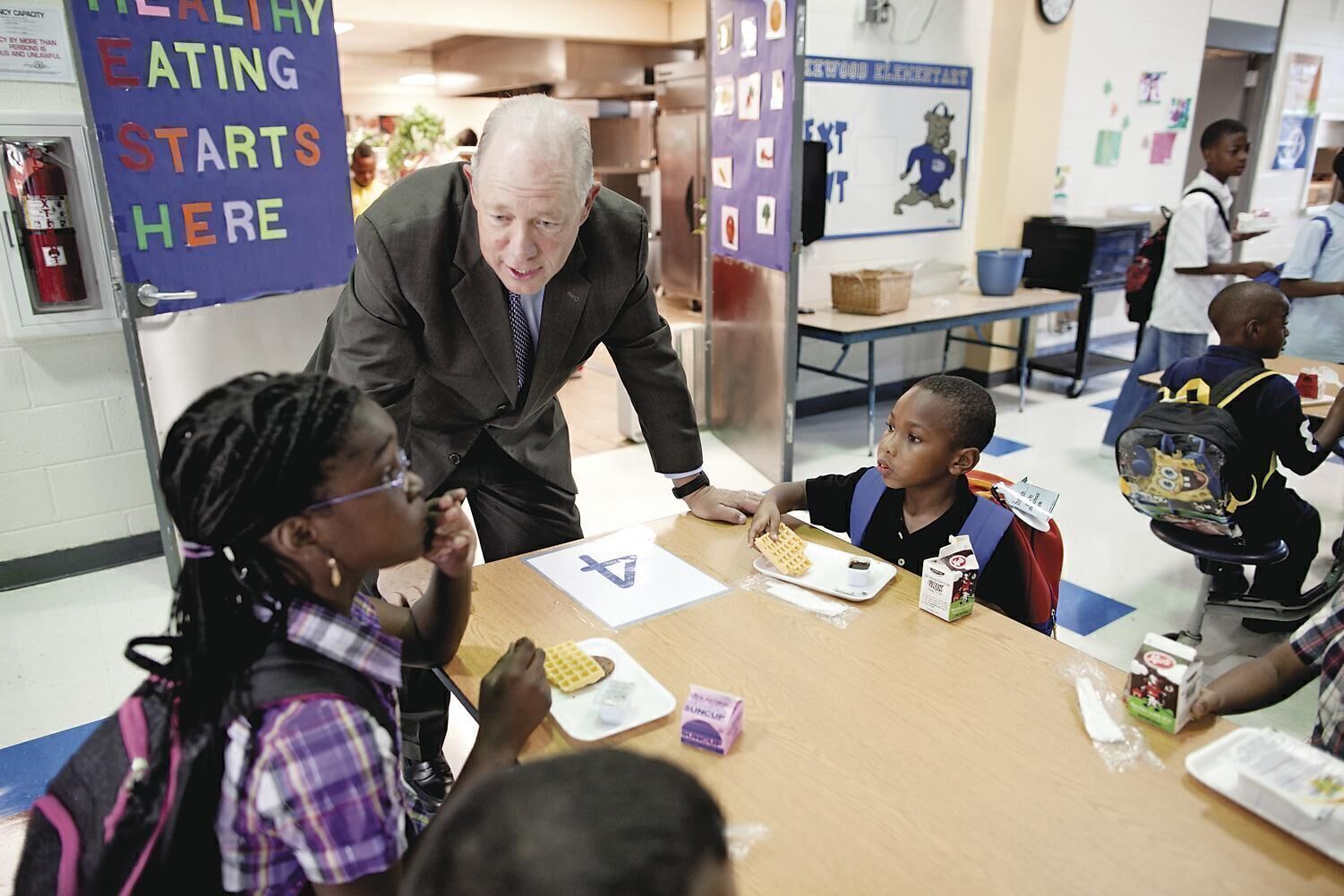
To get there, Share Our Strength introduced programs intended to connect kids in need with nutritious food; teach families how to cook healthy, low-cost meals; and call attention to the extent of childhood hunger in America.
It uses the private money it raises to pay for that work and to collaborate with governments, schools, and local charities to link poor youngsters with government subsidies their families have not yet taken advantage of.
In Maryland, for example, Share Our Strength provides money and advice to help education officials, local government agencies, and other hunger-relief organizations change the way schools serve breakfast so more needy kids can get a free meal.
Among the new approaches: Nearly 90 schools now serve breakfast during the first period of school rather than before school starts to accommodate students, especially bus riders, who are unable to arrive early.
“We are using private dollars to unlock federal- or state-level funds that already exist and are there to feed kids,” says Josh Wachs, Share Our Strength’s chief strategy officer. “This is leveraging assets and providing a return on our investment and the investment of our stakeholders who want to see movement on a problem.”
New Brand and Logo
Making the transformation from quiet grant maker to determined problem solver has required Share Our Strength to grow quickly and spend money on new staff members and marketing efforts. In the last few years, the charity has hired nearly 100 additional employees with newly needed skills in fundraising, marketing, accounting, advocacy, public policy, and program management, pushing the staff size to 169 and expenses for salaries and benefits from roughly $6-million in 2009 to more than $14-million this year.
It expanded its board, which had worked mostly in an advisory capacity, to include members focused on fundraising and with a diversity of business experience.
And it hired a branding company and a marketing consultant to revamp its logo and its whole look to showcase the No Kid Hungry message.
While its spending was growing, so were the charity’s revenues. From 2004 to 2008, Share Our Strength raised about $13-million each year. This year’s total is expected to be about $42.5-million.
Corporate Sponsors
Much of the charity’s support—84 percent this year—comes from corporate marketing deals and other arrangements. In the last two years, the charity has doubled to 40 its number of corporate sponsors.
Its signature promotional events are bringing in more money than ever, too.
Dine Out for No Kid Hungry, an annual weeklong event when restaurants across the country donate a portion of their proceeds to Share Our Strength, brought in $5.4-million this year, up from $575,000 in 2008.
Mr. Shore says raising money from businesses has helped buffer the charity from the economic downturn. Even when money is tight, spending on advertising and marketing often remains steady, he says, and supporting Share Our Strength can help businesses promote themselves.
“We are intentional in making sure to deliver value,” Mr. Shore says, adding that switching to the No Kid Hungry logo gave companies a more valuable charitable tie-in than when the group was known only as Share Our Strength.
“The No Kid Hungry umbrella makes it more immediately understandable what we are doing and what they are supporting.”
Online Pledge
Even with its corporate focus, Share Our Strength aims to increase gifts from individuals, which are projected to be about $7-million this year, up from just over $4-million in 2008.
A No Kid Hungry pledge, asking people to sign up online to show support for the campaign, has so far collected more than 280,000 signatures. Now the charity is sending e-mail pitches to people who took the pledge and hopes to more than double its online gifts in the next couple years, to $5-million.
Share Our Strength could attract criticism for the amount it spent building its staff and image, Mr. Shore acknowledges.
It paid a relatively big salary—$141,000—to lure a chief financial officer away from the banking and consulting world, and a hefty contract fee—$300,000—to a branding company to remake the charity’s image.
But, he says, the investments have paid off, revenues have soared, and spending is back in line.
“We went all in,” he says. “And we have something to show for it.