Charities Urged to Watch Donor-Anonymity Legal Challenges

By SUZANNE PERRY
Contributor
January 26, 2016 | Read Time: 9 minutes
Americans for Prosperity Foundation, a charity that promotes free-market economics and limited government, says two of its key supporters have faced horrific threats from social media, phone calls, and email.
On Twitter: “Can someone assassinate [their] family already? What’s taking so long?” “Let’s drag [them] out and let the hangman do his deed so they can twist in the wind.” By email: “I hope both of them get cancer and suffer for years and then die.” “Please crawl back under whatever slime pit you crawled out of. I wish there was a ‘Hell’ in which you would burn for eternity.”
Protesters have shown up at their houses and companies and hundreds surrounded the Washington Convention Center when the charity held a conference there in 2011, attempting to enter and accosting people as they left.
So the foundation believes it has good reason to stand up for a bedrock principle of charitable giving — donor anonymity.
“Current and potential donors are understandably afraid that having their identities disclosed will put them and their families at risk,” it argued in a legal complaint that it filed against California Attorney General Kamala Harris after her office asked the group in 2013 and 2014 to submit a list of its major donors to continue raising money there.
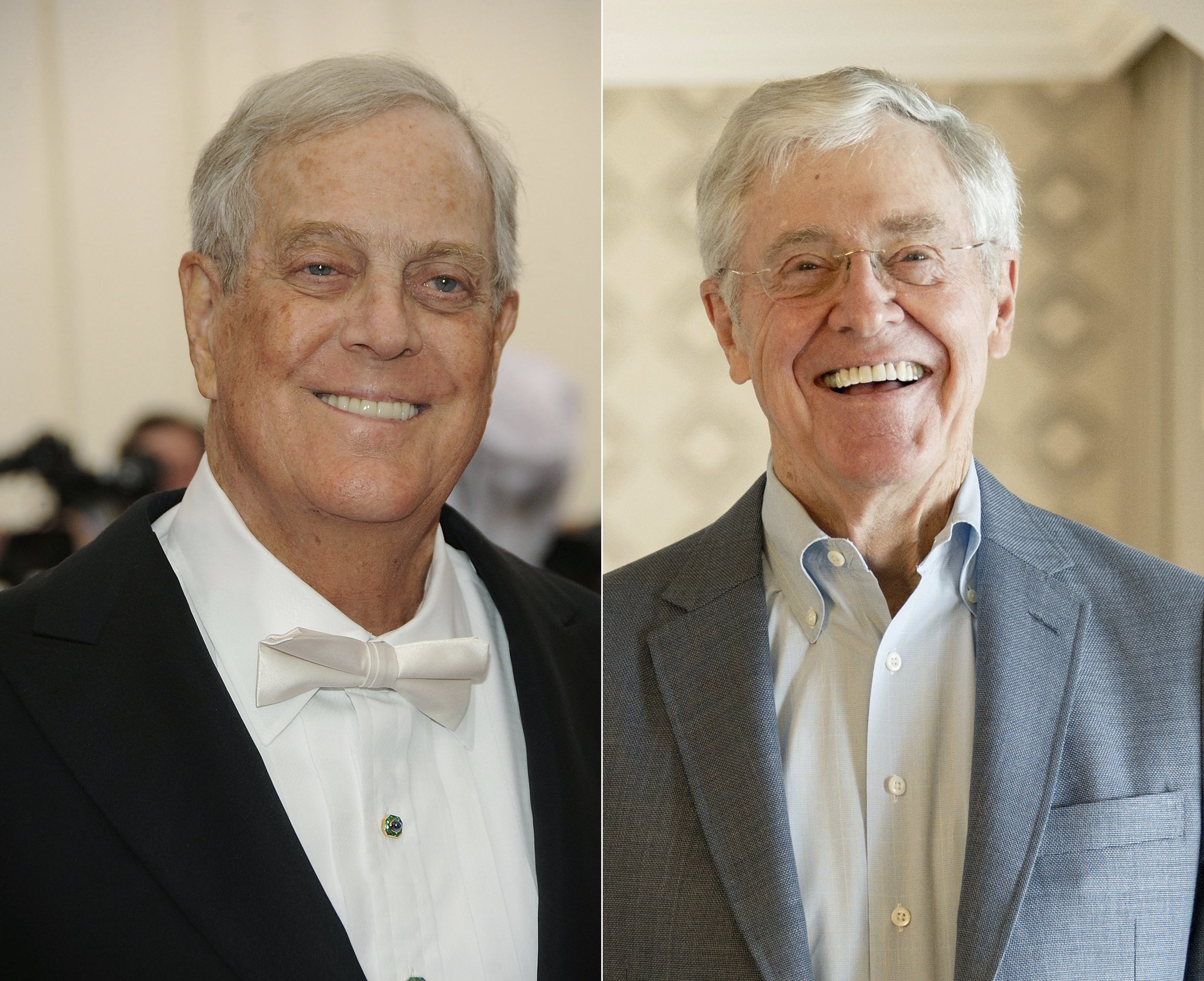
The Americans for Prosperity Foundation’s two key supporters?
Charles and David Koch, the billionaire brothers who finance conservative and libertarian causes and spend heavily to promote Republican candidates.
American Prosperity’s court case against California — and a similar legal challenge to New York Attorney General Eric Schneiderman — raise fundamental questions about how much the states should have a right to know about charity donors. A long list of conservative and libertarian groups have lined up to protest what they see as an unconstitutional attempt to chill free speech and free association, fueled by fears that the Democratic attorneys general have nefarious motives.
So far, the courts have mostly backed the states, finding that their requests for the donor information were reasonable given their responsibility to police charities. But the legal battles continue, with the Americans for Prosperity Foundation case scheduled for trial next month in U.S. District Court in California. And some nonprofit experts say it is time for a broader range of charities, not just conservative ones, to take a stand.
“If you care about your donors and the private nature of the relationship between your organization and them,” says Roger Craver, a veteran fundraising consultant, “you fight to the death to protect that privacy.”
So far, few other organizations have stepped into the fray, though that may soon change.
The Koch brothers’ legion of critics may find it hard to sympathize with two powerful and wealthy people who have inserted themselves so aggressively into the public-policy arena.
Ever since the 2010 U.S. Supreme Court Citizens United ruling lifted restrictions on corporate and nonprofit spending to influence elections, critics have called for more disclosure of the anonymous donors who finance politically active 501(c)(4) social-welfare organizations.
But the Americans for Prosperity Foundation, which the Koch brothers helped to found and that David Koch chairs, is a 501(c)(3) charity that — unlike its sister organization, Americans for Prosperity — cannot participate in partisan politics because of its tax status. As an article published online last year by New York University’s liberal Brennan Center for Justice put it: “Do Even the Koch Brothers Deserve Some Privacy?”
Records on Donors
The controversy centers on Schedule B, a document that is attached to the Form 990 federal tax filings that nonprofits submit annually. Charities must list the names, addresses, and total contributions of major donors, generally those who have contributed at least $5,000 during the year.
The schedule was introduced in 2000, designed to provide more protection of donor information than the previous system, in which nonprofits reported big contributors on a schedule of their own design. Among other things, it helps the IRS determine whether a charity is entitled to that tax status because it gets a substantial amount of money from more than just a few individuals, explains Marcus Owens, a nonprofit tax lawyer and former head of the IRS tax-exempt division.
While the Form 990 is public record and easily available on sites like GuideStar, federal law bars public release of donor names and addresses. Nonprofits must provide Schedule B to anyone who asks but can black out all but the dollar amounts.
Only a few states require charities to submit Schedule Bs when they register to solicit money, including California, which says it has long done so but stepped up enforcement in recent years. In court filings, Attorney General Harris said the state uses the information, which it does not make public, to monitor charities for fraudulent activity — for example, to look for “self dealing” by examining whether major donors are passing money to family members or setting up organizations for their own benefit rather than for charitable purposes.
But opponents say they have no faith the donor details will remain confidential. The Americans for Prosperity Foundation says it has documented more than 1,700 cases in which Schedule Bs filed in California were mistakenly posted online. And unlike the IRS, it argues, California has no sanctions for government employees who violate donor privacy.
The situation is a “catastrophic accident waiting to happen.” says David Keating, president of the Center for Competitive Politics, a charity that fights campaign-finance restrictions on free-speech grounds and has also sued California over its Schedule B policy. “Somebody could someday wake up and see every charitable donor on the Internet,” he says, “and people will say, How did that happen?”
Courts Back States
Most court rulings have shown little sympathy for the nonprofits opposing release of donor names, saying they had not presented evidence the policies had actually damaged them. The Ninth Circuit U.S. Appeals Court last year rejected bids by both the Koch group and the Center for Competitive Politics for preliminary injunctions to stop Ms. Harris from collecting Schedule Bs.
The U.S. Supreme Court declined to review the ruling in the Center for Competitive Politics case.
A U.S. District judge in July also refused to issue a preliminary injunction against Mr. Schneiderman that was requested by Citizens United, the conservative advocacy group that sparked the Supreme Court ruling bearing its name, and its 501(c)(3) affiliate, the Citizens United Foundation.
The Attorney General,” he wrote, “has shown that the Schedule B policy substantially relates to the important governmental interests of enforcing charitable solicitation laws and overseeing charitable organizations for the protection of the public.”
‘Threat to Free Speech’
Except for the Philanthropy Roundtable, an association of foundations and donors that has lauded the Koch brothers’ philanthropy, no major nonprofit or fundraising trade association has weighed in on the controversy. But Jason Lee, general counsel at the Association of Fundraising Professionals, has been consulting with Robert Tigner, a veteran direct-marketing lawyer, about the possibility of coordinating a joint response from nonprofit associations.
“There’s been information sharing, not rallying around any formal position statements,” says Mr. Tigner, general counsel at the Association of Direct Response Fundraising Counsel. “I’ve been lobbying some of my colleagues that we should have a collective one.”
Mr. Lee says his organization is concerned about the Schedule B cases but has been preoccupied with other nonprofit tax battles, for example a successful effort to defeat a proposal to allow nonprofits, rather than donors, to report gifts over $250 to the IRS.
Mr. Craver, who has represented liberal groups throughout his career, tried to rally support for the conservative groups fighting California in August, posting an “urgent alert to U.S. nonprofits” on his blog, the Agitator, asking them to support a friend-of-the-court brief in the U.S. Supreme Court case.
The effort was being organized by Mark Fitzgibbons, president of corporate affairs at American Target Advertising, the company founded by Richard Viguerie, who pioneered the use of direct mail to promote conservative causes (and is a longtime liberal bête noire).
“It doesn’t matter whether your organization is ideologically ‘liberal,’ ‘conservative,’ ‘neutral,’ or ‘agnostic,’ ” Mr. Craver wrote, “the threat to free speech and due process is exactly the same.”
However, almost all of the 58 organizations that joined the brief were conservative or libertarian, for example the Family Research Council, Gun Owners of America, and Independent Women’s Forum.
Mr. Craver says young fundraisers may not realize what’s at stake, but he and other older people recall efforts that donors made to shield their identities in the early days of the civil-rights and gay-rights movements.
The court filings all mention the landmark 1958 U.S. Supreme Court decision that declared unconstitutional Alabama’s effort to force the NAACP, the civil-rights group, to provide the names and addresses of its members in the state, ruling that the request violated the right of free association.
The Alliance for Justice, which represents progressive advocacy nonprofits, has not contested the right of the states to request Schedule Bs. Abby Levine, director of the group’s Bolder Advocacy project, says they are asking for details that charities already provide to the IRS so “the precedent is there to make the information available.”
However, she says the group is worried about the confidentiality issue. On Monday, it sent a letter expressing concern about draft regulation drawn up by California authorities to establish rules for protecting the Schedule B donor information. Sent jointly with Muslim Advocates, an advocacy and educational organization, the letter complains that the regulation would offer less protection than the Internal Revenue Code and allow other state agencies to request donor details by administrative subpoenas that do not require “probable cause” or judicial oversight.
The state has scheduled two hearings this week on the draft measure, which has also drawn fire from the conservative groups. They sent a letter complaining that it “utterly lacks description of any safeguards, processes, protocols, or accountability to maintain confidentiality”.
Privacy and Humility
However the courts eventually decide, the controversy offers a window into the rationale for anonymous giving. In addition to fearing reprisal, some donors are humble about their giving or want to avoid solicitations from other organizations.
“I’ve had clients who were not known to be wealthy,” says Gregory Colvin, a lawyer who specializes in nonprofit lobbying and political activity. “They were trying to live in every way a normal life,” adding, “These are people who are not seeking public recognition, not seeking their name on a building.”
Some advocates of donor anonymity, of course, draw the line when it comes to donations to nonprofits that are designed to influence elections.
But Rob Reich, co-director of the Center on Philanthropy and Civil Society at Stanford University, goes even further. He favors mandatory disclosure of all donations over $10,000 in any year to a single entity — even to 501(c)(3) charities.
“Philanthropy is an exercise of power, he said, “and in a democratic society, power deserves scrutiny. Making visible large donations is one way to try and hold wealth to account, to domesticate large fortunes in order that they serve democratic purposes.”