Fidelity Charitable Leader on the Most Popular Causes for Donor-Advised-Fund Gifts
February 7, 2020 | Read Time: 29 minutes
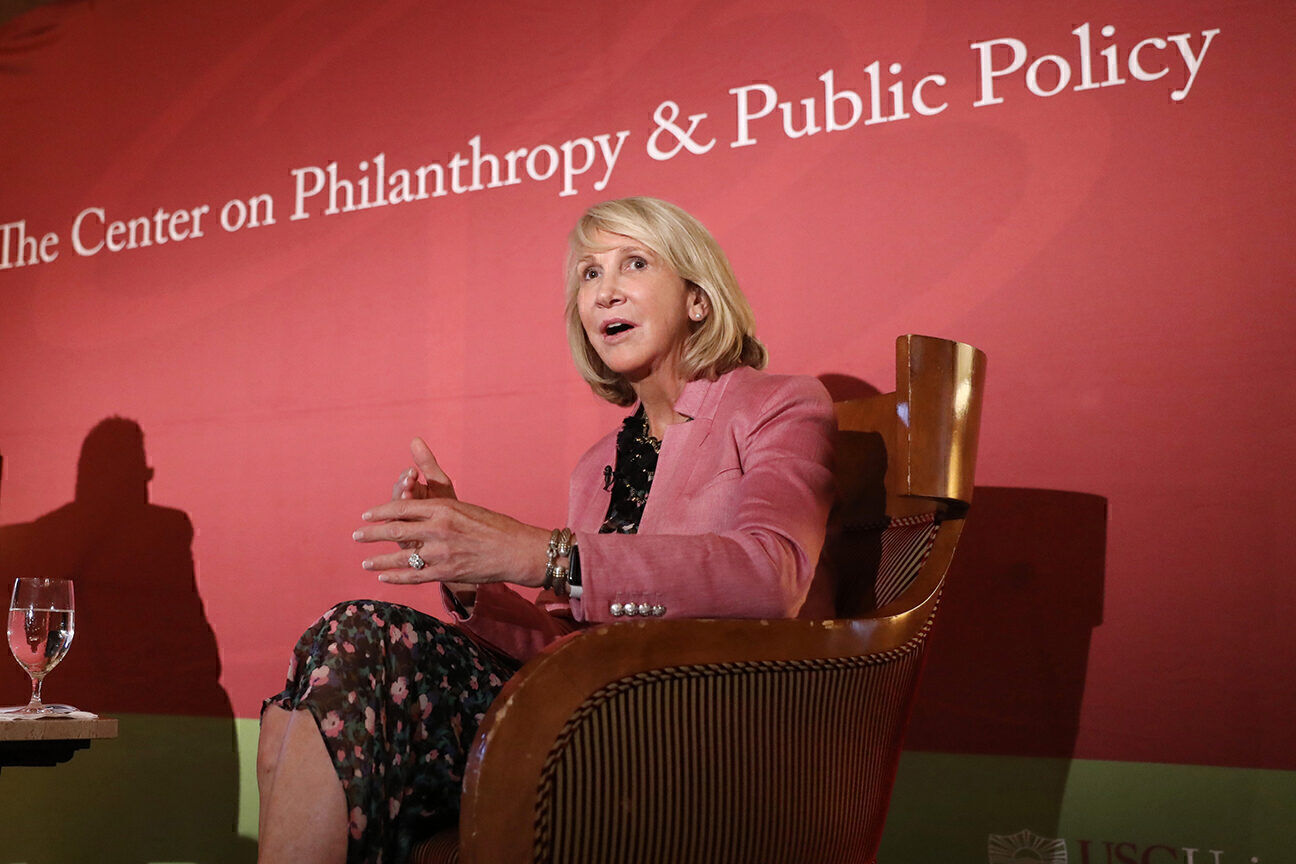
This week’s Business of Giving features Pam Norley, president of Fidelity Charitable, the first commercial donor-advised fund.
“We’re trying to come up with ways for people to be more intentional and inclusive and focused in their giving. We make a lot of tools and a lot of information available. We now actually have set it up that you can actually establish your own mission in connection with your account so that people can come together as a family and think about what they really want to accomplish, and then they can decide which charities they want to give to as a family, as individuals.”
Listen to the podcast which is hosted by Denver Frederick, or read the transcript below.
Denver: When the Chronicle of Philanthropy ran its annual list of the 400 largest charities back in 2016, many were taken by surprise that its top spot wasn’t occupied by an organization like the United Way or The Salvation Army, but rather Fidelity Charitable. It signified that the way Americans are going about their giving has changed dramatically, and that donor-advised funds are becoming the preferred vehicle for an increasing number of people. And here to discuss that with us tonight is Pam Norley, the President of Fidelity Charitable. Good evening, Pam, and welcome to The Business of Giving.
Pam: Thank you very much. It’s such a pleasure to be here.
Denver: You know, there are so many Americans that are connected to Fidelity Investments, either directly or indirectly; I think about one in five. Tell us how and when Fidelity Charitable, the first commercial donor-advised fund got started.
Pam: Fidelity Charitable is a national donor-advised fund, which allows people to use our platform for giving all around the world. It was established in 1991. Fidelity Charitable is a 501(c)(3), so it’s a charity in and of itself, associated with Fidelity… just that the services are provided by Fidelity Investments. So we’ve had that opportunity to build this amazing product, but it’s been over 28 years, 29 years. It’s been a very long time that we’ve been at this, and donor-advised funds in terms of popularity have really taken off just really in the last five years.

Denver: So for those who might be hearing about this vehicle for the very first time, how would you describe a donor-advised fund?
Pam: A donor-advised fund is a tax-efficient savings account for charity. It’s a very tax-efficient way to do your philanthropy because you get to take a deduction for the contribution that you make to set up your own account or a little mini foundation with as little as $5,000 if you use Fidelity Charitable, and then you have the ability to give that money out in $50 increments as soon as you’ve made the contribution. You also have the opportunity to invest those assets, so potentially adding even more to philanthropy as a result of having an account.
Denver: As little as $5,000? Now, does that have to be in cash, or can other assets be used to establish an account?
Pam: Good question. So most of our donors give us appreciated securities, which is a real benefit because you almost have the doubling of the benefit because instead of paying tax on the appreciation on that security, that can go to philanthropy. So, for example, if you bought Microsoft at $100, and it’s now worth $200, you could put that and donate that into your account, and then you’d have the ability to basically give away $200 and not pay tax on an additional $100 of gain.
Denver: You know, we’ve talked a lot on this show about corporate giving, corporate social responsibility, them doing more, trying to solve the problems around the world, foundations the same way. But at the end of the day, it’s really individuals who make up the lion’s share of giving in this country, correct?
Pam: That’s absolutely right. In fact, Americans gave away $420-some billion in 2018 and almost $300 billion of that came from individuals.
Denver: Wow. That’s an awful lot.
Pam: It’s remarkable.
Denver: Yes. Now, are there any rules that stipulate how quickly the funds that had been put into a donor-advised fund have to be distributed to a charity or charities?
Pam: So at Fidelity Charitable, we require that people be active grant makers. So, if in fact they have not made a grant within three years, we will actually take 5% from their account. We actually have an independent board of trustees who have a separate fund that grants out to charities as well, generally that support infrastructure and nonprofits. And so, the 5% will go out. If they in fact then don’t give the following year, we’ll sweep the whole account and then grant it out to charity on their behalf. So, very active grantmaking. Fortunately, we have people that are using this vehicle to do a lot of their philanthropy. And so, we’re seeing, on average, over the last decade, granting rates of between 20% and 24%.
Denver: Now, is that a Fidelity rule, or is that a stipulation of the way the whole system is set up?
Pam: That’s a Fidelity Charitable policy. We were established with a policy to grant out 5% on an annual basis, but it’s far exceeded that. Most of the other national DAF providers also have similar policies.
Denver: So that criticism you hear about people putting money into a donor-advised fund to warehouse it really isn’t legitimate?
Pam: No, it’s not accurate.
Denver: How many charities does the average account give to?

Pam: On average, we have about 10 grants per year, which has doubled in the last 10 years. And again, so much of what we’re trying to do is meet the donors where they are today in terms of their use of digital for their giving, for their shopping. For almost everything they’re doing, they’re on their phones. And so, we now have the ability to do a lot of our granting through our app, which has, I think, increased the ability for people to be giving more.
Denver: Cool. Pam, what are people giving to? You’re probably going to give out roughly $7 billion in grants. Now, is this pretty much consistent with Giving USA, the way people give directly to charity in terms of its allocation and distribution? Or people who are doing it through a donor-advised fund, is it different in any kind of way?
Pam: Generally, it’s similar to Giving USA. So basically, most of our donors give to religion, to education, to health and human services. Here in New York City, interestingly enough, the top three nonprofit beneficiaries of the donors for 2018, the first was New York Public Radio.
Denver: I like that one, to tell you the truth.
Pam: I know. I figured you would, Denver. And then the second one was, I think it’s the Jewish Federation appeal organization, and the third was Sloan Kettering.
Denver: No kidding!
Pam: And frankly, we have more donor-advised funds here in New York City than any other city in the country. They’re very generous.
Denver: So when people set up a donor-advised fund, does that represent the lion’s share of their giving or all their giving? What percentage do you think comes out of a donor-advised fund? And what part do you think comes out directly?
Pam: We don’t know for sure. I think the work that we’ve done makes clear that people are giving in all different ways. They give with their checkbooks. They give with their credit card. Some people have foundations, and then they also have a donor-advised fund. So, I think what’s happened is people are using and taking advantage of all the different vehicles and ways to give.
Denver: I thought it was interesting, Pam, that some of your research showed that the decision to establish and use a donor-advised fund predisposes its holder to value feedback, specifically from the organizations that it supported. Speak to that and what you’re seeing.
Pam: The mission of Fidelity Charitable is to make giving accessible, simple, and effective. So, we kind of break that down, starting with accessible. So, for $5,000, you have the ability to set up your own mini foundation or your own giving account. Two is simple. It’s a very simple experience. We meet you where you are. You can call, go on the web, use your phone app for granting. So we’re trying to make it very simple and easy to use, and we get great feedback on the interface. But the third thing is effectiveness – how do you get joy and feel that you’re doing a good job with your philanthropy? So, we’ve done a lot of work over the last year. We’re trying to come up with ways for people to be more intentional and inclusive and focused in their giving. We make a lot of tools and a lot of information available. We now actually have set it up that you can actually establish your own mission in connection with your account—
Denver: Oh, I like that.
Pam: —so that people can come together as a family and think about what they really want to accomplish, and then they can decide which charities they want to give to as a family, as individuals. Most people say that charities kind of choose them in the sense that something happens in their life, or they have a certain experience, and that results in them being inclined to give to one nonprofit over another because of what it stands for. But we’ve been very intentional in trying to get our donors to step back and reflect about what they’re trying to accomplish, and to work with the nonprofits to provide feedback and get feedback from the nonprofits in terms of the work that they’re doing on their behalf.
Denver: Right. And it does seem that donors to donor-advised funds have a higher rate of volunteerism than the general public.
Pam: That’s what we’ve discovered, and frankly, that’s the way that you really drive change, right? It’s not just your financial resources; it’s bringing your time as well.
Denver: You’ve talked a couple of times about technology, so speak a little bit more about that… maybe what’s coming up next, but that probably has been the thing that has changed this experience most dramatically and probably is why we’re seeing this incredible growth. Talk a little bit more about that.
Pam: Yes. So we invested pretty heavily in technology over the last five years just trying to update the interface, make it easy to use, intuitive, constantly working on our search functionality. There are 1.7 million nonprofits in this country. We have them all on our platform, but we have about 250,000 that generally our donors are giving to on a regular basis. We want it to be a good experience. So we want them to be able to find the charity quickly, be able to then research that charity, look to GuideStar, Charity Navigator, some of the other tools that we have available so that they can do their own due diligence around the charity and not just take it from the nonprofit itself. We spend a lot of time getting people to think through how to boost their giving IQ – How can I be more effective? How can I think about this? This isn’t just about your friends saying, “Hey, donate $1,000 to this particular cause.” This is about you getting connected to that cause, giving your time, being more intentional, learning about what the impact that organization has on the area that it’s focused on, and then being more involved.
Denver: What are some of your recommendations in terms of what people should do? Because those are great ideas, but how do they get started in doing it?
Pam: Our website, fidelitycharitable.org is very easy to get to. A lot of the things are before the logins so you can get a lot of research and do a lot of education. I would tell you that people are more spontaneous in their giving than maybe we expect that they are.
Denver: I think you’re right.
Pam: We wouldn’t say that we have a lot of usage of a lot of those tools, but it doesn’t stop us from putting it out there because once people start to use the tools and start to see all the things that they can learn about their own giving, they become more committed, more involved, and frankly, they get more pleasure from it.
Denver: You’re right. Like anything else.
Pam: Nobody just wants to write— you don’t want to just write a check. You want to know what this organization stands for and that they’re trying to drive change in their community.
Denver: And you’ll also vet these organizations to make sure that they are legitimate.
Pam: Yes. So that’s a very, very important part of the role that we play. So, again, in order for you to take the full tax deduction, you are irrevocably donating that money to Fidelity Charitable, the nonprofit, and then you have the ability to make recommendations on where you want the money to go to. We generally look at three things: 1) It has to be IRS-approved; 2) It has to be and stand for something that’s truly charitable; and then 3) There can’t be really an incidental benefit. Those are generally at a high-level kind of how we do this. But we spend a lot of time understanding who these charities are and whether or not they’re real or not. And unfortunately, like in everything, there’s fraud and bad actors.
Denver: Yes. Like disasters. They spring up, don’t they?
Pam: Yes. Disasters is actually an area where we give advice on where money should be given in the event of a disaster because there’s been so much fraud over the years. We work with an organization to vet which nonprofits are on the ground at the time of that disaster, that have the best systems, the best controls, the best kind of mechanisms to help those that are vulnerable and in need. What happens is a lot of nonprofits just get established – “Give to my charity. I’m going to get soup and diapers to the people in need.” And at the end of the day, they’re really not doing that. They’re not really on the ground. They don’t have systems to deploy at scale. And so, we generally work with the big organizations like the American Red Cross, and working with The Salvation Army and a lot of the community foundations that are in these areas that have been impacted.
Denver: That’s great to hear. Because you mentioned a moment ago that giving could be spontaneous. It’s never more spontaneous than after a disaster. You just react. You see a picture on TV, and you want to do something. And boy, I get hit with tons of mail, and I don’t know these organizations. One thing I’ve always told people is just never give to that organization. If you want to give to it, go to their website. But that link could be some phony organization.
Pam: Who knows?
Denver: “Who knows?” is exactly right.
Pam: We put the organizations that we have vetted right up on our website immediately after these disasters happen.
Denver: Yes, the good stuff.
Pam: So that the people have a trusted source.
Denver: Now, take a different kind of cause. Let’s say I was interested in saving the oceans. Would you advise me on what organizations and who are the best organizations to save the oceans? Or is it just there?
Pam: We do not take an opinion on one charity over another. For certain donors at a certain size of an account, we do have relationship managers who might work with them to do research on a number of organizations that are focused on saving the ocean, but we’re not going to direct you to one or another. We’re going to say “These are some of the organizations that we’re aware of.” We may do a visit with them to the nonprofit, get measures and metrics, and help them think through kind of who’s driving the most effective strategy to save our oceans.
Denver: You mentioned a moment ago that when people put money into a donor-advised fund, they can have that money earn more money in a tax-free way. Do most people keep it in a money market fund, or do they invest it?
Pam: Well, the default is actually a conservative income bond. So, we’re trying to get more intentional and trying to get people to invest the money, even if it’s only short term, because they’re just – particularly during the last 10 years in the bull market we’ve enjoyed. And that’s generally been working to allow people to accumulate assets in their account, getting additional return. But money market, yes. I think a lot of people are, “I just want to make sure this money is liquid so that I can donate it to the charities that I care about.”
Denver: Speaking of investments, do you have impact investments as an option?
Pam: We do. We actually have about $1 billion in impact, some form of impact strategy at Fidelity Charitable. We actually offer four or five impact pools that people can take advantage of to invest it. And then advisors work with some of our donors to help them with setting up impact funds and making investments in their communities in the form of recoverable grants, which is something we’ve gotten really good at doing, which is allowing people to borrow from their DAFs to give to the community. And generally, it’s an interest free loan that comes back to the DAF if certain metrics are met.
Denver: There are so many organizations that are out there, 1.7 million as of you mentioned, and hundreds of thousands that are active in receiving money from Fidelity. You’ve been trying to sort of think about how to organize that some and have done it around the UN 17 Sustainable Development Goals. Talk a little bit about those and what you’re trying to do to try to format this in a way that we can digest it.
Pam: So I think the UN Sustainable Development Goals are probably the best shot we’re going to ever have at saving and addressing every issue facing the world. And the fact that you could get all the countries, including the US, to adopt them in 2015 and outline measures and metrics around each one of them is just unbelievable. And then as you know, a lot of corporations now have selected different UN Sustainable Development Goals for their employee base to support. A lot of the nonprofits around the world are identifying with a particular goal. So, if you care about women in jobs or women in poverty or clean water, this particular nonprofit will have Sustainable Development Goal 14 or whatever the number is. I think it’s just an amazing way for the world to look at trying to achieve some level of…not perfection, but excellence. We set a goal of 2030, which is 10 years away. And if you talk to people that are behind this, I think people feel like there is nothing bad that can come from this. This is all very, very positive. I’ve been very impressed with the work that has been done around measures and how to track this and how to report on this, and that’s only going to get better with time. So, we try to make that information available to our Fidelity Charitable donors who care about this. It’s been much more broadly publicized outside of the US. I think just really in the last couple of years, the US has started to really recognize the opportunity with the UN Sustainable Development Goals, so I’m encouraged that momentum is going to continue to accelerate.
Denver: It’s really taken a lot of chaos and brought some coherence to it where you can talk about it in verticals and really have a discussion. It’s really done a wonderful job along those lines.
Pam: It is amazing.
Denver: Let’s talk about some of the trends, and boy, there are a lot of generational shifts that are driving this transformation in philanthropy, and that might be most pronounced between the way Baby Boomers give and the way Millennials look at their giving. What have you observed?
Pam: Millennials are the most generous generation I think we’ve ever seen. They volunteer. They work for companies that stand for a purpose. They have a lot of intention about how they see the world. And so, their giving is… a lot of generosity, very spontaneous. I think that as they come into wealth… and they’re just starting to come into wealth… that you’ll see an enormous amount of increase in philanthropy. Now, they’re not necessarily going to do it in traditional ways. I think that’s what we’ve got to be mindful of and understand like what platforms they’re going to use and make sure that we stay aligned at Fidelity Charitable with their preferences and how they want to do their giving. But Boomers, very generous as well. Most of our clients actually are Boomers, and most of our donors are Boomers. And so, we are very attentive and understanding of their need to drive social change as well.
Denver: And I find the Millennials to be very optimistic, aren’t they? I mean, they feel that they can change anything, and they got their posses, and they’re going to activate, and they’re going to get some things done. Much more solitary are the Boomers. They’re more inclusive, “I’m bringing everybody along with me on this cause.”
Pam: They believe in community, and I have two millennial children so I’m well aware of how they think about bringing their peer set to the things that they care about to try to solve these issues. They are optimistic, and that’s fabulous.
Denver: Yes. Beats the alternative. I would agree. Pam, did you detect any changes in the way donors went about their charitable giving, their strategy, as a result of tax reform?
Pam: So I’m still not willing to say definitively that tax reform from 2017 has impacted philanthropy giving, and that largely is because the only data that we’ve had so far is the data from 2018 in terms of how much giving, and giving went up. I know there’s an inflation-adjusted concern with whether it did go down as a result of tax reform. But what we find at Fidelity Charitable is that 60% of giving is done in the last four to six weeks of the year. And as we all know from last year, we had a pretty rocky stock market those last three weeks.
Denver: Horrible.
Pam: We have a very rocky stock market those last three weeks of 2018, which we do believe impacted people’s willingness to be philanthropic and be charitably inclined. And we’ve seen again – now, again, I can only speak from my team’s perspective – but that we’ve had… the granting is up 30%. So, as you mentioned, we’re at $6.7. We think we’ll be at $7 billion, and that’s up from $5.2 last year, which was a record. We’re still seeing people continuing to replenish their accounts. So, it could be just donor-advised funds growing in popularity. It could be that they’re using the bunching strategy, which is giving every other year to their accounts, but then taking the standard deduction, which was doubled, as you know, in tax reform from 2017 and the other years. So there’s still a lot to be kind of dissected.
Denver: I was just wondering … is it healthy in a way that donor-advised funds allow individuals to support organizations around that 12-month cycle, as opposed to in lumps, like at the end of the year? I worked for a lot of nonprofit organizations, and I remember February and March and April could be pretty abysmal because there were no contributions coming in. And I just wondered if there was a more even distribution because of the way these funds are set up and the way the allocations can be made across the whole calendar year?
Pam: Well, first, I would say that nonprofits, again, using technology, have become much more targeted in their campaigning. So they very easily now know who cares about the issues that they’re focused on trying to solve. And so, they’re much more intentional in terms of how they target donors, which is a wonderful thing. So, you’re likely matching up people with causes that they really care about already, which is huge progress, as opposed to just shotgunning emails, letters… whatever solicitations out. I do think that there is this kind of a steady stream of flow. As I said, there’s a lot of activity at the end of the year, but mostly that’s on the contribution side. We’ve seen really healthy grantmaking during the course of the whole year, which I think is … what we tell nonprofits is that: “If you’re getting a contribution or a grant from a donor-advised fund, you know they have other assets. So, it’s a great target for you.”
Denver: And I was going to ask you about that – what advice you have for nonprofits? Because you’re telling me you’re going to give about $7 billion away in grants. You’re the biggest, but you’re just one of the donor-advised funds. And I know a lot of nonprofits who are probably saying: “How do I get some of that? What do I need to do?” What would you advise them?
Pam: So we really work hard to educate nonprofits on donor-advised funds, how to work with donors that are using donor-advised funds for their grantmaking. We have webinars. We have a lot of information on our website. There’s a lot of myths out there. I’ve heard myths like, “We can’t solicit anybody who has a donor-advised fund.” Ninety-seven percent of the monies that flow from Fidelity Charitable to the nonprofits have a name and address on them, just like a check or an application that’s filled out in connection with the credit card usage. So those people are – they should be solicited just like any other giver.
Denver: Right. And the thank you letter should not go to you but should go to them.
Pam: No. And it does occasionally go to me, which is frustrating.
Denver: I bet it does.
Pam: Because then you have to try to call the nonprofit to say “No, you shouldn’t be thanking me. You should be thanking the family that sent this.” So, there’s a lot that nonprofits can do, and we’re constantly trying to work with them. We now are serving them directly on our phones. I know yesterday we had record volumes, and a lot of it was nonprofits just calling to make sure we had updated addresses and checking in on grants. We try to make that service very flawless.
Denver: Women have always been at the table when it comes to charitable giving, but they’re there now more with their own checkbooks. What is the impact of that on the sector?
Pam: I think it’s only positive news because women generally are very philanthropic. Even though they may not have been writing checks, they were always involved in the decisions. Most of the donors that we talk to will say, “My wife’s very involved in. Work with her to make sure that we’re aligned in terms of where we want to do our giving,” and now, they’ll have the wealth associated with that. So, it provides for, I think, a lot of optimism for the future in terms of increased giving across this country.
Denver: Do they give in a different way, do you see? In terms of taking different considerations, in terms of the way they make their giving or…?
Pam: So, again, more intentional. They want to do their research first. They want to know about the organization, particularly for significant grants.
Denver: It’s like they buy a product, which guys don’t do. Guys just click.
Pam: That’s right.
Denver: They check all these reviews out.
Pam: They do. They’re likely to go and do the research and talk to people, maybe visit the nonprofit to get more familiar with the cause and the work that they’re doing and get behind it, and then also volunteer their time.
Denver: Fidelity Charitable, which had been based in Boston, is now headquartered in Raleigh, North Carolina. Tell us a little bit about the corporate culture at Fidelity Charitable, how you go about hiring and getting the right people on board, and what makes it such a special place in which to work.
Pam: Fidelity Charitable is an amazing place to work. So, we’re based in North Carolina, but we have offices in Westlake, Texas. We have offices in Boston. We have offices really all around the country. The culture is a really important component of this group, and this team in the sense that everybody comes in every day fired up about the mission to make giving. Our North Star is to make it easier to give away money so that there’s more money given away. And so, we have people on the phone talking to people all around the country who are invested in a particular charity, and they always want to share the information about what that charity does. They get so excited. It’s infectious. I think we are really focused on trying to make sure that the money gets to the charities really quickly. We try to turn things around in a very short period of time. One of the things I’d tell nonprofits – back to nonprofit advice – is “Please sign up to use ETF.” So much of this is check-driven. When you’re talking about disasters, you can send a bunch of checks to Red Cross, but nobody can get to it if you’re sending it over to the community foundation in Houston; nobody can get to it because there’s a hurricane, and everything is flooded. So we’re really trying to make sure that we’re serving everybody’s interest as quickly as we can. The culture is really, I think, very collegial, very collaborative. You have a little bit of an ability to come work for a charitable organization with a really strong mission, but also being a great community of Fidelity Investments.
Denver: Yes. Best of both worlds, you’d think.
Pam: It is. It’s a remarkable place. And I’ve left, I moved away from Boston to go down to North Carolina to be part of it.
Denver: Do you do anything to shape the culture or influence the culture? Is there any particular behavior you try to set an example that you hope …?
Pam: We’re very much listening to the voice of our associates. So, I have a meeting today with the whole company; I will ask them: “What do they want to hear from me?” So, it’s about them telling us how we need to educate them and keep them updated. We spend a lot of time doing surveys. We’re doing a survey right now. If anybody’s listening, hopefully, they’re going to take the survey that just gives a quick update on the culture and how they’re doing and how engaged they are. We have very high engagement scores but, again, a lot of it comes back to the mission.
Denver: It’s two-way communication in every sense of the word. Let me close with this, Pam. Giving out $7 billion in grants or so to 150-, 200,000 organizations, whatever, you have considerable influence in the sector. How do you leverage that influence to help make the sector more efficient, more effective, and create greater impact?
Pam: Transparency. We want to try to make sure that everybody knows the good work that’s being done by our donors, the good work that’s being done in terms of investing in and being able to always meet the donors’ expectations; understanding the philanthropic sector, kind of what the trends are – investing trends, giving trends, contribution trends; and most importantly, I think trying to provide joy in the world as a result of the philanthropy that our donors are doing; having them have a sense of joy and happiness that comes from helping their community, their country, their world be a better place for all.
Denver: That’s so nice to hear because you don’t hear enough of that in terms of … we focus on the problem and not the joy that we are getting from giving… and also people are getting from receiving. And that’s a nice way to end. Well, Pam Norley, the President of Fidelity Charitable. I want to thank you so much for being here this evening. What is some of that information you have on your website? And if anybody wants to open up an account with you, where do they go, and what do they need to do?
Pam: It takes five minutes, and they can go to fidelitycharitable.org. They can go online, they can call our 1-800 number, or they can do it on their app. We actually have the ability to do it right online there.
Denver: Well, thanks, Pam. It was a real pleasure to have you on the show.
Pam: My pleasure as well. Thank you, Denver.
Denver: I’ll be back with more of The Business of Giving right after this.