From a Childhood Tragedy, a Movement to Build Safe Play Spaces Finds Firm Ground

By Caroline Bermudez
Contributor
May 1, 2011 | Read Time: 4 minutes
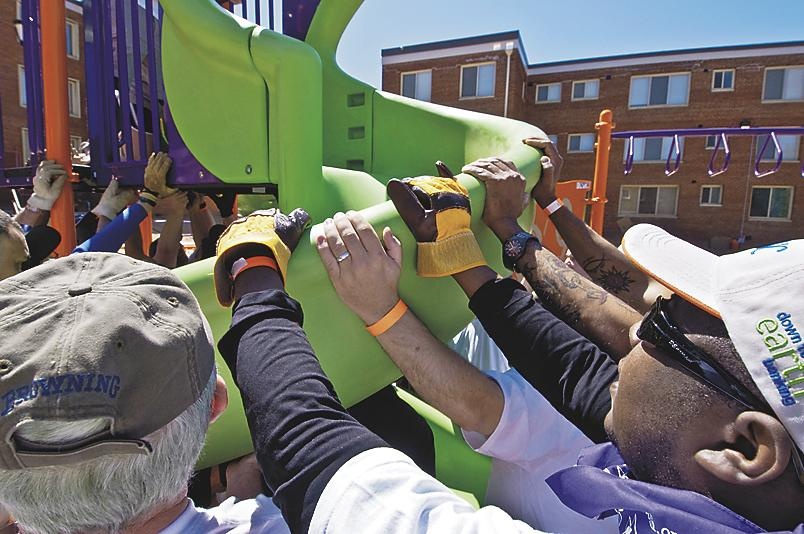
The nonprofit group KaBoom began in 1995 when Darrell Hammond read an article about two children in Washington who died of suffocation in an abandoned car on a hot day because there was nowhere for them to play.
Since then, the group has built more than 1,900 playgrounds. Mr. Hammond recounts the story of the nonprofit in his book KaBoom! How One Man Built a Movement to Save Play. Following are excerpts from an interview with him conducted by The Chronicle.
Why did you write this book?
I wanted to tell everybody that they can be a part of the continuing solution to solve our biggest challenges. And the second thing is, we’re facing a play deficit in our country and we treat play as a luxury, not a necessity. It’s through play that kids build muscles and social skills and use their creativity, both to have a happy childhood but also to have a productive adulthood.
You started KaBoom when you were 24. What advice would you give to young people?
Let’s not overromanticize start-ups. It was a very difficult period. We had a lot of success and I’m the first person to say that I didn’t start out to start something. It just ended up that the Home Depot came on board and gave me money.
The first thing I tell people is, Is there any way that you can go make something that’s already working work better? And if not, then you should consider a start-up.
The second thing I tell them, We romanticize going big, going fast, and what I tell people is, Be great first, which may mean that you’re going to grow slow and deliberately, but have more impact. Find a few people that have a significant amount of wisdom, and from that wisdom tap into it to help you through the transitions that you’re going to go through in your life and in your leadership.
What have been your biggest successes?
I’m most proud of the Ben & Jerry’s ice-cream flavor they named after KaBoom, KaBerry KaBoom.
I would say the other success is Operation Playground. When we went to the Gulf Coast 100 days after Hurricane Katrina and built in Bay St. Louis, a lot of people thought that we were simply trying to be relevant down there and to raise money off this horrific tragedy.
They didn’t understand, and probably we didn’t either at that point, how important play was to bringing back normalization to the kids. In communities after communities, they were telling us how much better their kids were doing by having this safe place as a playground.
We’re still building to this day. We haven’t forgotten and we’ll continue to build as long as there’s a need down there.
And what about failures?
Our international [projects in] in Rwanda and Belfast, I poured a lot of my own personal heart and soul into those and they didn’t work. But I also knew when to pull back, partly because of the advice and counsel of other people around us, and it was taking too much time, too much effort when we were also trying to do other things in the organization.
The other failure I would say is that as a young manager with no real good role models around me, I wanted people to adapt to my style instead of me adapting to their style.
I’ve made every management mistake in the book. I wished that I would have been enlightened by surrounding myself earlier with good mentors and role models.
How would you describe the progression of KaBoom?
We started out as community builders and the playground was a Trojan horse. We get communities to come together around a common cause—the well-being of kids—and focus on achievable wins, breaking up the project so that not everything has to be done at once, and that little things could give a single mom an opportunity to have a success that creates a desire to want do it again.
What’s happening now is that our demand is greater than what we can actually build. So five years ago when we looked at what does scale mean to us, it was not more chapters or franchising our model. It was open-sourcing our model by using technology to give away what it was that we knew so that if anybody wanted to replicate what we were doing, it is all online to do for themselves and not wait.
The biggest change for us is to be both an offline organization that has had great success in keeping that intensity, and at the same time building an online community. Most organizations are either/or. We’re trying to do both.