‘Get Off the Hamster Wheel’: A Message for Fundraisers
Fundraising and leadership expert Allison Fine offers tips for how to build trust in your organization — and how to stay sane.

By Chronicle Staff
Contributor
December 17, 2025 | Read Time: 2 minutes
Keep up with everything happening in The Commons by signing up for our weekly newsletter.
Allison Fine, a leadership and fundraising expert, has attended more than a few nonprofit board meetings. Trustees, she says, always zero in on this fundraising question: How much money are you bringing in?
“We stuff our boards with people from professional backgrounds — lawyers and finance people — and they come at this with generally little or often no context for the work,” she said in a recent Chronicle interview. “And the easiest thing for a board of people from diverse backgrounds who may not know nonprofits well to focus on is cash coming in the door right now.”

Such pressure to raise more and more money has contributed to what Fine calls “transactional fundraising” — a relentless chase for dollars in which development offices turn every donor interaction into a gift solicitation. That relentless pursuit of cash erodes trust in organizations. The long-term effect: a weakening of institutions that build community and unite people across differences.
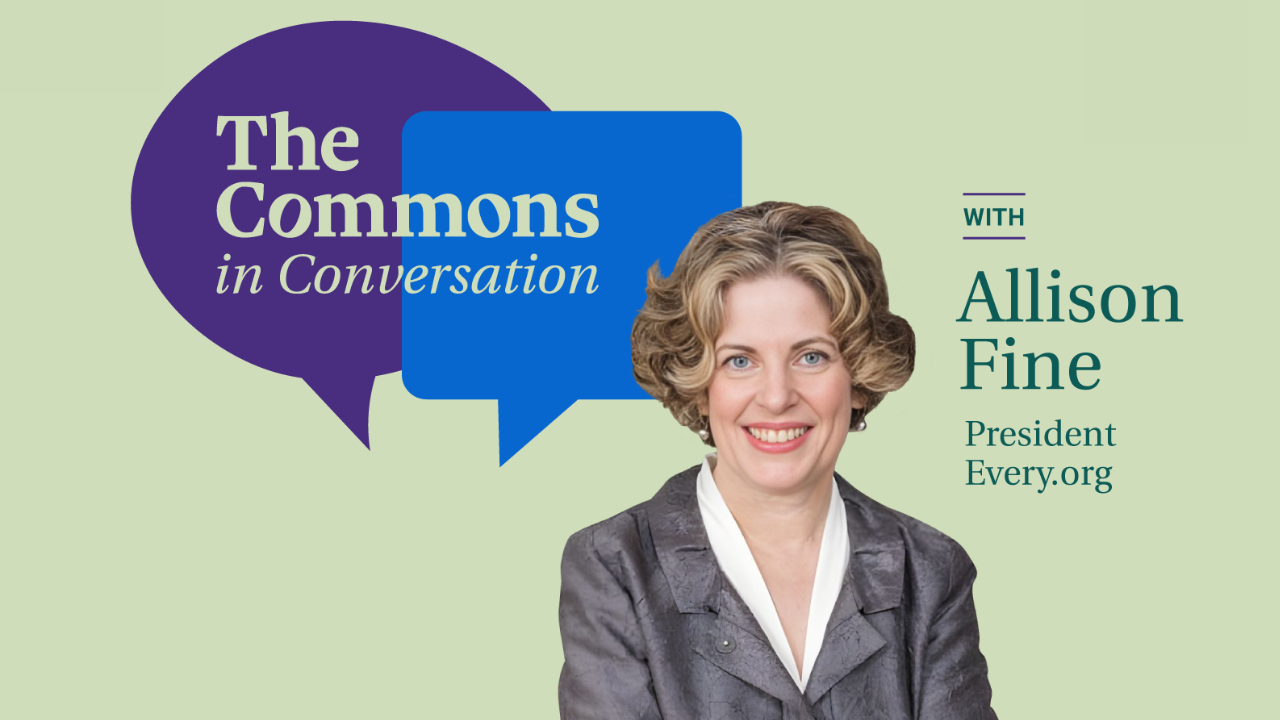
It’s time, Fine said, for fundraisers to “get off the hamster wheel” and return some humanness — and sanity — to fundraising. The first step, she told Chronicle senior editor Drew Lindsay in a Commons in Conversation interview, is to work with C-suite leadership and boards to take a more holistic view of fundraising.
“We need to begin to ask different questions at the board table,” she said. “For instance, we could be asking how the donors feel about our organization. Do they feel invited and included, or do they feel like an ATM machine? What are our donor-retention rates? Are they going up or are they going down? What are we doing that works well for donor retention?”
Watch the full interview with Fine on our YouTube channel. She offered a lot of small things organizations can do to earn the public’s trust — on their website, in their storytelling, and even in the use of artificial intelligence.
The Commons is financed in part with philanthropic support from the Arthur M. Blank Family Foundation, Einhorn Collaborative, and the Walton Family Foundation. None of our supporters have any control over or input into story selection, reporting, or editing, and they do not review articles before publication. See more about the Chronicle, the grants, how our foundation-supported journalism works, and our gift-acceptance policy.