How an Estate-Planning Tool Can Help Fundraisers Win Bequests (Podcast)
August 9, 2019 | Read Time: 22 minutes
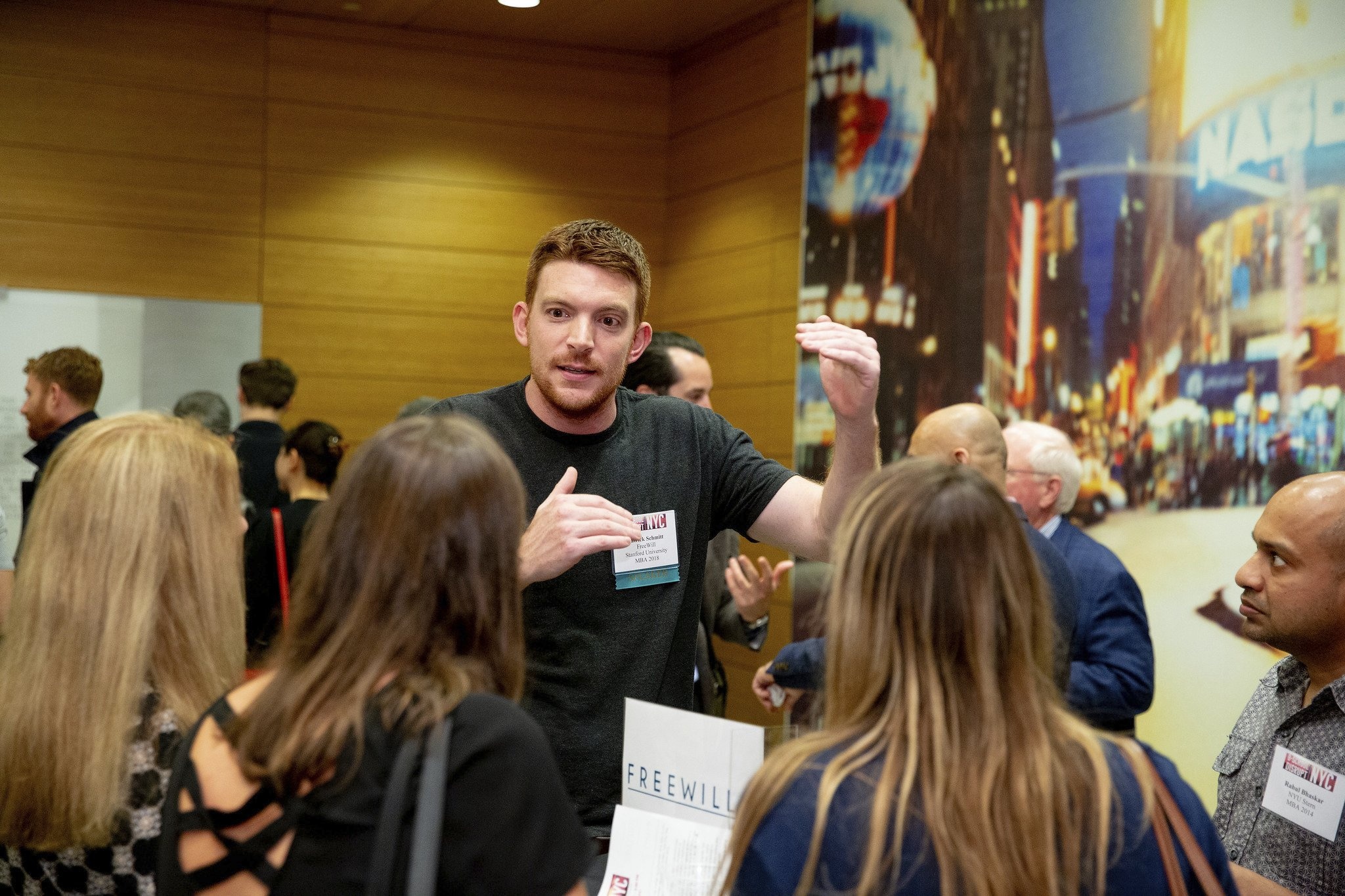
This week’s Business of Giving podcast features Patrick Schmitt, co-founder of FreeWill. The organization has raised more than $700 million for charities over the past few years. FreeWill’s charity partners pay a subscription fee for customized, inviting digital tools for estate planning. Charities then share these tools with their supporters for free.
“One thing that we highly recommend is that every person who’s in digital fundraising or marketing or annual fund needs to get trained up in planned giving and really understand it,” Schmitt says. “A typical planned gift is three times someone’s total lifetime charitable giving. And so, if you’re ignoring that, frankly, you’re not doing your job well enough.”
Listen to the podcast, which is hosted by Denver Frederick, or read the transcript below.
Denver: There is a massive transfer of wealth occurring, some $35 trillion over the next 20 years, as the baby boomer generation passes on. Is there a way that more of this wealth can be directed to charitable causes and nonprofit organizations? Well, a company by the name of FreeWill believes that there is, and has created an easy and simple process that helps make it possible. And it’s a pleasure to have with us tonight the Co-founder and Co-CEO of FreeWill, Patrick Schmitt.
Good evening, Patrick, and welcome to The Business of Giving!
Patrick: Good evening. Thank you for having me here.
Denver: Share with listeners the idea behind FreeWill and how you came up with that idea.
Patrick: FreeWill, at its core, has raised about $700 million for charity over the last few years; actually, most of that’s in the last 12 months, so that’s been really exciting. What we’ve realized is that planned giving – these gifts in a will or a trust – are just orders of magnitude larger than any other type of giving. And so, what we decided to do is really study… out at Stanford University… why people weren’t making more planned gifts. We realized that people really struggle with estate planning, and then when they even get around to estate planning, no one’s asking about charitable giving. So, we made some tools that are free, warm, intuitive, to help people do their estate planning. We actually nudge charitable giving in the process, and people give six times more when they use our tools compared to any other normal process.
Denver: That’s a pretty impressive opening Patrick, I must say.
Well, before you started this venture, you did a slew of research, both with nonprofit organizations and with baby boomers themselves. Let’s start with nonprofits. You studied and examined the planned giving offices at these organizations. What were some of your key takeaways?
Patrick: Well, I think there’s two real challenges for a planned giving office. The first is that the data is so poor in planned giving. If you think about everything that’s changed around direct mail and digital fundraising, which is more of my background, it’s become a hard science, and you can really understand what’s happening in real time. The challenge for organizations is that only 20% to 25% of people who make a gift in a will or trust tell the organization, so you may send out a postcard, and you only know if it works 35 years later. So, that’s a huge challenge.
The second is that it’s structural. Many planned giving offices or teams live under major giving, and so they use exactly the same tools – We’re going to go out; we’re going to have breakfast or lunch, we’re going to have a series of conversations, and then we’re going to make an ask. Now, it’s not a terrible model, but it’s wholly incomplete. What we’ve seen is that the same people that are making $20 annual checks can leave $100,000 bequests, or sometimes it’s people that have never made any gift at all, who are really just savers, are leaving massive bequests. Most organizations just tend to ignore them; part of that is based on organizational design.
Denver: What solutions would you recommend to these nonprofits to become more effective in their planned giving department?
Patrick: One thing that we highly recommend is that every person who’s in digital fundraising or marketing or annual fund needs to get trained up in planned giving and really understand it. A typical planned gift is three times someone’s total lifetime charitable giving. And so, if you’re ignoring that, frankly, you’re not doing your job well enough.
The second piece is really investing in: how do you make planned giving easier for folks? And then how do you do so in a way that’s trackable, so that you can really understand your audience and figure out what’s working and what isn’t?
Denver: Some of the changes in tax – the recent tax reform – has that impacted planned giving in any way?
Patrick: The biggest shift is actually to the step before planned giving, which is what are called qualified charitable distributions. These are gifts that are coming out of your IRA. You’re only eligible to do so if you’re over 70&frac; this year, so it’s roughly born before June 30, 1949. But for those folks…Denver, we were talking earlier about the big drop in the number of people that are itemizing deductions, and especially if you’re not working, but that shift has gone from about 24% to about 9% — people who itemize deductions. The magic of a qualified charitable distribution from your IRA is it actually just lowers your overall income instead of raising deductions, so it’s perfectly tax efficient. And frankly, if you’re over 70&frac; , this is the way you should be giving.
Denver: You also interviewed a lot of baby boomers. What did you hear from them?
Patrick: Baby boomers hate nothing more than estate planning, and they avoid it.
Denver: It’s scary, isn’t it?
Patrick: It’s terrifying. And people use the words like “scary” and “complicated” and “expensive.” They’ll say things like, “I’ll do it next year,” even though they said that last year. More than half of boomers don’t have an estate plan. It’s also true that more than half of parents don’t have an estate plan, both of which are huge problems. And even those that do, they’re usually typically out of date. Maybe the kids are no longer minors; they moved states; they’ve gotten remarried – all of these things. An estate plan should be updated at least every five years, if not more often, and nobody’s doing that.
Denver: Well, I also think they just don’t want to face their own mortality.
Patrick: Certainly.
Denver: It’s death. We don’t want to use that word, but it seems pretty immature not to.
Patrick: Right. It’s a core human aversion. People don’t want to think about their own mortality, and people have dealt with this differently for thousands of years. But it’s really something you really want to do for your family and for the causes you love.
Denver: Well, that’s a good background. And therefore, what you’ve done is you’ve created this tool, this platform called FreeWill. Tell us, Patrick, how does it work? What do you do when you go to the website? How complicated is it? How long does it take?
Patrick: Great questions. So, we sought out to make something that was warm, intuitive, and free to really take care of all the barriers we just talked about around estate planning. About 65,000 people have done their estate plans through FreeWill so far. These are people who are allocating their entire life savings for the most part.
The way that FreeWill works is it’s a website. You can think about it as TurboTax for estate planning. You can use it to make a will online the same way you would Legal Zoom or Rocket Lawyer. It’s becoming incredibly prevalent. By some estimates, the majority of estate planning is happening online these days.
You can also use it to get all your affairs in order, and then what we call “document your wishes” before taking it to a nearby attorney. And if you have a more complicated estate, that makes a lot of sense. If you have property overseas, if you have kids with different spouses, even if you just have a very large estate, that’s a great avenue for you as well.
Denver: What does it cost?
Patrick: It’s totally free for individuals. We actually ran some experiments early on at Stanford to say: What’s the difference between charging $100, which seems like a fair value for a full estate plan, and charging zero? Twenty times more people will do it when it’s free.
Denver: You mentioned earlier that people who are doing it in this fashion are giving six times more to charity than they would otherwise. Why is that the case? Are there pathways? Are there prompts? What do you do to get that kind of result?
Patrick: One of the most interesting findings in our Stanford research that was surprising to us is how rare it was for anyone to even be prompted to think about charitable giving during the estate planning process.
Denver: That’s incredible.
Patrick: It’s true of Rocket Lawyer and LegalZoom. It’s also true of most attorneys. There’s so many things happening at this moment: Who gets the stamp collection? Who might be the guardians for children? What song is playing at the funeral? All these things are top of mind, and so charitable giving goes out the window.
When you can ask about it and use what’s called “social proof,” which is “Denver, many of your friends or many Americans do this; would you like to consider it?” That giving goes up by a factor of three or four, and actually, the average gift doubles, and so you see a dramatic impact. Americans are charitable people; 90% of folks give somewhere every year, and so few people give in their wills or estates that it’s largely a factor of process and not motivation.
Denver: What’s the average bequest on FreeWill?
Patrick: The average bequest is $82,000.
Denver: Wow! That’s impressive.
Patrick: These are the same people writing $20 checks to NPR or Sierra Club. It’s not the overwhelmingly wealthy.
Denver: Talk a little bit about the nonprofits you partner with, the process of getting them on board, and the mutual obligations that you have to one another.
Patrick: We work with more than 190 nonprofits, ranging from the United Way and the Red Cross, all the way down to this lovely local dog shelter in California. What we do with them is we create custom versions of the tools that they can then share with their own supporters. So, their supporters get access to free tools that really help them with a core need, and then in those tools when you get to the philanthropic prompt that I was speaking about earlier, it says, “Great. Do you want to give to the Red Cross or do you want to also type in your own organization? You’re free to leave to nobody at all; you’re free to leave to multiple…”et cetera. But it makes giving to the Red Cross extremely intuitive, and it makes these tools available to their donors. And so, it’s a huge win, and we’ve seen, as I mentioned, more than $700 million committed through FreeWill.
Denver: That’s incredible. So, if you’re not a partner of FreeWill, then those charities will be eligible if the person who is filling it all out wants it to go to a particular charity, whether you have a relationship with them or not.
Patrick: Exactly. There are no restrictions on whom you can give to. Anyone who’s listening and needs one can go to frewill.com. They’re free to select one of the charities there. They’re free to type in their own church or synagogue or alma mater, whatever it may be. We’re thrilled to support the broad sector, even those we don’t partner with.
Denver: Well, Patrick, you have nothing but audacious goals. You’re looking to raise a trillion dollars here in the next decade or so. $700 million is an awful lot of money, but you have a long, long way to go. What are some of your plans for getting there?
Patrick: We think we’ve just hit the tip of the iceberg. Sixty-five thousand is a very large number of people. It’s also a very, very small percentage of the population, and $700 million is pretty outstanding already. For context, the entire Democratic field of the 20-plus candidates, plus the other 300, have raised $250 million combined, with the massive spotlight. And so, we think there’s a huge opportunity across the US with a great philanthropic culture.
And then, two, three years from now, we’d expect to be expanding to Western Europe, which has very similar demographics… Canada, Australia. We have people that we’ve talked to who are really interested in bringing it to Japan, which has quite a bit of an aging culture; China just has a massive population, less of a culture of philanthropy, but that’s something that can be brought along. So, big effort. But we have an amazing team, and we think it’s quite possible.
Denver: If FreeWill is of no cost to consumers, and you’re a for-profit company, what is your business model, and how do you generate revenue?
Patrick: What we’ve done is we’ve been able to partner with nonprofit organizations who pay us a flat annual subscription fee, based on size of the organization for custom versions of the tools. And then what they’re seeing is, in many cases, a 100-1, or in some cases, 10,000-1 ROI, and so that’s been thrilling for them.
Most nonprofits are already investing in planned giving in some way, and sometimes that’s in direct mail, where you don’t actually understand whether it’s working; sometimes it’s in other long-term events. We’ve seen this as just incredibly efficacious, both for organizations that want to spin up a planned giving program, and for folks that want to accelerate a planned giving program… on top of a few officers that they already have.
Denver: So, this is more or less a flat fee, based on the size of the organization, as opposed to the amount of money that they take in.
Patrick: That’s correct. What we realized is that we want to help people be wildly successful and we don’t want them to think, “Oh, I shouldn’t. What if I’m too successful? I haven’t budgeted for that.” So, now, we can go all in.
Denver: And that also sometimes is against the culture of nonprofit organizations. They have a hard time getting their arms around a percentage, and then they’ve just got ethics and concerns and things of that sort, which I think are a little outdated myself, but they still exist.
I mentioned in the opening that you are the co-founder and the co-CEO of FreeWill, with one of your co-founders, Jen. What are the advantages of an arrangement like that? What are some of the difficulties you need to work around?
Patrick: I think that co-CEOs can either be the best or worst idea you’ve had. I have been incredibly lucky with my co-founder, Jenny. Jenny is brilliant. Just to give you some very quick context on each of us: Jenny went to Harvard, top of her class in Applied Mathematics; worked in finance; helped start the impact investment fund at Bain Capital; has some other startup experience. My background is totally different: grew up on the East Coast, Jenny’s West Coast; worked in nonprofits; ran email fundraising for President Obama, worked at Change.org. We met out at Stanford and clicked very quickly. We realized that we were totally different, but with very similar values, and that’s what’s made it work.
The upside is that there are some things that only a CEO can do, and I don’t think we can do twice as much; I think we can do three times as much because we only do the things we’re really good at. And so, we have very few overlapping weaknesses, which is great. We actually don’t have that many overlapping strengths as well, So that’s been excellent.
The things you have to do to make that work is have an incredibly clear decision-making process. There is very little that we have to agree on. You don’t want to operate on consensus; instead, you want to make sure that on these three types of decisions, Jenny’s in charge, and I’m going to give as much input as possible, and then vice versa as it happens… And so, a high degree of trust, very clear decision-making processes, and a complementary skill set. If I was a co-CEO of someone like me, it wouldn’t work.
Denver: And also having that clear decision-making process, that will also give you speed and things won’t drag on and drag on and back and forth, and things of that sort.
Everybody talks about starting a business while they’re at school, in your particular case is when you were in business school at Stanford. It’s always a very romantic notion, but sometimes it isn’t all that romantic. What advice would you have for a young person, perhaps in a college or in graduate school, thinking about starting a business? What have you learned from that, and what would you like to pass on?
Patrick: That is a great question. I think a few things. One is, it’s hard. You are constantly at a place – at a grad school, at a place like Stanford, the opportunity cost of your time is so high because there’s so many things you could be spending time on, and choosing to work on the social venture you have or the startup you have instead of going to see that speaker, going to spend time with amazing classmates, is a really hard choice.
The second is that it can also be an incredible accelerant of your experience. What I realized is that some of my classmates were bored out of their minds in accounting class, and I was desperate to learn it because we were going to have to figure this out next week. And when things are immediately applicable, at least for me, it made the learning so much faster. It really hones the things I needed to learn, and I could go out and talk to the best professors, the smartest classmates, the right classes, and really sharpen my thinking on a lot of that.
And the last thing I’ll say is sort of “Why not?” In other worlds where you’d have to quit your job, the risks are much higher. We weren’t otherwise going to be working during grad school, and so it was a great chance to take a really big bet on something that we thought could change the world, or it could fall flat on its face. We’re glad how that worked out, but even if it had failed, it would have been a great experience.
Denver: It always makes sense when you do things on the side like that, as opposed to cashing in all your chips and taking that big jump. This has got a nice little safety net below it, which you have not had to avail yourself of.
Talk a little bit about your corporate culture, the kind of company you’ve tried to build, and what makes FreeWill such a great place to work.
Patrick: We’ve got some really core company values that we focus on and talk about all the time. Let me highlight two of them. The first is kindness, which everyone would say is important, but few people focus on. It’s something we even screen for in hiring people.
Denver: How do you do that?
Patrick: Anyone who’s getting hired for any particular role – let’s talk about an engineer, for example. We developed a scorecard on a bunch of key attributes. Some of them will be existing technical knowledge, some of it will be overall acumen – things like tenacity and kindness are there, and they’re scored just as highly as technical acumen. Doesn’t mean you can’t know how to code and come, but if you are not an exceptionally kind person, we probably shouldn’t hire you. We ask questions about that, talk about how they view their past experience, whether they blame other people or take responsibility when things didn’t go well, how they talk about people that aren’t in the room…all those things really emphasize it. And then I think Jenny and I try to treat each other with extreme kindness, and that flows down. We also try to treat our partners and our users and even competitors… We don’t have that many competitors, but when we do, we try to treat them exceptionally kind as well.
And then the second is focus. As we have a very smart team that’s growing quickly, we try to only work on one, two, or three things at a time and do them exceptionally well, which means that we actively choose to be bad at things, and that’s okay. Some people don’t feel comfortable being bad at some components of a business or an organization, and you have to be if you’re willing to make focus a priority.
Denver: That’s really interesting. I think on both counts, I think that it’s probably easier to teach someone to code than it is to teach someone to be kind. And one of the things I really like what you just said about focus, too; it’s a good way to avoid burnout. It’s organizations who try to focus on too many things at once that just absolutely wear out the team. But if you’re really disciplined and strict about it, people will be fresh and energized, as opposed to just feeling completely underwater all the time.
Let me close with this, Patrick. What challenges or problems have you encountered that you never envisioned when you first started FreeWill? And, conversely, what has been the most pleasant surprise for you?
Patrick: I think one of the biggest challenges that we didn’t expect is that the hardest thing about running a company, especially one that’s going somewhat well, is choosing what to say no to. We recently went through an exercise where our partners have been generally thrilled with FreeWill. And especially as we started rolling out some new tools around qualified charitable distributions, they said, “Oh, great. What’s next? We have this problem, this problem, this problem. We’d like you to solve them all for us.”
And we’d love to solve all their problems, and we had to go through a really deep research process around whether or not to address donor-advised funds or stock gifts next, and then go tell people actually that we’re doing nothing on donor-advised funds for at least nine months, a year, maybe even two years and really focus on helping stock giving as well. And so, then having to go call people and say, “Thank you for asking for this thing and be willing to pay for it. We are not going to give it to you, and we’re not going to take your money for it.” It was a really interesting challenge.
I think the thing that’s gone – maybe I could have reasoned this from the onset, but has gone stunningly well is how incredibly joyful it is to work in the nonprofit community, and specifically the planned giving subset of the nonprofit community. I guess it makes obvious sense that if you’re doing planned giving for a conservation organization, you’re probably not a jerk. But in aggregate, we work with so many amazing, lovely people.
Just two weeks ago on the New York subway, someone just yelled at me. And I was like, “I haven’t been yelled at in seven months.” This is incredible because both our team and most of our partners are just such amazing people across the board. The folks running animal shelters in the northwest, to different other people running Christian foundations in Texas, to running the colleges in Boston, they’re all just extraordinary folks. And it’s been so nice to become their friends, and it’s been such a joy to be part of that landscape.
Denver: Planned giving folks are a very interesting group of people, and somebody equated them once as that they’re like the field goal kickers of a football team: They’re not out there with the rest of the team; they’re awful on the field by themselves because nobody else in the organization understands anything that they do. But I think you’ve certainly made the point they make a huge difference, perhaps the biggest difference, in terms of the health of an organization.
Well, Patrick Schmitt, the Co-CEO of FreeWill, I want to thank you so much for being here this evening. For those who want to use the site and learn more, tell us that website again. And for nonprofits who might want to take a look at becoming part of this venture, what do they need to do?
Patrick: So, people who want to make an estate plan for free and think about charitable giving, but also if they don’t want to, totally fine, it’s freewill.com. Very easy. Nonprofits can go to the same site, or you can also just email me. I’m patrick@freewill.com. Got to claim that email address early in the company’s history, and so feel free to shoot me a note, and we’ll get you set up with the right folks.
Denver: One of the benefits of being a co-founder, no doubt about it. Well, thank you, Patrick. It was a real pleasure to have you on the show.
Patrick: Thank you. It was great to be here.
Denver: I’ll be back with more of The Business of Giving right after this.