New Group Aims to Boost Interest in and Efficacy of Impact Investing

By Alex Daniels
Contributor
December 5, 2019 | Read Time: 4 minutes
A group of nine private and corporate foundations and family offices have pooled $12 million in a fund to draw more interest in impact investing and to ensure that investments made with the public good in mind truly make a difference.
The collaboration is called the Tipping Point Fund. The contributors are the Ford, MacArthur, Packard, Rockefeller, Surdna, and Visa foundations; the Omidyar Network; the Rockefeller Brothers Fund, and Blue Haven Initiative, a family office co-founded by Liesel Pritzker Simmons and her husband Ian Simmons, which manages impact-investing portfolios.
The fund will support policy changes designed to encourage new investors interested in helping the environment or to provide social benefits through their investments. It will also support efforts to collect and standardize how impact investments are measured.
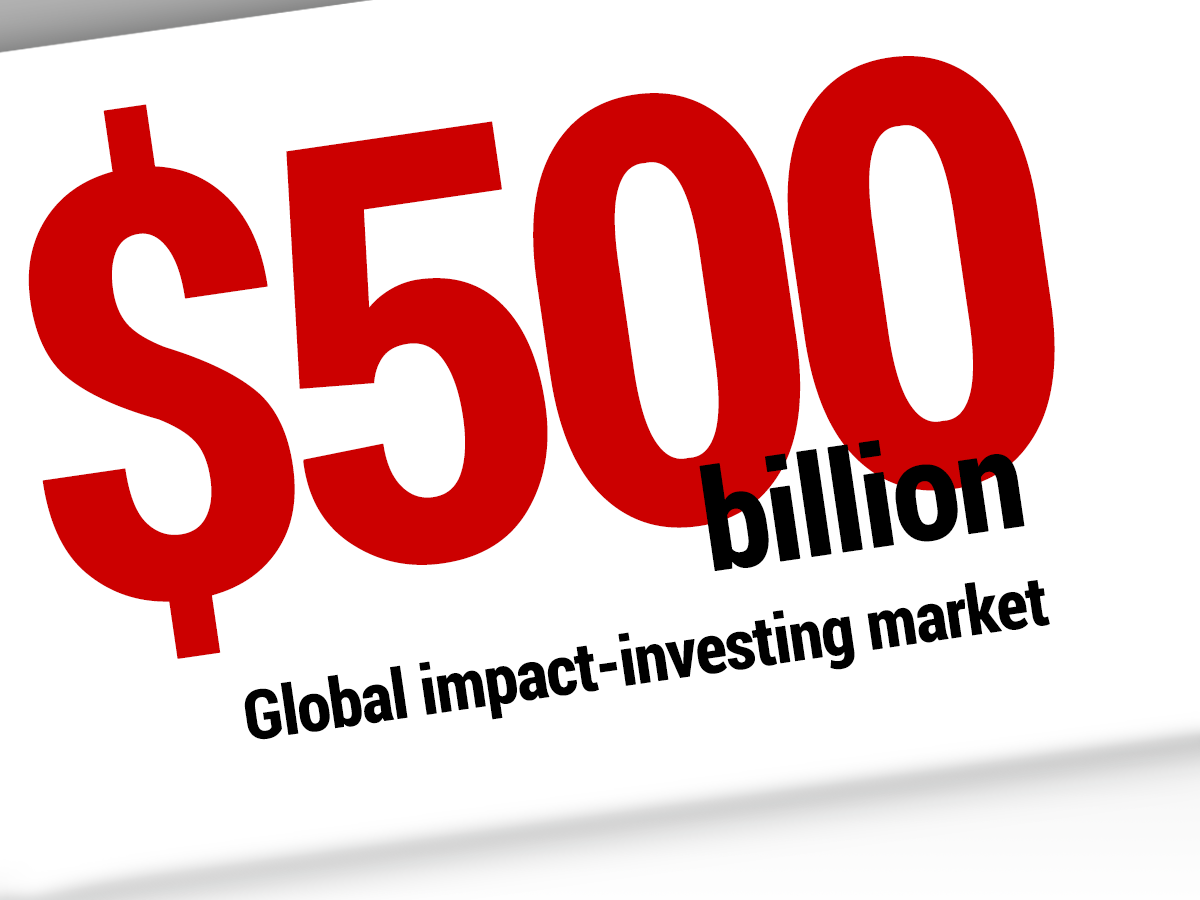
The global impact-investing market topped $500 billion in 2018, according to the Global Impact Investing Network. Foundations have made impact investments for decades. In the past several years commercial investment houses, such as Bain, Goldman Sachs, and TPG, have become interested.
Fran Seegull executive director of the U.S. Impact Investing Alliance, which helped design the fund and will assist its management, says the new effort is designed in part to address concerns over “impact washing” — when investment firms tout an investment as having a positive impact without evidence to back it up.
As impact investing has become more popular, efforts to hold investors and marketers accountable have proliferated, causing uncertainty in the market, Seegull says. She’d like the fund to create a central clearinghouse for impact metrics so investors can have more confidence.
“While we welcome new capital sources and new actors to impact investing, it’s essential that we find ways to scale the field with integrity,” she said. “There are some bad, bad actors out there that would take advantage of this confusion to engage in impact washing.”
Broader Strategy
The goal of making impact investing mainstream fits with broader strategies at Ford and Omidyar to rethink capitalism and reduce economic inequality, said Mike Kubzansky, chief executive of the Omidyar Network, and Darren Walker, the president of the Ford Foundation, who joined Seegull on a conference call this week to tout the fund.
Kubzansky referred to a statement released in August by nearly 200 corporate leaders that redefines a corporation’s purpose to include benefiting workers, the environment, and local communities — in addition to shareholders — as a turning point for impact investing.
“The social purpose of business is finally up for discussion, opening the door for impact investors to play a leadership role in the next phase of our economy,” he said. “We’re under no illusions that this alone is a panacea, but we view it as an important part of an agenda to address how capitalism works,” he says.
What’s needed, Kubzansky said, is for corporate investment houses to follow philanthropy’s lead in supporting the “infrastructure, norms, conventions, and guardrails” that underpin the integrity of the market and give investors confidence.
An Improved System
Ford’s Walker noted that younger people have an increasingly sour view of capitalism. The foundation he leads, he said, should play a major role in establishing faith in the market as a force for good, and not just the bottom line.
“The Ford Foundation is a creature of capitalism, and part of our work ought to be to improve that system,” he said. “Part of the challenge is that our markets today have been constructed in ways that lead investors to value short-term profit while discounting long-term returns and impact.”
Helping make impact investing more of the norm could not only attract more commercial investors but also appeal to foundation leaders who have remained on the fence. According to a Foundation Source survey of 122 grant makers conducted this year, just more than half have made some impact investments. Nearly two-thirds said they were uncertain about the quality of the investment products being offered by financial advisers.
The fund will begin to make grants in 2020 and has not identified specific policy items it will push. Walker and Seegull cited U.S. Treasury guidance issued in 2016 that paved the way for foundations to make more impact investments from their endowments as a positive example of a policy change that has helped the market.
Seegull said the fund will look for ways to help implement existing policies for maximum social impact, including opportunity zones, which steer investments to areas with high poverty rates, and the newly created U.S. International Development Finance Corporation, which will promote investments in other countries.
Later this month, the fund plans to issue its first request for proposals, which will invite ideas for putting impact-investing policy on the radar of 2020 presidential campaigns.
“We see this as a prime opportunity to craft a new agenda for the impact-investing movement,” Seegull said.
Alex Daniels covers foundations, donor-advised funds, fundraising research, and tax issues for the Chronicle. He recently wrote about grant making that gives grantees more power in decision-making and about the distribution of $1 billion to four research institutions. Email Alex or follow him on Twitter.