Podcast: Nonprofit StrongMinds Helps Uganda Tackle Mental Health
October 12, 2018 | Read Time: 22 minutes
This edition of the Business of Giving features Sean Mayberry, founder of StrongMinds. The charity works to provide mental-health services to Uganda, a country with 40 million people and, as of 2015, just 30 psychiatrists. One in four women suffers from depression, making it difficult for them to work, raise their children, and participate in their communities. Since 2014, StrongMinds has treated 40,000 Ugandans and hopes to expand.
Listen to the podcast, which is hosted by Denver Frederick, or read the transcript below.
Denver: Social entrepreneurs work to solve many problems such as poverty, education, and the environment. And there are many entrepreneurs from around the world working on the same problems. But then there are those challenges that although they affect tens of millions of people are essentially overlooked and completely ignored. One of those will be the mental health of women in Africa, particularly those suffering from depression. My next guest identified that need and established an organization to address it with some amazing results. He is Sean Mayberry, the founder and executive director of StrongMinds. Good evening, Sean, and welcome to the Business of Giving.
Sean: Hi Denver. So glad to be here.
Denver: You founded StrongMinds back in 2013. How did you become aware of this issue in a way that compelled you to say to yourself, “I have to do something about this”?
Sean: Happy to tell you the story. I lived and worked in Africa for over a decade. Most of that time, I was doing development work. I was really focused on physical health issues like HIV AIDs, malaria, even clean water. But during that time, I saw throughout my work African friends, colleagues, peers, patients who were suffering from mental illness, and I would be there trying to get an African mom to sleep under a mosquito net, or to make sure that she uses a condom for safe sex. It was incredibly frustrating for me that when I saw this African mom, and clearly in some cases they would have a mental illness, there was nothing I could do to help those individuals. I’d have to walk away. I could not refer them to a clinic. Most clinics in Africa don’t provide mental health treatment. So, it was really frustrating for me. So, I really saw that need.
Then for me to really create StrongMinds, we used group interpersonal psychotherapy as a foundation. It was really in a way sheer luck… like so much in life is. I read an article in the New York Times that was talking about what’s called the randomized control trial, a carefully controlled experiment, if you will, on psychotherapy in Uganda. That was completed back in 2002. And it had amazing results. It really showed that you could treat depression effectively using group talk therapy. Unfortunately, that RCT, as they’re called, sat on a shelf for over 10 years until I read the article. Then I pursued the researchers, and that really led to the beginning of StrongMinds.
Denver: And although you have not personally suffered from mental illness, you’re not a stranger to this issue, are you?
Sean: No. Unfortunately, I’m not. I’m quite fortunate in the sense that, yes, I’ve never suffered from depression personally. But I’ve really had a front row seat, as I call it, to depression. I grew up in a family with parents who suffered from depression. I understand what depression does to children, adolescents…what it does to families…what it does to the individual. Unfortunately, even today, I have close family members who still suffer from depression. So, I really understand the pain and how debilitating that mental illness is.
Denver: Talk to us a little bit more about the impact depression has on women in Africa. And this is well beyond just being sad.
Sean: Absolutely. That’s a common misunderstanding that depression is really sadness. Sadness, as I like to think, is really equated to the common cold. Depression is a serious mental illness that’s more like cancer that has significantly debilitating symptoms: inability to sleep, inability to focus or even eat. There’s really nine major symptoms we’re looking at. But depression debilitates the sufferer.
In Africa, an African mom who is depressed, she can’t go to work. She can barely get out of bed. She can’t take care of her kids, and the entire family suffers. So, the negative impact of depression is almost endless.
Denver: I guess all of the other efforts of international development to try to help that woman or to help those families are pointless.
Sean: Absolutely. What we see in Uganda is roughly one in four women suffer from depression. From what we’ve heard of our colleagues in other African countries, that number is fairly consistent. So, it’s really I would say at an epidemic level. But when you help a mother to become depression-free, her entire family, her entire life turns around. We work under a mantra at StrongMinds that when you save an African mom from depression, you save the whole family; and we’ve collected that evidence that when women become what we call depression-free,they are no longer able to be diagnosed with depression because we’ve reduced their symptoms so much. We see and have seen the data ourselves: that they go back to work; their incomes increase; their kids go back to school; their kids start eating better because the mom just becomes a full-time, really engaged mother. So, the impact is really rewarding.
Denver: Looking at Uganda, about 45 million people, I’d just be curious: How many psychiatrists would you say are in the country?
Sean: Unfortunately, like many African countries, there’s just a handful. There’s anywhere between 20 and 30 psychiatrists in that entire country. And if you think of say, New York City, there’s 20 or 30 psychiatrists just in a few city blocks.
Denver: I’m going to ask you to walk us through this interpersonal group therapy technique that you use. But let me first ask, when you began this program, was it embraced or did you encounter some suspicion and wariness at exactly what you were up to?
Sean: Great question. We work closely with the Ministry of Health in Uganda within their Department of Mental Health. They’ve always supported us from Day One when we started working in Uganda in 2014. But out on the ground, we work and target the most impoverished, the poorest women possible suffering from depression. So, we’re working in the slums of Kampala and other areas. There’s a lot of just lack of knowledge of what depression is. The typical African mother that we treat, she doesn’t know that she has depression. They will constantly tell me as I’m talking to our patients in groups and who’ve completed our groups, that they thought that they were the only ones suffering from this illness. So, there’s not that common awareness. For us, it was really about just creating awareness of what depression is, what it is not. Also doing that among family members, spouses so that it would be easier to really engage them and get them to come to our groups.
Denver: Is there a stigma around it?
Sean: There is a stigma. It’s a quieter stigma. When you think of an African mom who is depressed in a slum, she’s not able to help her neighbors with many of the tasks that communities in slums like to share in terms of looking after one another’s children or cooking community meals. So, the neighbors of a depressed woman will think that the woman by her not helping them is simply – maybe she thinks she’s too good. They don’t understand that it’s depression that’s holding the individual back. So the stigma really becomes – the depressed woman’s friends isolating her or even criticizing her, which in many cases can exacerbate the symptoms of depression because now you have many what we call interpersonal arguments; and for us, that’s a trigger in psychotherapy.
Denver: Walk us through this model. It takes about three months. There are three different phases to it. Tell us how it works.
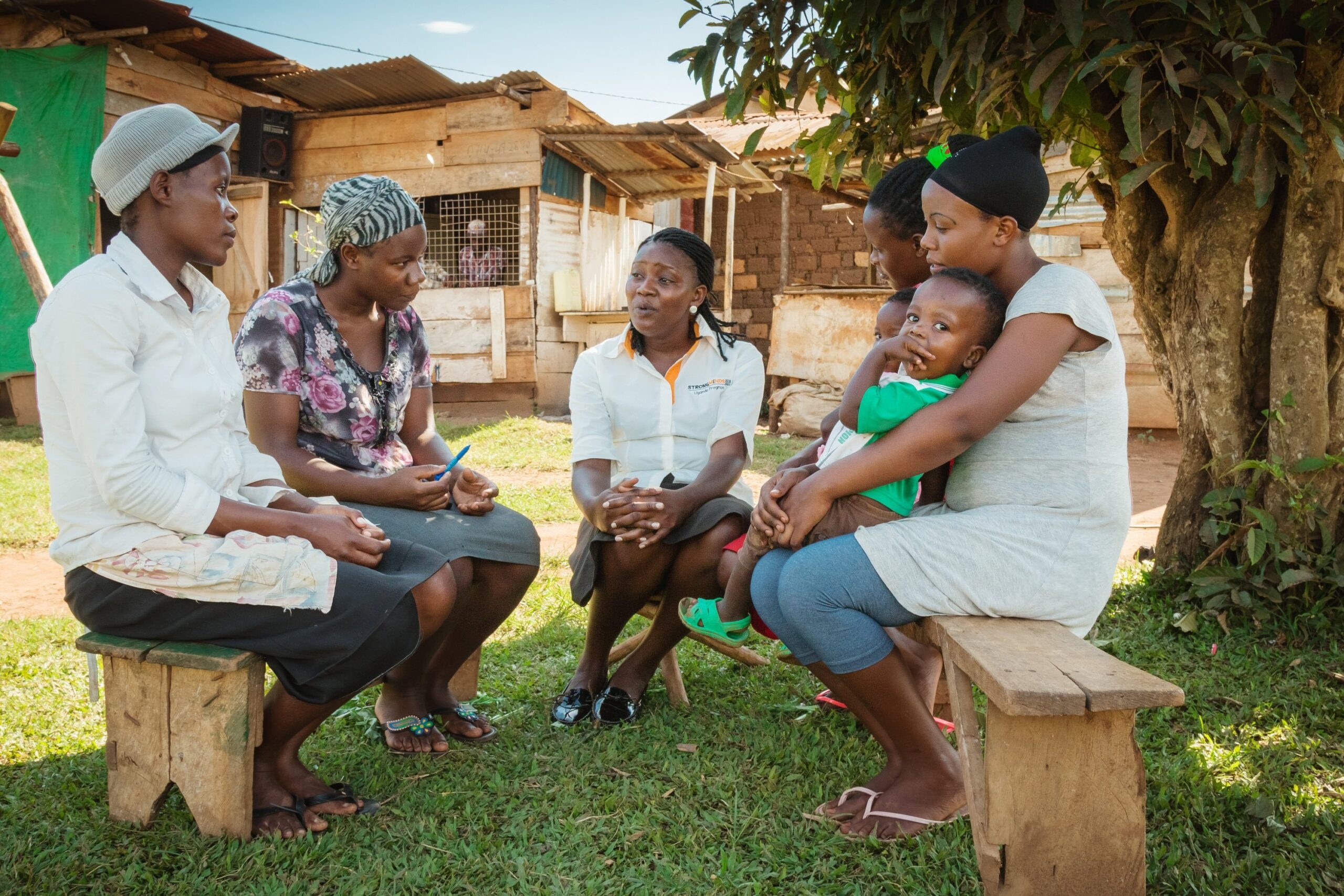
Sean: Thank you, it lasts for 12 weeks. Women come together once a week in groups– anywhere between 12 and 15 people. They meet for 90 minutes a week during those 12 weeks. It’s led in many cases by a StrongMinds mental health facilitator. You can think of it as a group leader, and it’s really about bringing women together and helping them to identify triggers of depression, and then really coming up with plans– both long and short-term plans and goals, so that they can overcome depression.
The whole theory of interpersonal psychotherapy is that depression comes from how you interact with other people. So some of the triggers within that psychotherapy, for example, could be interpersonal disagreements. You’re having arguments with your spouse. It could be social isolation. It could be grief over the death of a loved one. So, we identify those triggers and help those individuals to share life experiences in their group and learn from others in the group on how they can change their interpersonal relations.
Denver: Do women pay for this?
Sean: No. absolutely not. All women who attend our groups do so freely. Again, they’re extremely impoverished and poor. The average woman we’re treating lives on just about $2 a day, and she’ll have anywhere between three and five children. So, you can imagine; we would really just be unable to charge for this service.
Denver: How do you train these leaders?
Sean: Great question. We use again group interpersonal psychotherapy which was actually originated here in New York. One of the originators was Dr. Myrna Weissman. One of the reasons we use interpersonal psychotherapy is because it’s fairly straightforward and if you will, easy to train individuals. We do seven days of classroom training in the theory and the approaches. And then it’s really putting our facilitators, our group leaders, out on the ground treating women, but under a very closely watched year of on-the-job training, if you will. So, we’re watching what they’re doing. We’re helping them with difficult patients. It’s a lot of hand-holding through that year. Then, if they successfully complete that first year, we really certify them in our version of interpersonal psychotherapy, and then they can go forward.
Denver: Interesting. After the 12 weeks, do women often continue to meet as a group?
Sean: They do. And we’re really excited about that. After 12 weeks, we’ve collected the data as far as almost 12 months out. And right now, about 81% of our groups continue to meet. At week 12, we walk away. StrongMinds walks away because there’s so many depressed women, we have to get to the next group. But really, a huge majority of the groups keep meeting, which for us is super important because we help women in the groups to learn the skills to overcome depression. But one of the important things that’s happening is they’re creating friendships and bonds that were really lacking as a depressed individual. So, by continuing to meet with the group, it’s an added opportunity for them to manage depression. If they can’t manage a new episode by themselves, they have their group members that they can rely upon.
Denver: I know you’re keenly focused on impact. So what has the impact been after 12 weeks, and beyond that, in terms of how many of these women are depression-free?
Sean: We’re really excited about that. Right now, we’ve treated almost 40,000 patients since we started in 2014, and on average across all those patients, 75%– three out of four of the women we treat are what we call depression-free.
Denver: The thing that I find remarkable about this, and maybe that’s because I live here in the United States, is that all this is done without medication. Speak to that.
Sean: True. No medication. Some of the women we treat do require medication. It’s really just between 1% and 2%. Some of the women don’t respond or don’t respond fully to our psychotherapy, and we’re constantly measuring where they are in what we call our diagnostic tools, so we understand how their depressive symptoms are trending. And for some of those women, yes, we have to make what we call referrals. We’ll bring them to a clinic or a hospital to make sure they can get medication. So, that’s a huge minority. We’re really able to show that psychotherapy is an effective intervention, and effective treatment for treating depression.
Yet here in the US, you’ll talk to psychotherapists, and you can read the information, the research, the literature that shows you that in many cases, psychotherapy for treating depression is just as effective as medication. There’s a number of things here. We know our psychotherapy works effectively. But we also know, even if we wanted to use medication for our patients, it’d be incredibly difficult. Most of our patients, if not all of them, can’t really afford medications over the long term. Those who do take medications, we’ll actually pay for those medications for them. Also,it’s about access. You can’t really find medications over the long term for say, 6 or 12 months. It’s just not available.
Denver: What’s your cost per participant?
Sean: That’s a really important figure for us. Right now, today, we average about $100 per patient. So, that $100 is what it costs us from the moment we find them until the moment we’re done treating them, it’s $100. That’s really reduced over the years. Back in the early days, that cost was up $300, $400. So, we continue to drive to bring that down.
Denver: Your program, Sean, focuses exclusively on women who suffer depression, about twice the rate of men. Have you ever made this available to men?
Sean: We have. We treat roughly… just about 1% of our patients are men. And we do that for a number of reasons. Many times – some of the times, rather—women will come back to us when they’ve completed a group. They’re thanking us. They’re really excited about the future, but they’ll tell us, “You know, I think my husband may be depressed. Can you help him?”
Then there’s other cases where, when we work in a community, we’re successful in doing that because we partner with what we call community leaders. Here in the US, you would think of those as just a mayor of a few blocks of a town or a city. Just the way it is in Uganda… most of those, if not all of those community leaders are men. So, as we’ve worked with them over the years, many times these leaders will come back to us and say,” I know of some depressed men in my community and my block within a slum. Can you treat them?” So, for those several reasons, we decided to start treating men about two years ago.
Denver: All startups are exceptionally challenging, and this certainly was no exception. Trying to raise money for mental health in the international development field is really about as tough as it gets. Tell us about those early days and what you learned that allowed you to come out the other end with an amazing organization.
Sean: Thanks for that question. Raising funds for mental health in Africa is certainly the hardest thing I’ve ever done and continues to be. I’m looking forward to that changing someday down the future. When we started, we started StrongMinds in 2013, getting the idea together, the model. Trying to find stakeholders to support it. And we began work in early 2014.
In those first two years, finding funding was incredibly difficult. We spent almost the first year without external funding. So, I was incredibly and am incredibly passionate about the subject. My family, wife and several children, we used our family savings to get StrongMinds going. I worked in an attic in New Jersey and struggled along. Eventually, we found some funding, some seed funding that we would only use in Uganda to pay salaries of the team there. So, I continued to really just use my savings. But we’ve been fortunate now. Those were years one and two, and we’re about to finish year five now where we have a wonderful collection of stakeholders, donors, supporters who believe in us and are helping us to move ahead.
Denver: Who are some of those?
Sean: It’s a great mixture. We’ve been really fortunate to work with what’s called the Big Bang Philanthropy Group. It’s a collective of funders and donors. Those include the Mulago Foundation, Draper Richards Kaplan, Children’s Relief International and many, many more. It’s difficult to name them all. But many of those funders believed in us early on and now continue to fund us. Going back to another point you had asked me, early on, we thought it was all about treating depression and helping women to become depression-free, and that’s all we had to do.
But we really learned as we were talking with funders and stakeholders, that there’s a lot more interest in helping women to overcome poverty or women’s empowerment. So, we’ve been able to frame our approach or our impact along those lines. Our donors and supporters care about depression. But they care more about a woman going back to work and children being taken care of. So, we really learned to talk about the broader impact of our work and not just mental health. Because many of our funders, and I respect this, view our mental health work as a means to an end. That was a huge learning.
Denver Yes. Don’t sell the elimination of the problem, but sell what it means and the solution.
Sean: Simple, right?
Denver: That’s what people want to buy.
I totally agree, and that’s where we are today.
Denver: You also had a great partner with the researchers over at Columbia University. What did they do for you?
Sean: They were wonderful. Lena Verdeli at Columbia, Merna Weissman, as well. They were the early researchers, creators of interpersonal psychotherapy, and then really took it forward in terms of bringing psychotherapy to many countries around the world. Lena was part of the original randomized controlled trial when I sat down with her back in 2013 and expressed my interest of: how do we scale this up in Africa. She was a huge supporter, continues to support us, does training for us, quality control, and I think most importantly, just became my friend and mental health mentor because I am not a mental health expert. I’m more of a business individual. To this day, Lena continues to help our organization, and we are incredibly grateful for that.
Denver: As we mentioned, you are in Uganda. Thanks in part to Cartier Philanthropy, StrongMinds is going to bring this program to a second country. Give us an update of where you stand with that.
Sean: We’ve gone through a long process of really deciding where is that second country we should expand into? Looked at a lot of data, a lot of information. Talked to a lot of people. And we’re down to just two countries. We’re trying to decide literally right now between Zambia and Malawi. We have a great StrongMinds team member who is on the ground in those countries right now. I’ll be in Zambia and Malawi in a few weeks and look forward to making that final decision. And the plan is to open that office in early January. So it’s really exciting.
Denver: I bet it is. Tell us a little bit about the corporate culture at StrongMinds and some of the things that you think makes it distinctive and a wonderful place to work.
Sean: I think it’s a great place to work. I would tell you, most of my colleagues – all of my colleagues would agree. Corporate culture is so important. I worked for years at the Intel Corporation making microprocessors. I come to StrongMinds with that high-tech sector of aggressive management, bottom-line orientation and about getting things done quickly. And that’s what StrongMinds is like. It’s not a typical nonprofit. We work quickly. One of our core values – we call it: Think Big and Act Fast – it’s about moving as quickly as possible, aggressively getting to outcomes, solving problems. It’s dynamic. It is high pressure.
But one of the great things about all of our team… we have about 70 people who work with us, and I’m so grateful to all of them – is we all share a passion for solving mental health. That’s the number one thing we look at when we’re meeting prospective new candidates to join our team. Do they have a passion to solve the depression epidemic in Africa? I will hire somebody who has high passion and maybe is lower on the skill level any day. We have, I will tell you, a dynamic and somewhat unique culture in the nonprofit or social enterprise sector.
Denver: Tell us a little bit about your hiring process. And how do you identify those people? Because a lot of people can be passionate on an interview. How can you really find out who has the real passion?
Sean: That’s the hardest thing to do. Interviewing and really trying to get under the skin of the individual, into their head, is so difficult. Actually, we take a more passive stance there. When we’re talking to people early on, and maybe those initial phone screenings, or the first interviews, we’re really letting them tell us and to volunteer their own passion. We believe if they have passion, it’s going to come out naturally. If I’m talking to a new prospective candidate, and I have to ask them or probe around why they’re passionate, that individual isn’t a good match. We should see that instantly. They should be telling us why. There’s many other ways. But for us, it’s more about how quickly does it come out in the discussions.
Denver: Is there one thing that you do to shape and influence the culture? Anything you do intentionally?
Sean: Absolutely, I think I do a lot of things. I think the number one thing I do, of course, is role modeling. I make sure that I am leading us on culture. It’s interesting because at StrongMinds, we just recently officially came up with our core values. We’ve always known what they are, but we never really have them written down. So if you think about culture as coming from the core values, I make sure that I role model every core value. And already at StrongMinds, now that we have our core values everywhere and in our mind, it helps us to make decisions about, should we do this? Or should we start this program? And we go to the core values. It’s really guiding us. For me, again, it’s really about walking the talk, so that everybody can see that if the leader is doing that, hopefully, they should do that as well.
Denver: Let me close with this Sean. You have some very audacious goals. Not the least of which is to reach 2 million people by 2025. What is that going to take? How do you envision getting there?
Sean: It’s a big, hairy, audacious goal, as we call it, and we’ve had that since we started in 2013, and it’s staying there, and we are going to reach that. It’s really about understanding that we can’t do this ourselves. We’ve treated nearly 40 thousand women, and we can’t get to 2 million if we continue to do the same model. For us, it’s about pathways to scale. How do we scale up? How do we grow and increase our impact?
There’s two ways to do this. It’s really working through larger development NGOs who are out there, who are already reaching hundreds of thousands of people. How do we integrate our depression treatment program within these larger programs? We’re making some early success there. Then the other way we’re trying to scale is really about integrating ourselves into what we call the public health infrastructure, working in the Ministry of Health, working within all of the health clinics that exist in the countries where we’ll be operating by 2025. So that doctors and nurses can identify, diagnose, and begin to treat depression. It’s about finding the right levers to multiply the impact.
Denver: Plugging into those established lines of communication.
Sean: Entirely. Don’t reinvent the wheel.
Denver: Sean Mayberry, the founder and executive director of StrongMinds, I want to thank you so much for joining us this evening. Tell us where people can go to learn more about the organization or where they can support you, if they should be so inclined.
Sean: Anyone interested. We’ve got a great website, www.strongminds.org. A lot of information there. You can reach out to me there if you go to that website, and there’s a lot of information on our cost efficiency, our output, and certainly, plenty of Donate buttons. We welcome any new supporters, and we’re so grateful.
Denver: Thanks so much Sean. It was delight to have you on the program.
Sean: What a pleasure to be here. Thanks, Denver.
Denver: I’ll be back with more of The Business of Giving right after this.