Diversity, Equity, and Inclusion
Retreating From Race
Under pressure from the Trump administration, some grant makers are urging nonprofits to eliminate references to race in applications.

By Alex Daniels
Senior Editor, Foundations

January 13, 2026 | Read Time: 6 minutes
It wasn’t a stretch for Kiyomi Rollins, founder of Ke’nekt Cooperative, to feel threatened in the early days of President Donald Trump’s second term. The president forbade federal diversity, equity, and inclusion efforts through an executive order and called for investigations of organizations that make race-based grants.
Her group, an Atlanta community hub that provides microloans to Black-owned nonprofits and coordinates mutual-aid programs, directly counters Trump’s vision.
“Our mission statement literally is, ‘We are a Black liberated third space,’” she says.

Trump’s policies were not a huge shock to Rollins. But the reaction from philanthropy was. In many cases, grant makers fell in line with the administration’s position, reversing years of vocal support and the commitment of billions of dollars to racial equity following the 2020 murder of George Floyd by Minneapolis police.
Today, that effort “is at risk of crumbling” according to a report jointly produced by Candid, which compiles data on nonprofits, and ABFE, formerly known as the Association of Black Foundation Executives.
More than half of the 246 Black-led nonprofits surveyed by the two organizations said they had been pressured to tone down their language related to race to make nervous funders feel at ease.
Rollins and other nonprofit leaders who focus on racial justice say that many of their longtime funders are now slower to return phone calls — if they do so at all. Like other nonprofit leaders interviewed by the Chronicle, Rollins declined to name which foundations out of concerns about future funding.
The pullback from grant makers is having dire effects. With nonprofits of all kinds facing financial turmoil, the loss of foundation support is leading to layoffs among racial justice groups that have traditionally struggled to find funding.
Many grant makers have tweaked their websites so they don’t refer to race and have asked grantees to excise terms like “Black,” “diversity,” or “underrepresented” from their program descriptions, lest they serve as flags for federal investigators or conservative law firms looking to file a discrimination lawsuit.
Not only does Ke’nekt’s mission statement spell out with great precision that its aim is to benefit Black people but Rollins also regularly uses other phrases like “boycott, mutual aid, and cooperative economics” that she says have turned off some grant makers in recent months.
Her response to funders: “This is the time to be even more bold with your support.”
Requesting to Remove the Word “Black”
In at least one instance, grant makers have even pushed a leader to change her group’s name.
Omi Bell founded a nonprofit in 2016 because Black women entrepreneurs receive a tiny proportion of venture funding. Her group hosts pitch competitions and supports entrepreneurs. Its name is a clear reflection of its mission: Black Girl Ventures.
Two-thirds of nonprofit leaders in a survey said they had experienced, or anticipate experiencing, pressure from funders to change how they talk to the public about their work.
That name no longer sits well with some grant makers, she says. In the past year, one grant maker that was mulling a grant even asked her whether she’d consider changing it to remove the word “Black.” While her programs have always been open to entrepreneurs of all races and gender identities, some foundations have asked her to emphasize inclusivity in a way that doesn’t necessarily mean “Black.”
They’ll ask if Bell targets rural ZIP codes, or instead of using the phrase “poverty alleviation,” which has a history of suggesting a problem associated with Black people, she says, funders encourage her to use the more positive sounding “work-force development.”
“I can’t frame my work as much around race, or even as much around gender as openly as I used to be able to,” she says.
Deleting References to Race
Bell and Rollins are far from alone.
Nearly two-thirds of 408 nonprofit leaders surveyed by the Center for Effective Philanthropy this summer said they had experienced, or anticipated experiencing, pressure from funders to change how they talk to the broader public about their work.
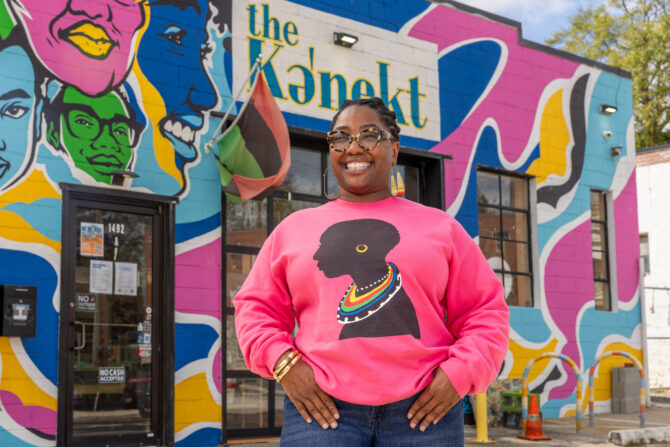
Ke’nekt Cooperative, founded by Kiyomi Rollins, provides microloans to Black-owned nonprofits and coordinates mutual-aid programs.
Funders don’t appear to just be pushing grantees to send a different message. Following the election and into the first months of Trump’s second term, a significant number of grant makers changed their own language, watering down how they depict their work related to social justice, according to a study by the National Committee For Responsive Philanthropy.
In surveying 773 foundation websites, the group found nearly 10 percent of grant makers had changed their content, deleting or minimizing references to race and/or gender between November 2024 and March 2025.
That change is bleeding over into decisions about the work that foundations will fund. Some nonprofits are being asked to delete mentions of race in descriptions of strategies that guide their work and then resubmit their applications, says Aaron Dorfman, president of the National Committee for Responsive Philanthropy.
“There is no question in my mind that some foundations have pulled back on their support for racially explicit grant making, racial justice work, and movement building,” he says.
Some Grant Makers Remain Unbowed
The chilling effect on such work hasn’t been a sectorwide deep freeze. Many grant makers, including the Robert Wood Johnson, MacArthur, and Nathan Cummings foundations, remain steadfast in their commitment to racial equity. Others have redoubled efforts, such as the Packard Foundation, which in July created a program dedicated to racial justice after concluding a five-year initiative on the subject.
In the months following the executive order, Rey Ramsey, president of the Nathan Cummings Foundation, like many of his peers, sought legal guidance. Ramsey was in charge of leading the grant maker’s commitment to racial, environmental, and economic justice, or REEJ, a strategy that had been adopted in 2022, and needed certainty that the philanthropy’s grant-making practices were within the law.
The lawyers confirmed what Ramsey, also a lawyer, already believed: The foundation’s practices — it does not make grants strictly on the basis of race — were entirely legal.
Ramsey understands that other grant makers may be more sensitive to the idea of being targeted. And Nathan Cummings may yet come under scrutiny from the Trump administration. But he says expressing his views and implementing the foundation’s mission is a constitutional right.
While risk assessments of legal exposure are prudent, they can “run amok” and cause leaders to veer from their core values out of fear, he says.
“Our beliefs are not seasonally adjustable,” he says.
Declining Support and Growing Expenses
In Atlanta, Kindred Futures, a nonprofit that works to reduce the racial wealth gap, has seen many groups it supports, and many partners, suffer. Some have cut up to 50 percent of their staffs because of reduced foundation and government support, says Janelle Williams, Kindred Futures’ co-founder.
Kindred Futures, Williams says, is on track to meet its expected revenue. But its expenses have grown. It has had to spend more on services, as well as shoulder increased costs to ensure its work is legally defensible, fine-tune messaging to funders and the broader public, and beef up IT protections in response to cyber threats.
While some foundations have scrubbed their websites to avoid any mention of race, Williams is steadfast in staying the course. Her message to grant makers is that there are more than
2 million Black households in the South that have a zero or negative net worth.
If the data changes, maybe her mission will change, but until then, she says Kindred’s focus on Black wealth is bound to help people regardless of their background.
“The data demands that our work be race-explicit,” she says. “But it is not race-exclusive.”