October 30, 2008 | Read Time: 9 minutes
The bar for celebrity activism has been set at new heights
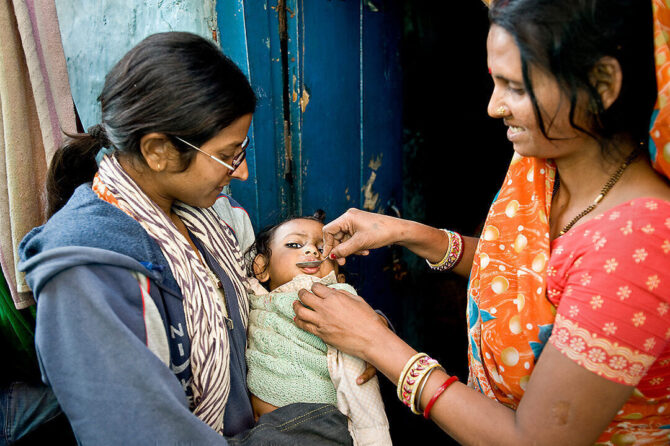
On a Thursday morning in May, the actress Ashley Judd climbed into a van and rode to a cement hovel in Kinshasa, the capital of Congo. Inside, she met a couple who spoke about how their lives had improved since they were educated about birth control by Population Services International, the charity Ms. Judd represents as its “global ambassador.”
“Altogether, Therese has had nine pregnancies, three of which, out of mad desperation, she aborted with herbs obtained by friends,” the actress wrote in a blog on the Web site for YouthAIDS, a program run by Population Services International. “But it was that or have more babies for whom Victor and she could not offer anything near adequate care, given they were already barely surviving.”
Ms. Judd’s goal for the trip, like others she has taken, was to collect stories about the serious health challenges facing people in the world’s poorest countries.
Armed with those tales, she returns to the United States and tells lawmakers, her fans, and other Americans about the work that Population Services International does in improving people’s lives.
“As a friend of mine put it, I go to these places and do all the feelings, and you write the checks,” she explained to a group of travel-industry leaders at a conference in New York this fall.
Long-Term Ties
Ms. Judd’s work with Population Services International is emblematic of a growing kind of celebrity engagement. More stars today are forging long-term relationships with charities, visiting their programs, meeting with legislators, and speaking about their work on television news programs.
Nonprofit officials say that the singer Bono and the actress Angelina Jolie can be credited with raising the bar for celebrity activism, with their work in behalf of refugees and the needs of developing countries. Julie Andrews, Julianne Moore, Natalie Portman, and Jane Seymour are among other celebrities who have been pursuing a more intense form of involvement with an array of causes. Charities, in turn, have become more sophisticated in enlisting them.
Ms. Judd, who serves on Population Services International’s board, has traveled to a dozen countries and testified before the United Nations and the U.S. Congress during her six years aiding the organization.
“There has been a dramatic increase in celebrity involvement in group activism,” says Darrell M. West, vice president and director of governance studies at the Brookings Institution, who writes on the topic in Global Development 2.0: Can Philanthropists, the Public, and the Poor Make Poverty History? “Celebrities like political and charitable involvement because it makes them feel they’re doing something meaningful to improve the world.”
The hands-on approach taken by Ms. Judd has brought significant benefits to Population Services International. During her trip, Ms. Judd introduced the Canadian ambassador to Congo to the charity’s work. Now the group is discussing ways to get money from Canada’s government.
The actress also helped put the issue of family planning on the Congolese government’s agenda. She emphasized the link between reproductive health and poverty to local government officials, who until her visit had not considered family planning to be a concern. The country’s top official on the issue of gender recently recognized Population Services International as the government’s “partner” on family planning.
“Some of these things might have happened without her visit,” says Theresa Gruber-Tapsoba, the charity’s country director in Congo. “But the fact that she met with donors and raised the profile of our work has made it a lot easier for us to get access to people and to be remembered by them.”
In an interview with The Chronicle, Ms. Judd said it was the charity’s careful planning of her trips that kept those visits from being all show and no impact.
“Our programs are too good, our staff are too good,” she says, sitting in a small hotel room in the Ritz Carlton above Central Park this fall while in town for the Clinton Global Initiative, the annual meeting arranged by the former president Bill Clinton to enlist donors, policy makers, and celebrities to provide aid to projects around the world. “They help organize my interactions with key government officials and are incredibly focused and targeted about following up with them after my visit.”
Potential Pitfalls
Many nonprofit officials and scholars believe the growing influence of celebrities on charitable causes is helping to attract new types of supporters to charities and the missions they pursue. But they warn that nonprofit groups need to be smart about who they recruit to their causes, particularly as the public has grown more skeptical of celebrity involvement.
“Charities need to go into this with their eyes open,” says Alan J. Abramson, a senior fellow at the Aspen Institute. “Sometimes charities underestimate their own brand, and that’s something they need to lend out with care, because, after all, celebrities are getting something out of this too.”
Andrew F. Cooper, associate director of the Center for International Governance Innovation and author of Celebrity Diplomacy, notes that the United Nations strengthened its vetting process for the “goodwill ambassador” program after it recruited a few people who weren’t up to the task, such as Geri Halliwell, also known as Ginger Spice.
“There is sometimes a fickleness and a faddishness,” he says. “Certainly not every celebrity has the human resources, the personality resources, to be on the level of someone like Angelina Jolie.”
Ms. Judd says she makes a point of keeping up with the knowledge she needs to be an effective spokeswoman. As a trustee, she receives regular updates on the charity’s finances, plans, and programs. Marshall Stowell, her primary liaison at the group, sends her booklets of information in preparation for trips abroad, meetings, and events.
William J. Garvelink, the U.S. ambassador to Congo, says Ms. Judd’s focus on the country has made it easier for him to make the case in Washington that Congo needs more support. But he says Ms. Judd’s success hinged on her ability to speak authoritatively.
“She knew in detail not just about HIV but about the politics of the country,” he says. “Finding people like her is critical to the credibility of the agency they represent, because you’re dealing with a lot of people in the country, in the U.N., who know the situation too. So if you pop in and out, that diminishes your message.”
Seeking Aid
In addition to speaking about the charity in public, Ms. Judd reaches out to people directly on behalf of Population Services International and its YouthAIDS program. That program, which raised about $12-million last year, was started in 2001 to use the power of marketing, advertising, and popular culture to encourage young people to stop the spread of HIV/AIDS.
Many of the program’s corporate sponsors have joined because of Ms. Judd. The head of Beam Global Spirits and Wine, for example, agreed to support YouthAIDS after meeting Ms. Judd through her husband, a Scottish racecar driver.
Ms. Judd has also helped recruit other celebrities to YouthAIDS. She introduced the actress Salma Hayek and the singer Juanes to the charity and traveled with them to see the group’s work in Central America.
Ms. Judd tutored a new representative, the model Frederique Van Der Wal, in the ways of celebrity activism during the trip to Congo. The actress also appeared in a National Geographic documentary about AIDS in India with three Bollywood stars, as part of the charity’s efforts to use more celebrities from outside the United States.
“I have to somehow entice corporations and thought leaders and powerful CEOs, and a lot of the time they won’t pick up the phone to me but they’ll pick it up to Ashley,” says Kate Roberts, the former advertising executive who started YouthAIDS.
Getting Over ‘Self-Pity’
Ms. Judd says it was not concern for HIV/AIDS, per se, but a coincidence of timing that first drew her to Population Services International’s YouthAIDS program. She was active in campus social-justice movements as a student at the University of Kentucky and briefly contemplated joining the Peace Corps.
But instead she went to Hollywood. In 2002, she was filming a movie called Twisted, which was keeping her up working most nights. She says she was growing tired of her “self-pity” at fatigue-induced foibles, like forgetting to turn on the hot water before getting into a shower.
At the same time, her friends Bono and Bobby Shriver were encouraging her to join their Heart of America tour to raise money for the fight against AIDS. While she didn’t participate in that event, she was attracted to the idea of doing something to help others. When Ms. Judd received a letter from Ms. Roberts shortly after through her publicist, asking the actress to learn more about YouthAIDS, she agreed.
“There’s really no magic formula,” says Ms. Judd. “It boils down to something as simple as they asked.”
Ms. Judd says she is particularly moved by the issue of gender inequity. Over the years, she has become as much a spokeswoman for that cause as for Population Services International.
This spring, for example, she served as host at a meeting of the United Nations Foundation about the connection between gender inequity and poverty. Tamara Kreinin, executive director of the women and population program at the United Nations Foundation, also encouraged Ms. Judd to speak on a panel about gender inequality at the Clinton Global Initiative.
Ms. Kreinin is hoping to plan a trip to Ethiopia with Ms. Judd and leaders of the Nike Foundation that would draw attention to the issue. Ms. Judd would visit both the U.N. Foundation’s programs and those run by Population Services International.
Ms. Kreinin says that Ms. Judd’s visit would help energize members of her staff and the girls who are benefiting from the charity’s program in Ethiopia, even though few, if any, girls outside the country’s capital know who she is.
“It makes both the girls themselves and the people conducting our programs in the country feel valued by having someone like Ashley Judd come to visit them,” she says.
Mr. Stowell says that Population Services International has worked with Ms. Judd as her charitable interests have evolved.
The charity’s programs are relatively diverse, so the group is often able to accommodate her interests. Sometimes, though, the charity will take Ms. Judd to visit programs run by other groups. In Congo, for example, she made a stop at Women for Women International’s programs.
Ms. Judd, who lives with her husband and two dogs in Tennessee, says she is not sure in what ways, if any, her acting career has benefited from her charity work. She says she’s “really not into cross-pollinating,” and tries to keep her acting and activism separate.
But she says she always prefers to talk about her activism. “I do that shamelessly,” she says. “I’m grateful that the media, when I’m allegedly on a show to talk about my film, is generally far more interested in my human-rights work.”