SNAP Crisis Exposes Limits of Philanthropy’s Safety Net
As the longest government shutdown comes to an end, food banks remain under crushing demand. New data analysis shows most rely on contributions from individuals, not foundations, to keep shelves stocked.

By Eden Stiffman
Senior Editor
November 13, 2025 | Read Time: 5 minutes
One of the most severe impacts on nonprofits from the government shutdown has been the halt of federal food aid. Millions of people across the country have turned to nonprofit food banks and pantries to make up for the loss of government food benefits and wages during the shutdown, which came to an end Wednesday night. But that surge in demand has exposed the precarious financial situation these groups are in. They may be common fixtures in American communities, but new research shows they rely heavily on individual donations and receive little funding from foundations.
There are more than 15,000 food-aid nonprofits across the country, from large regional food banks to small pantries and soup kitchens, according to new data analysis from the philanthropy research organization Candid. Together, these groups spent roughly $37.4 billion in 2023 and brought in about $38.4 billion in total revenue — a little more than a third of the $100 billion the federal government spends annually on the Supplemental Nutrition Assistance Program, or SNAP.
Despite their visibility and reach, only about 57 percent (8,700 organizations) have received any philanthropic grant funding since 2020, and more than half of those received less than $50,000 total, according to Candid.
“Food aid nonprofits are primarily relying on donations from the American people,” said Cathleen Clerkin, associate vice president of research at Candid. “At a time when individual Americans are losing their jobs, losing their paychecks, and losing their food stamps, it’s almost like telling people to pull themselves up by their bootstraps and also cutting off their bootstraps.”
Much of the support these groups receive is not in the form of cash contributions, either. The 4,431 nonprofits that filed their detailed IRS Forms 990 in 2023 reported nearly 60 percent of their contributions were noncash, largely food donations from corporations and individuals. These groups also receive food directly from the government, something that has also been curtailed during the shutdown even as demand rises.
Clerkin called the situation “untenable,” warning that if SNAP benefits continue to lapse, individual food-aid groups could see an influx of thousands of additional people in the coming weeks, based on her analysis of the number of food aid groups and SNAP recipients in each state “Food banks and pantries are already our safety net,” she said, “When you throw everybody on the safety net, the safety net’s gonna break.”
‘Harder Than the Pandemic’
At Connecticut Foodshare, which serves the entire state, demand has doubled over the past two weeks, said CEO Jason Jakubowski. His organization typically distributes about 4 million meals a month through its network of more than 600 food pantries, meal programs, and mobile distribution sites. Now in the two weeks since SNAP payments were halted, it has already delivered that same amount.
“These have probably been two of the hardest weeks of my professional career,” Jakubowski said. “We’re really in uncharted territory. … It’s been harder than the pandemic,” when government support for individuals and institutions increased.
To keep up, Connecticut Foodshare’s board approved an emergency $1 million allocation from its reserves to buy food and later received $3 million in state funding. “The food we’re getting is literally being received on one end of the building and going out on the other,” Jakubowski said.
Still, the crisis underscores the limits of private charity. About 65 percent of Connecticut Foodshare’s funding comes from individual donors, 5 percent from government, and the rest from corporations and foundations.
Even with record donations — nearly $3 million in two weeks, up from $800,000 over the same period last year — the organization is spending record amounts to purchase food that once came through federal programs. They’ve also had to add temporary staff and trucks to meet demand.
In normal times, Jakubowski said, about 70 percent of his food is donated by grocery retailers, 25 percent comes from federal sources, and 5 percent is purchased. Over the past nine months, Connecticut Foodshare has received 36 fewer trailer loads of USDA food than expected, worth about $1.7 million.
‘We Don’t Want to Run Out’
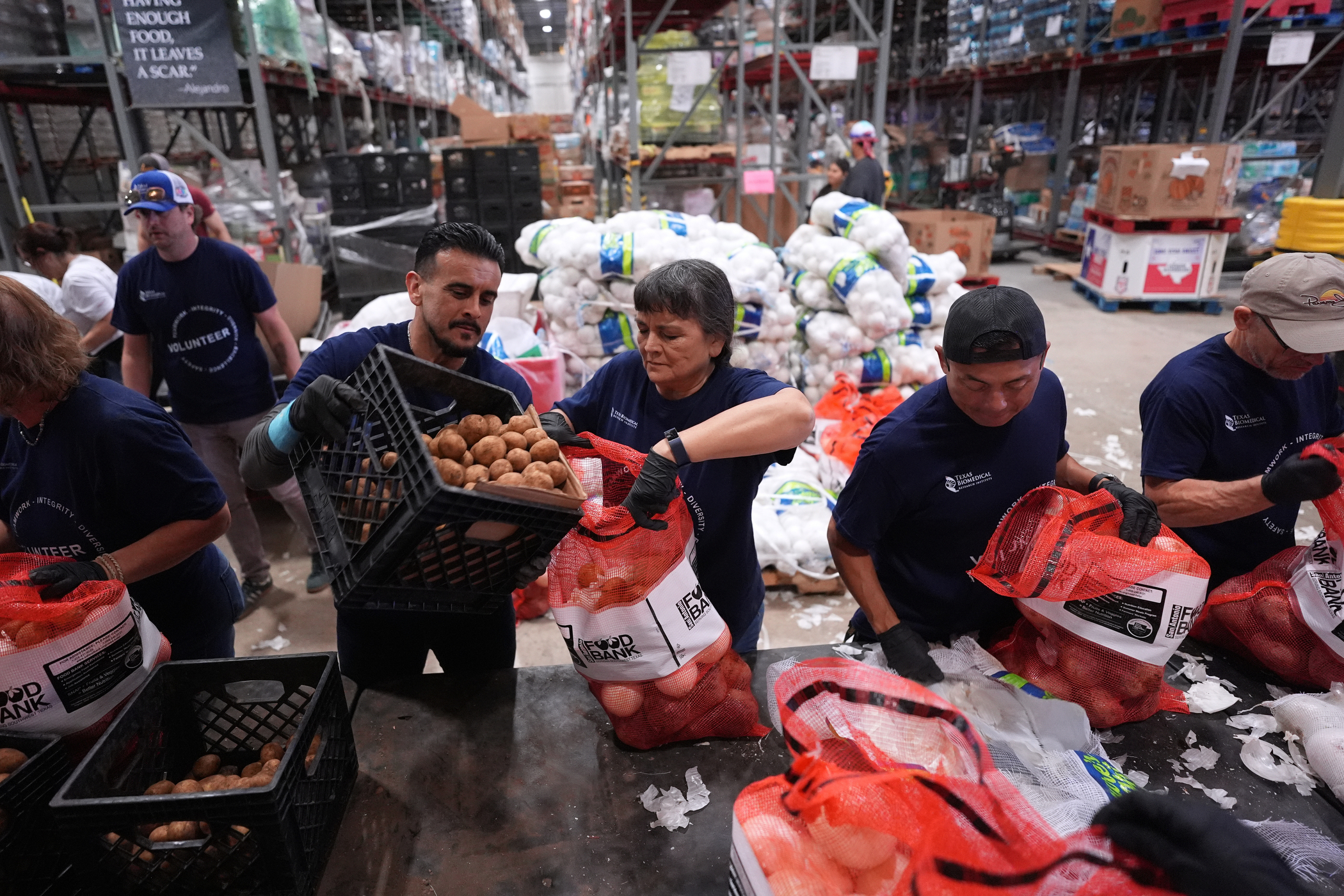
The San Antonio Food Bank, which serves a 29 county area in southwest Texas, has seen a similar surge. CEO Eric Cooper said his organization typically serves 105,000 to 120,000 people a week across 29 counties. During the shutdown, that number rose to about 170,000 people per week.
“We fight the daily disaster of poverty,” Cooper said. “But when a natural disaster occurs — like flooding or now this man-made disaster, the government shutdown — we respond to that, too.”
His team organized special food distributions for unpaid TSA agents and military families, while warehouse inventory dropped from 11 million pounds to 5 million due to reduced government supply.
“Our challenge has been not enough inventory being donated to meet the demand,” Cooper said. That means having to purchase more food, which is a less efficient use of resources, he said. “We can’t stretch that dollar as efficiently to feed as many with as much, but we don’t want to run out.”
The San Antonio Food Bank’s $46 million annual operating budget includes a mix of public and private funding — roughly 30 percent from government and the rest from private sources. About 60 percent of private giving comes from individuals, with additional support from corporations, faith groups, and foundations.
Cooper said the math simply doesn’t work without public aid. For every meal food banks provide, SNAP normally delivers roughly nine. “Private philanthropy can’t replace the federal government and its role in taking care of Americans who are doing all they can,” Cooper said.
Legal and Political Whiplash
After weeks of uncertainty, tens of millions of Americans are expected to receive full November SNAP benefits now that the federal government has reopened. A cascade of court rulings, emergency state measures, and conflicting federal guidance had left state agencies and nonprofits scrambling to determine when, and how fully, benefits would be delivered. Several state governments and national nonprofit coalitions, including the National Council of Nonprofits, sued to restore benefits. Even with the government reopened, uncertainty and long lines remain as food aid groups head into what is one of their busiest times of year — Thanksgiving.
For every food-bank executive describing emergency allocations and individual donor surges, the underlying message is consistent: Philanthropy and charity can supplement public aid but cannot substitute for it.
People think food charities are the end-all, be-all solution for anything having to do with hunger, Jakubowski said. “If the last couple of weeks have proven anything, it’s that SNAP absolutely is the first line of defense against hunger in the United States.”