Using the Power of Art to Bring Back Memories and Spark Ideas for Alzheimer’s Patients

By NICOLE WALLACE
Features Editor
December 10, 2009 | Read Time: 4 minutes
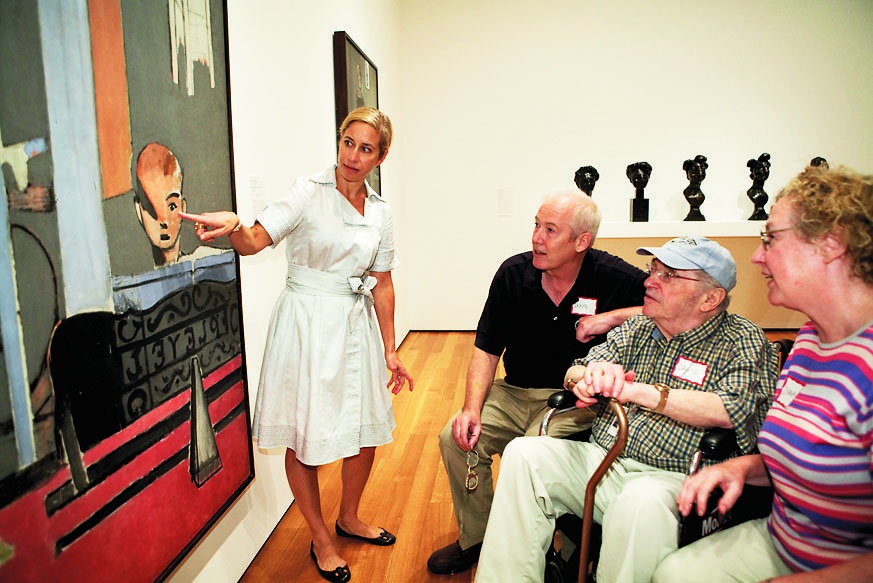
Tuesdays are quiet at the Museum of Modern Art, the one day each week that the New York institution is closed to the public. But one Tuesday afternoon a month, small groups move through the empty galleries to look at and discuss works of art.
The exclusive tours are not for scholars or visiting dignitaries, but for people in the early or middle stages of Alzheimer’s disease and the family members who take care of them.
“What’s wonderful is that a work of art doesn’t require short-term memory,” says Francesca Rosenberg, director of community and access programs at the museum. “It’s there in front of the participants. They’re able to talk about it and interpret the work, right then and there.”
For people with Alzheimer’s disease or other types of dementia, the Meet Me at MoMA program provides mental stimulation and an opportunity to express themselves, socialize, and tap into long-term memories, says Ms. Rosenberg.
During one tour led by Ms. Rosenberg, in the midst of a discussion of a Marc Chagall painting, a man with Alzheimer’s disease talked about the Jewish cemetery where his grandmother was buried. The man’s wife later said that she had never heard that story before.
“It’s really the Chagall painting that brought that memory up for him,” says Ms. Rosenberg.
Reducing Isolation
The program doesn’t rely simply on such stories, however, to prove its value. The New York University School of Medicine studied the effort and found that it improved the moods of both people with dementia and their caregivers. It also increased self-esteem among participants with dementia while decreasing caregivers’ sense of isolation.
The MetLife Foundation, in New York, has awarded $850,000 over four years for the MoMA Alzheimer’s Project, an effort to spur programs like Meet Me at MoMA at museums nationwide. Educators from the Museum of Modern Art have traveled across the country to conduct free seminars and in-person training sessions, and the museum has developed a guide to getting started.
So far, 30 museums have started or are planning programs to make art accessible to people with dementia and their caregivers, including the Virginia Museum of Fine Arts, in Richmond, and the Museum of Fine Arts, Houston.
The Meet Me at MoMA program grew out of three years of research, interviews with people who have Alzheimer’s disease, and testing to develop the right teaching strategies.
Each month, about 100 people sign up for the tours, which last roughly an hour and a half and focus on four or five pieces that share a common theme. To create a nonthreatening atmosphere that encourages discussion, groups are limited to no more than 16 participants — eight people with dementia and eight caregivers. Wheelchairs, portable stools, and listening devices are available for anyone who needs them.
Sharing Stories
Educators approach Meet Me at MoMA in much the same way they do any tour they give at the museum, says Amir Parsa, one of the museum’s educators and manager of the MoMA Alzheimer’s Project.
For each work of art that the group considers, educators provide information about the artist and the time period when the work was created, and then they ask the group questions about what they see and how they interpret it.
Mr. Parsa will often start with an open-ended question, such as “Does this painting suggest a certain season?” Ninety percent of the time, he says, that will get the conversation started.
“But if nobody answers, I might say, ‘Do you think that this scene reminds you of spring or summer?’” he says. “And if I still see nobody’s really responding, I might say, ‘Does this painting suggest summer in any way?’”
Mr. Parsa encourages participants to share any stories they want to tell, even if they don’t seem to be directly related to the piece.
“The tangential comments, the personal connections, the narratives that will unfold in that group are more important than the information I might give about Salvador Dali,” he says.
The arts can play a vital role in healthy aging, improving older people’s physical and emotional health and helping them build stronger social networks, says Gay Hanna, executive director of the National Center for Creative Aging, a Washington group that promotes arts programs designed for older adults.
Too often, she says, people think about aging in terms of disease and the physical and cognitive losses that age often brings, without considering what older people can still contribute. But programs like the one at the Museum of Modern Art help change that view.
“The patient becomes a person again, and the caregiver sees that person,” says Ms. Hanna. “They actually have time that is spent not dwelling on the infirmity, but really being active and part of the greater life stream.”