How Can Philanthropy Help the Working Class?
A partnership between a big-city foundation and small-town Minnesota offers an unusual answer.

By Drew Lindsay
Contributor
April 4, 2017 | Read Time: 12 minutes

The late Russ Ewald, a legend in Midwest philanthropy, didn’t enter grant making with conventional credentials. His career featured stints as a liquor-store clerk, a combat Marine, and a minister. Even after becoming a prominent Twin Cities leader controlling millions in foundation assets, he still played pool at the clubs he had frequented as a boy during the Depression.
“He was always on the street,” says Jim Storm, who co-wrote a biography of Mr. Ewald. “He wanted to be where the action was.”
In the mid-1980s, Mr. Ewald was in his 60s and leading the McKnight Foundation when an economic crisis hit Minnesota. Reports from outlying areas brought news of layoffs, mine closings, and suicides by farmers who had lost their land and livelihood.
At the time, McKnight was focused almost exclusively on the Twin Cities, but Mr. Ewald hooked a trailer to his Cadillac and drove the state with Virginia Binger, daughter of William McKnight, the grant maker’s founder and the executive who turned the St. Paul-based 3M company into a giant.
Upon their return, the two decided to throw an economic lifeline to rural Minnesota, but in an unconventional way. Rather than establish satellite offices in rural outposts, Mr. Ewald used McKnight dollars to seed six regional Minnesota Initiative Foundations. Most important, he handed control of the money to local leaders. One of his favorite expressions: “If you put fences around people, you get sheep.”
That was 1986. Today, the far-flung and enduring results of that strategy are hailed by those who see economic development as essential work for community foundations. With Mr. Ewald’s blessing, these homegrown foundations put aside much traditional grant making in favor of backing local businesses through loans. “Some of the leaders in the field are just now coming around to what they’re doing,” says Janet Topolsky, who leads a rural-philanthropy program at the Aspen Institute.
If you put fences around people, you get sheep.
The McKnight effort is also remarkable in light of the common critique of philanthropy as too elite, too arrogant, too focused on cities. Foundation loans to businesses might seem like corporate welfare to some, but they are welcomed in communities wary of charity. More important, perhaps, they have helped build a bridge between a big-city foundation and a small-town working class not typically on the receiving end of philanthropy.
Demise of the Family Farm
The West Central Initiative is perhaps the most unusual of the foundations midwifed by Mr. Ewald. It is believed to be the first nonprofit to earn federal designation as a regional economic-development planner. Last year, it awarded three times as much money in business loans as in grants. And many of its grants pay for worker training at local companies.
Most of the 82 communities in the West Central region are home to fewer than 1,000 people. As in many areas served by the McKnight initiative network, Donald Trump won the 2016 vote in every county in the region, sometimes by a margin of almost two-to-one.
Connecting those small towns are long stretches of two-lane highways that loop around lakes and cut through rolling prairies. For decades, agriculture was king here, but in the early 1980s, the national recession, drought, and dwindling grain exports toppled the generations-old economy. Some family farmers sold off to giant agribusinesses. Many went bankrupt.
“It was the end of an era when a husband and wife could make their living off the land,” says Sandy King, an early West Central hire. One of the newly created foundation’s first projects was to send trucks to feed the very farmers who were once key breadbasket producers.
Mr. Ewald saw such tragedies throughout the state on his driving tour. When he asked how McKnight could help, local leaders surprised him with their answer: Let us use philanthropic dollars for economic development.
“That wasn’t in McKnight’s vocabulary,” says Tom Renier, founding president of the Northland Foundation, the initiative foundation in the state’s northeast region. “Russ Ewald first said, ‘That’s a losing proposition: You’ll either make bad loans and go out of business, or you’ll make loans that banks already do.’ ”
But the locals persuaded Mr. Ewald they had a role to play, particularly as gap financers. When start-ups or expanding businesses couldn’t qualify for full commercial financing, the foundations would step in with small loans to top off what banks and government agencies anted up. The cash, they hoped, would prove an accelerant for business growth, bringing jobs and wealth to the community.
Foundation investment in businesses is in vogue today, but it was so peculiar at the time that McKnight secured permission from the Internal Revenue Service. It would be years before the Council on Foundations admitted McKnight’s spinoffs as members, says John Molinaro, who worked at West Central for its first 20 years. “We were a bit different than anything else out there.”


Mom-and-Pop Businesses
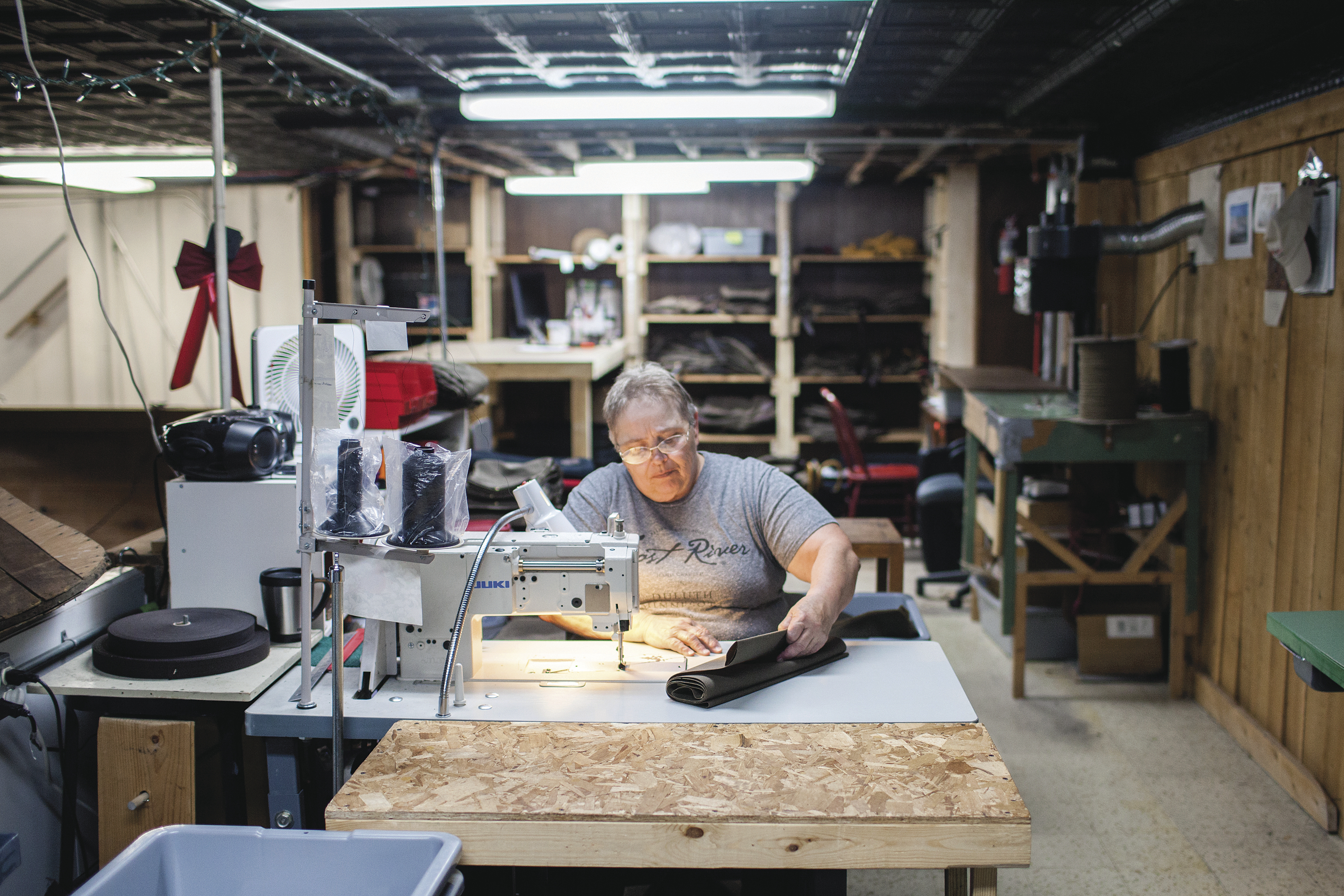
When West Central began making loans, the board and staff concentrated on mom-and-pop manufacturing firms, many launched by farmers working out of a garage to supplement their income. “Ours was a ‘grow from within’ strategy,” says Mr. Molinaro.
One of West Central’s first businesses was BTD, a small-parts manufacturer in Detroit Lakes. The company started in 1979 with two employees but grew quickly, with West Central helping pay for equipment purchases. Today, BTD has six facilities nationwide and employs more than 1,000 people, including 427 in Detroit Lakes.
DyCast Specialties, another West Central beneficiary, is one of the largest employers in the town of Starbuck, population 1,300. Its 50 employees work out of a 30,000-square-foot building sheathed in corrugated metal. The manufacturing floor hums five, sometimes six days a week as ingots of aluminum and zinc are melted down and transformed into custom parts for hand tools, telecommunications networks, and even ammunition for the military.
Founded in 1983, DyCast has grown from a family business to a $7.5 million corporation. In the 1990s, as demand outstripped the company’s growth capital, West Central gave it two expansion loans. When the 2001 recession hit and orders slowed, the foundation let the company stop making loan payments until it got back on its feet. “Without that, I’m not sure we’d be here today,” says CFO Ed Bolas.
During the Great Recession, West Central stepped in with grants to bring in national experts to train workers in efficient production. The training more than halved turnaround time for orders.
There are signs that foundations are making a difference. The number of manufacturing jobs increased 53 percent even as the industry slumped nationwide.
West Central officials get what it means to be a small manufacturer in a small town, Mr. Bolas says. He can’t say the same for the dozens of bankers, insurers, and others who make the two-hour drive from the Twin Cities. They don’t understand the DyCast business model, he says; one recommended using cloud storage to streamline operations but was flabbergasted to learn that a quarter of DyCast workers don’t have computers at home.
“You get these yahoos that come out from the city, and they don’t have a clue what’s going on out here,” Mr. Bolas says. “There are hundreds of small businesses out here just like us, and the banks come out and act like we’re a retail business.”
Mr. Bolas regularly attends West Central’s roundtables to discuss community issues. Government is not going to be able to fix a lot of things in small-town Minnesota, he says. “But if you can bring together people and ideas, maybe we can figure it out on our own. That’s where the initiative fund comes in.”
A Manufacturing Boom
Over 30 years, the six initiative foundations have made more than $250 million in loans to businesses. Millions more dollars have gone to grants for technical assistance and training. The result, according to McKnight: at least 46,000 jobs created, plus thousands saved.
The overall economic impact of the foundations is hard to measure; many small towns continue to struggle to keep businesses and residents. Still, there are signs that the foundations are making a difference. In West Central, the number of manufacturing jobs increased 53 percent from 1990 to 2012, according to the Federal Reserve Bank of Minneapolis. During the same period, manufacturing employment nationwide dropped 33 percent.
The foundations support an astonishing array of businesses to both generate jobs and enhance quality of life. These include a fire-truck manufacturer, child-care centers, a biodiesel fuel producer, nursing homes, and software companies. One foundation is bankrolling a Somali woman who trains employers on the culture and traditions of her fellow refugees. It’s also helping a former teacher develop a market to sell glasses for children with attention-deficit disorder and other concentration issues.
Some loans amount to highly unorthodox philanthropy. West Central has made loans to open a Subway franchise and other restaurants, albeit with hesitation. Other investments look like long-shot bets; the Northland Foundation recently helped open Vikre Distillery, which is run by a husband-and-wife team with no background in business or distilling liquor.
Though foundation-backed businesses fail, loan-default rates are low — less than 1 percent at West Central, for instance. That’s in part because foundation officials know their borrowers personally and, unlike banks, offer flexible repayment terms so businesses can ride out hard times.
“It’s not like It’s a Wonderful Life, where Jimmy Stewart is making loans to the town taxi driver,” says Neal Cuthbert, a former McKnight official who oversaw the foundations. “But these are all people that the foundations know.”
The Kids Grow Up
Mr. Cuthbert worked at McKnight for a quarter of a century before retiring this year. Initially, he says, the foundations were like children, leaning heavily on the parent organization for funding and guidance. McKnight watched over them closely, demanding they produce exhaustive strategic plans and regional analyses.
About a decade ago, McKnight began to pull back funding and move from the role of guardian to partner. The regional foundations “were pretty sophisticated by that time,” Mr. Cuthbert says. “They had organizational practices that McKnight didn’t even have.”
Today, rural Minnesota has a significant philanthropic presence where once there was none. The six initiative foundations have collective assets of $270 million and attract funding from donors, businesses, and foundations apart from McKnight. Though economic development remains key to their mission, they are beginning to look more like traditional community foundations; in the last decade, each has invested heavily in early-childhood education.
Today homegrown foundations have put aside much traditional grant making in favor of backing local businesses through loans.
As they grew, the foundations became a sort of civic glue, bringing people together for planning and projects when there’s no governmental unit strong enough — or, in increasingly partisan times, trusted enough — to unify far-flung communities. The foundations “are very much a connective tissue in those areas,” says Andi Egbert, assistant director of the state’s demographic center.
Mr. Cuthbert says the foundation loan programs give them more influence in the business community than McKnight might have. Help from a community charity can also deepen a company’s civic commitment; inspired by West Central, the original owners of BTD started a foundation to give back to the region.
Rural-City Divide
In 1986, just 5 percent of McKnight’s grant making went outside the Twin Cities area. Today, that figure is 17 percent. Though McKnight is trimming support for the initiative foundations, it has no plans to end support altogether.
It’s rare for a foundation to support a grantee for 30 years, says Kate Wolford, McKnight’s president, “but we know we’d better stick with a good thing.”
The value of a partnership between a big-city philanthropy and small-town Minnesota is perhaps more important now than it was 30 years ago. Like in much of the rest of the country, cultural and economic divisions have split Minnesota in two: the Twin Cities metro area versus the rest of the state, known as Greater Minnesota. Since 2010, Republicans outside the Twin Cities have campaigned on the message that Greater Minnesota has been ignored and left behind by the fast-growing metro region. The result: The GOP won control of the Minnesota House in 2014 and the state Senate in 2016, with overwhelming support in Greater Minnesota.
Through the initiative foundations, McKnight hopes to counter the perception that the Twin Cities doesn’t care about Minnesota. McKnight and its offspring don’t always see eye to eye. At times, the foundations have funded businesses that aren’t in keeping with McKnight’s efforts on, say, climate change, Mr. Cuthbert says. Also, McKnight’s promotion of new regulations to clean up the state’s rivers isn’t always popular in rural Minnesota’s many conservative precincts.
Still, the initiative foundations offer a vehicle to bridge the urban-rural divide by bringing it to a personal level, Mr. Cuthbert says. He’s seen this with businesses that have received foundation loans.
“They know that they are benefiting from an act of charity by a Twin Cities foundation,” he says.
Mr. Cuthbert, who during his McKnight tenure traveled the state and met with business leaders frequently, says he was routinely welcomed with unusual warmth. “That’s because in many ways, we’re saying, ‘Your life matters. And we’re concerned about your livelihoods and well-being.’ That act of recognition is important for anybody who feels marginalized.”