A Los Angeles Couple’s No-Nonsense Charity Helps the Working Poor
Greg and Jodi Perlman started The Change Reaction to help people in their city stay afloat during times of crisis. They’ve given $60 million to 43,000 families over the past six years.

By Maria Di Mento
Contributor

October 28, 2025 | Read Time: 7 minutes
Greg and Jodi Perlman have no use for rich people who dither about helping the poor. The Los Angeles couple, whose fortune comes from Greg Perlman’s real estate business, said they see far too many wealthy people failing to help those less fortunate, because they think they need to develop a complicated giving strategy or spend time analyzing and measuring the potential outcomes of their philanthropy. Instead, they say, affluent donors should let their hearts guide them and let the money flow.
“When lower- and middle-income people give, they lead with their hearts. They’ll give to a homeless person on the street quicker than people who are holding onto their money and managing it,” Greg Perlman said. “We try to say, ‘What do you need?’ You tell us, and then, ‘Okay, here’s the money.’”
Although they have a small family foundation — which gave out over a half million dollars to support scholarships, education, and human service groups, according to 2023 tax filings — the Perlmans practice what they describe as “direct giving with guardrails” through their six-year-old nonprofit, The Change Reaction. Through it, they give extensively to help Los Angeles’s working poor, aiding those who are often one paycheck away from losing everything or in danger of falling into debilitating debt because of a hospital stay or other emergency.
The Perlmans don’t do this work alone. They rely on a network of boots-on-the-ground professionals who work directly with struggling Angelenos and know their needs best. They include social workers, clergy, police officers, teachers, city council members, and others who vet potential beneficiaries and then complete a short online grant request describing what kind of help the person or family needs and why.
The Perlmans say they give from the heart, but they are also giving in response to economic realities. While the poverty rate for full-time workers in California was 6.7 percent in 2023, and 23.6 percent for the state’s part-time workers, according to the California Poverty Measure, Los Angeles County had the highest poverty rates among working adults throughout the state: 12 percent for both full- and part-time workers and 7.8 percent for full-time workers.
Since launching The Change Reaction in 2019, the Perlmans have given 46,107 grants to over 43,000 families, totaling more than $60 million so far.
The couple help people with everyday situations: a financial crisis due to missed work because of an illness; the inability to keep or get a job because of a broken-down car. The Perlmans step in and pay for things like a month’s rent or furniture for a family getting off the streets and into an apartment. They help keep working people from having to make choices between buying groceries or paying an electricity bill.
More on Direct Giving
-
Podcast | Giving Done Right
The Power of Direct Cash Transfers to Fight Poverty
“It’s amazing what a small amount of money can do,” Jodi Perlman said. “People literally say to us, ‘You’ve changed my life.’ We don’t necessarily look at it as changing their life. We look at it like we’re enhancing their life — we’re helping them in a crisis.”
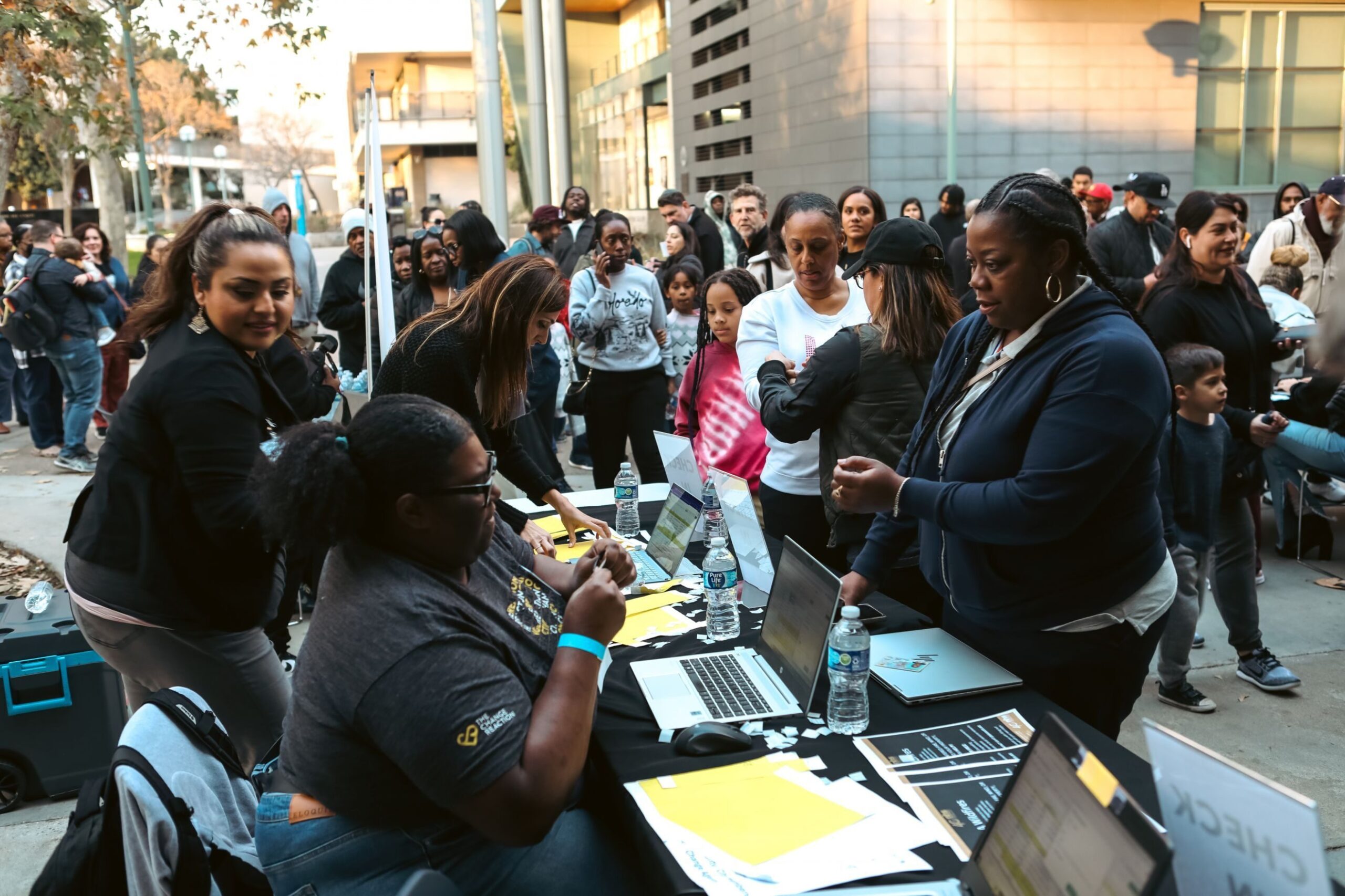
Change Reaction’s 11 full-time staffers read through and approve requests, usually within two to three days, and then forward the money or pay the person’s bills directly. Grants typically range from $500 to $5,000 and are primarily a one-time donation.
The organization also partners with around 180 charities, 70 local schools, and 15 area hospitals that alert The Change Reaction team to individuals and families who need the Perlmans’ help. The couple said they receive approximately 800 requests a month and approve most of them.
Learning Through Giving
The Perlmans didn’t start The Change Reaction until they had gained some giving experience. They learned about the conditions of the working poor through their support of human service groups and through Greg Perlman’s real estate business, GHC Housing Partners, which develops and operates low-income and affordable housing, including Section 8 housing, throughout the country.
In 2009 he established what later became All Ways Up, a foundation to help low-income tenants living in the properties the firm managed. Today it primarily provides scholarships and other assistance to first-generation and financially strapped college students.
Their support for the San Fernando Valley Rescue Mission, a Los Angeles-area nonprofit that provides shelter and services to people experiencing homelessness, opened the Perlmans’s eyes further. The couple said The Change Reaction’s president, Wade Trimmer, who was then the head of San Fernando Valley Rescue Mission, pointed out to the Perlmans in 2014 that many of those living in the nonprofit’s homeless shelter had full-time jobs. That came as a shock to the couple.
“He explained all the different reasons why working people might become homeless, so we started giving them money for security deposits and furniture so they could move into housing,” Greg Perlman said. “The impact we were having with not a lot of money — we realized this is really big-time stuff.“
The couple also backed a program that helps cash-strapped families of those receiving care at University of California at Los Angeles’s hospitals pay for things like hotel stays, transportation, and other related costs. After learning how much financial stress a hospital stay can have on a family’s finances, the Perlmans set up a fund that hospital social workers and nurses can draw from to help patients and their families cover non-medical costs. They have since started such funds in multiple Los Angeles-area hospitals.
The Perlmans are the primary funders of Change Reaction’s grant making and stepped up their support early this year when they gave the organization $10 million to launch a special fund for those who lost homes and other property due to the recent Altadena and Pacific Palisades fires. They have since raised an additional $10 million from other donors for the wildfire fund and have so far given out about $14 million through the fund to pay for basic needs like food, clothing, and shelter, and to help people replace cars and other property destroyed by the fires.
“I was really proud we were able to cross over into $10 million in outside donations,” Greg Perlman said. “That’s a really nice gift when you’re able to move the money and show people you put your money in and it’s going out into people’s pockets.”
The money the couple raised from other donors for the wildfire fund was a bit of a departure, Jodi Perlman said. While they have talked a few friends and family members into supporting The Change Reaction’s efforts, she said she and her husband don’t generally do a lot of fundraising from other wealthy donors. On the other hand, Greg Perlman has made several forays into trying to encourage more wealthy Angelenos to help the needy. Those efforts have mostly resulted in frustration.
“I was on a mission for a while to crack the wealthy and to start changing their way of thinking,” he said. “I’d go and sit with them and start going, ‘Come on guys, we’ve got to unleash this money, there’s too much money that we’re sitting on.’ And, you know, lately I’m kind of off of that a little bit. There’s just so much hoarding, there’s so much scarcity mentality, and I just don’t get it.”
Yet Greg Perlman hasn’t given up entirely. The Change Reaction is in the early stages of developing an effort to encourage more L.A. residents to understand and ameliorate the everyday hardships of the city’s working poor.
“People have to realize that the government’s not gonna be there. California’s got a deficit, and our federal government has a giant deficit, so it’s gonna be up to us to figure out how to help our neighbors,” he said. “I want The Change Reaction to be so ensconced in Los Angeles that more people can help their neighbors. The power of many with small dollars has become more interesting to me than finding one person like us who will give a bunch of money.”