Funders want to help boys and men — again. Will they stick around this time?
Richard Reeves is betting a slow-burn strategy — not a crisis pitch — can build the lasting infrastructure the last Obama-era wave never did.

By Drew Lindsay
Contributor

August 20, 2026 | Read Time: 12 minutes
Keep up with everything happening in The Commons by signing up for our monthly newsletter.

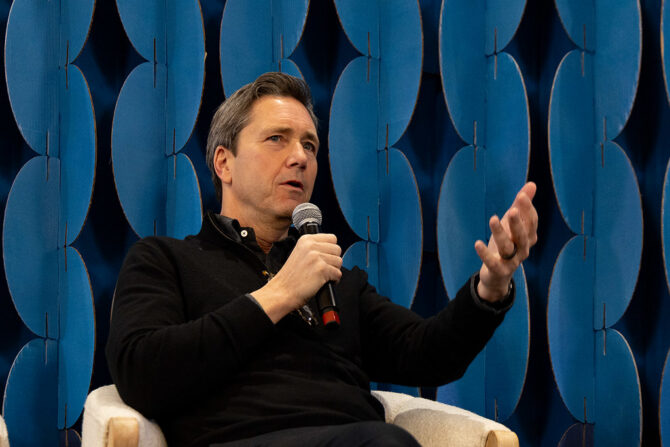
The zeitgeist found Richard Reeves in 2024, when Barack Obama’s summer reading list featured the British-American scholar’s Of Boys and Men. No matter that the book was nearly two years old. The former president’s endorsement helped turn the 57-year-old Ph.D. into a go-to media source for analyzing the manosphere, toxic masculinity, and the bromance between Gen Z men and Donald Trump. Today his appeal is such that he warms the guest seat for both Trump-supporting podcaster Theo Von and the liberal Daily Show host Jon Stewart.
In these appearances, Reeves often douses hot takes with facts and data. Men, his research finds, are economically and socially adrift, caught in what he calls the “male malaise.” Their search for status, belonging, and purpose explains, at least in part, how they show up in bro culture and MAGA politics.
Outside the media spotlight, Reeves is working within philanthropy to turn his moment of fame into something permanent — a movement for men and boys akin to what women’s advocates from Elizabeth Cady Stanton to Gloria Steinem built. Today an estimated 60,000 organizations promote the rights, health, and advancement of girls and women. Reeves hopes to assemble a look-alike network with the same blueprint — advocacy groups, health organizations, research institutions — if not equal size.
“I have no shame in admitting that I’m basically just trying to copy it,” he says.
Philanthropy has thrown itself into campaigns for boys and men before, only to pull back. Reeves knows this. He’s pursuing a somewhat counterintuitive strategy to earn long-term support from distractable, chase-the-shiny-object funders. Rather than sound dire warnings and sync up with hot funding trends, he wants to build evidence that will undergird effective policy and programs — hence, his launch of a new think tank, the American Institute for Boys and Men.
In this age of runaway populism, Reeves jokes, “I’m the guy who thinks we need more think tanks.” But AIBM reflects his broader approach to building a sustainable movement. The key? Follow the data.
An ‘unbeatable’ champion
Reeves is generating an abundance of such data through the American Institute for Boys and Men, which opened in 2023. In its second year, revenue topped $7.3 million — roughly the budget of the Institute for Women’s Policy Research. Reeves believes the organization will settle in at half that size, if not smaller.
AIBM’s backers include well-known philanthropies such as the Lumina, Packard, and Walton Family foundations and Laura and John Arnold. Notably, Melinda French Gates — a hugely influential champion of women’s causes — awarded $20 million each to Reeves and another leading men’s advocate, Gary Barker, CEO of Equimundo, to distribute as they see fit. It’s not enough “to have a conversation about women’s rights in our country,” she told CBS. “We have to make sure that men and boys do well.”
The funders describe Reeves as a big asset. Articulate and telegenic with three grown sons, a charming British accent, and a wry sense of humor, he is an “unbeatable” champion at a time when the country is primed for his message, says Brian Collier, former president of the Gambrell Foundation, the grant maker of the Belk department store family. “Sometimes you have to have the right person at the right time with the right research.” Gambrell, AIBM’s first funder, gave the organization $1 million to launch and another $1.5 million over five years.
Adds Kirby Smith, chief strategy officer at Arnold Ventures: “Anything that Richard Reeves does or writes is of interest to people who care about policy.”
Reeves began to focus on boys and men while at Brookings. An expert on how class and racial divisions drive inequality, he repeatedly confronted statistics that upended conventional assumptions about gender. At society’s highest levels of power and income, men continue to dominate and outpace women on measures like salary. But further down the economic ladder, he found, men and boys are taking a beating.
On measures ranging from mental health to labor-force participation to academic achievement, men lag women, often by large numbers. In the working class, men suffer more than double the number of “deaths of despair” — suicides, drug overdoses, and alcohol-related fatalities — as women. Earnings for working-class women are growing while they are stagnant for men. And the higher education gender gap has effectively reversed: Women now outnumber men by roughly the same margin that men held before the 1972 Title IX law banning sex-based discrimination.
Such findings are attracting an unusual array of funders who increasingly see the challenges facing boys and men as central to their missions. Want to improve mental health? Economic inequality? Educational attainment? Boosting boys and men will go a long way to making progress on all these issues, they say.
Arnold Ventures gave $2 million to AIBM to create a sports betting policy hub, part of Arnold’s newly launched program to study the exploding sports betting and prediction markets, related health hazards, and potential regulatory guardrails. The Lumina Foundation, meanwhile, is targeting the gender gap in higher education as it tries to lift attainment. It has given $500,000 to AIBM and related groups.
“We know we can’t reach our attainment goal if we ignore new context for 50 percent of the overall population,” says Joelle Deleveaux, Lumina’s strategy officer for innovation and discovery.
Packard has given more than $700,000 to AIBM from its democracy, rights, and governance program. Men are increasingly disconnected from family and community, frustrated by school, and anxious about their economic prospects, says Ben Chou, who leads the foundation’s program. Such feelings lead some to conclude that democracy is failing them.
“There are some legitimate grievances that men and boys are facing in this country right now,” Chou says.
When those grievances run deep and wide, “you get a culture where people just want to burn the whole thing down,” says Jessica Sieja, who, with her husband, Andrew, founder of a Chicago tech company, runs their Alta Futures family philanthropy.
Sieja and Chou lead a new funder collaborative that will go public soon, with its first grants likely to promote education, fatherhood, and men’s sense of belonging.
The Obama moment
The last time philanthropy mobilized around boys and men, it focused on boys and men of color. The 2008 election of Barack Obama, the nation’s first Black president, combined with a reckoning over a series of high-profile killings of Black men — including Trayvon Martin and Michael Brown — to fuel the movement.
Philanthropy’s contribution: hundreds of millions poured into efforts to improve outcomes in education, criminal justice, economic mobility, and more. Months after Obama’s 2009 inauguration, the Open Society Foundations launched the Campaign for Black Male Achievement, which invested or leveraged some $320 million over a dozen years. Five years later, in concert with the launch of Obama’s My Brother’s Keeper initiative, 11 grant makers created a pooled fund — the Executive Alliance for Boys and Men of Color. These philanthropies, including heavyweights such as the Ford, Kellogg, and Robert Wood Johnson foundations, initially pledged $200 million.
By the decade’s end, however, the funding surge was receding. The Campaign for Black Male Achievement closed in 2020. The coalition that included Ford and other big national funders currently counts eight members and commitments of less than $10 million — a far cry from the more than 40 partners who promised “audacious goals” and “bold solutions” in the 2010s. It’s rebooting as the Executive Alliance Fund. Ford stopped funding it in 2020. The Kellogg Foundation — which helped launch the alliance — no longer considers boys and men of color a primary framing for its work, according to the grant maker.
Philanthropy moved on too quickly, says Camille Busette, who joined the Robert Wood Johnson Foundation in 2025 and leads programs, grant making, and impact investing. “It would be sort of fantastical to think that just eight or 10 years of funding would erase a problem that’s been around for much longer.”
Several important institutions born of the moment endure.
My Brother’s Keeper, now housed at the Obama Foundation, is chief among them, along with Cities United, now one of the most influential players in the gun-safety movement. Local mentoring programs for men and boys of color also gained attention and funding, advocates say.
Over all, however, the 2010s moment didn’t create the scale or permanence that the rhetoric and big grants promised. “The work has had an ebb and flow that often feels like three steps forward, two steps back,” says Shawn Dove, who led the Campaign for Black Male Achievement.
Funders had intended to create a sustained infrastructure, Busette says. “But there’s little left that we can build on now.”
A slow burn
Reeves knows this history — and philanthropy’s unpredictability. “When the mood changes and the spigot turns, hundreds of millions of dollars can get very quickly released,” he says. “And then it gets turned off again.”
To guard against that, he believes he must resist the temptation to declare a crisis. Advocates in the 2010s often framed their arguments as an emergency; their reports carried titles like “Why We Can’t Wait” and “A Time for Action.” But such a sense of exigency, he argues, sparks quick, large infusions of cash, not the long-term investment needed to build institutional infrastructure.
If you sound alarms about a problem, he says, “you get the fire engines. They come and blast $200 million on it, and then they leave again. … I’m trying instead to make this a slower burn, more sustainable. I don’t want someone writing a check for $100 million for this right now because they have a wheeze about it. That’s not how you build an ecosystem.”
Reeves also is taking a different tack on race. Black men and boys are one of AIBM’s five focus areas, and he takes pains in interviews and his writing to document that men and boys of color face some of the toughest challenges. Still, he declines to put race at the center of his campaign.
That isn’t a tactical choice to dodge the attacks on diversity, equity, and inclusion efforts that have followed Trump’s election. Reeves wrote his book and launched the think tank before those started, when progress on racial equity was a headline issue, particularly after the police murder of George Floyd in 2020.
Rather, it’s the data itself that demands a broader approach, Reeves says. They show that race isn’t always the determinative factor in gender disparities. Suicide rates, for instance, are higher for Native American and white men than for Black men. Similarly, Black men born in poverty are more upwardly mobile than their white counterparts, according to research by Harvard’s Opportunity Insights project. White men — particularly those who aren’t affluent — “are at the sharpest end of the stick” on some indicators, Reeves writes in his Substack.
How, he asks, can a movement morally justify excluding those most in need of help?
Strategically, a tight focus on race is also problematic, Reeves says. It narrows the range of advocates and funders who might rally to the cause when a big tent is needed to raise long-term support. “My bet is we’ll build a more sustainable movement,” he says. The women’s movement, he notes, doesn’t center on race.
Racial-equity advocates see risks in this approach. They argue it could push Black and brown men out of the picture. “We as an institution don’t want boys and men of color to be left out,” says Roland Kennedy, executive director of the Executive Alliance Fund. “That can happen.”
Men of color are already an afterthought, says Robert Wood Johnson’s Busette, who in 2018 called for “New Deal”-like support for poor Black and Native American boys. She argues that today’s wave of interest in boys and men reflects the newfound political importance of white working-class men — as both a driver of Trump’s rise and a key to any Democratic comeback. Whatever movement emerges from this moment, she says, men of color must help lead it and design solutions. That, however, is not likely.
“Part of our legacy in the United States is that we don’t actually value Black men and Black boys,” she says. Their well-being and success are “just not a high priority for us.”
Ahead of expectations
With the big boost from French Gates, fundraising for the movement is ahead of expectations. Reeves put $5 million of her $20 million gift into AIBM and another $5 million in the funder collaborative making its first grants soon. The remaining $10 million is scattered chiefly among researchers and projects to raise awareness of related issues.
Outside its work as a think tank, AIBM is also housing programs that Reeves hopes to incubate as standalone nonprofits. The first to launch: the Male Educator Network & Policy Institute, which aims to increase the number of men in K-12 classrooms. On the policy front, three top Democratic governors — Gavin Newsom of California, Wes Moore of Maryland, and Gretchen Whitmer of Michigan — are creating commissions and policies in response to his research.
Still, Reeves acknowledges that philanthropy for boys and men is “emergent” and reflective of “the somewhat idiosyncratic interests of a handful of philanthropists.” Several large foundations are weighing grants, he says. Will they ultimately broaden their view of gender equity and make lasting investments?
“Let’s see,” he says.
The Commons is financed in part with philanthropic support from the Arthur M. Blank Family Foundation, Einhorn Collaborative, and the Walton Family Foundation. None of our supporters have any control over or input into story selection, reporting, or editing, and they do not review articles before publication. See more about the Chronicle, the grants, how our foundation-supported journalism works, and our gift-acceptance policy.
Reporting for this article was underwritten by a Lilly Endowment grant to enhance public understanding of philanthropy. The Chronicle is solely responsible for the content. See more about the Chronicle, the grant, how our foundation-supported journalism works, and our gift-acceptance policy.