Students and Community Members Tap Into Indigenous Food Traditions

By NICOLE WALLACE
Contributor

March 20, 2025 | Read Time: 2 minutes
Students at Cal Poly Humboldt come together with community members to learn about and study Indigenous food traditions and land-management practices at the Rou Dalagurr Food Sovereignty Lab and Traditional Ecological Knowledges Institute. Rou Dalagurr is a Wiyot phrase that means “everyone works” or “works together.”
An institute at Cal Poly Humboldt has hosted seed and plant exchanges, workshops on tuna canning, and more.
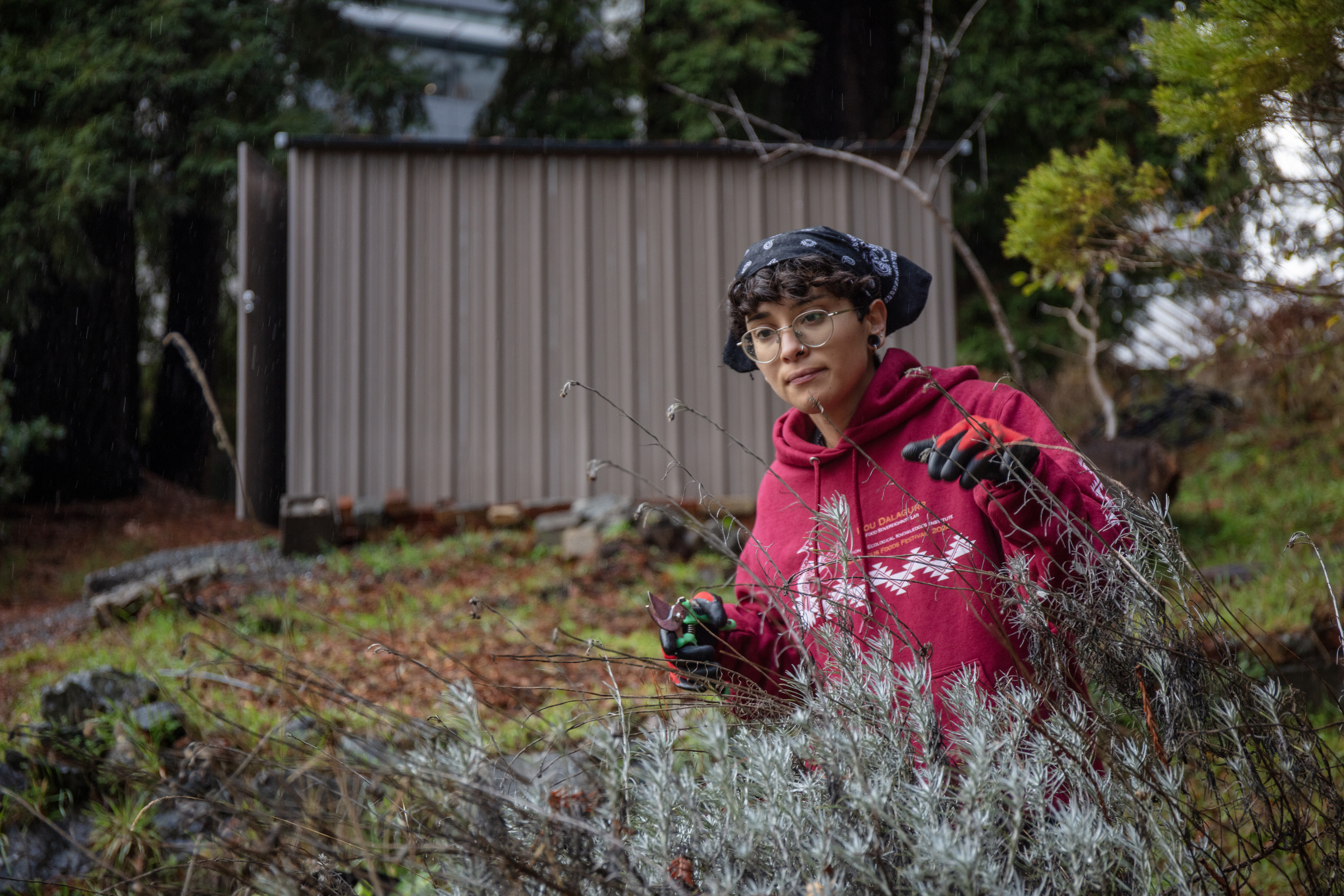
The lab has hosted Indigenous food festivals, seed and plant exchanges, a program on the restoration of kelp forests, and workshops on tuna canning, salve making, rose hip processing, and more. In addition to the science lab, there’s a demonstration kitchen, an Indigenous garden, and a small forest, which is managed with input from a community advisory committee.
“It’s really a space that elevates Indigenous science and traditional ecological knowledge and provides hands-on learning opportunities,” says Cutcha Risling Baldy, co-director of the food sovereignty lab and associate professor of Native American Studies at Cal Poly Humboldt.
“When students are able to engage with Indigenous peoples, not just as something to be studied but, instead, people who have incredible scientific knowledge, historical knowledge, ongoing knowledge of this place, it expands how they understand their own approach to their education,” Risling Baldy says.
There’s a lot to learn from Indigenous land-management practices, especially as climate change accelerates, says Kaitlin Reed, co-director of Rou Dalagurr and associate professor of Native American Studies at Cal Poly Humboldt.
Indigenous people long used fire as a tool to manage forests in the region, Reed says. Many of the plants respond to fire in a positive way: It helps them grow bigger and stronger and be less vulnerable to damage. But colonization put an end to traditional forest management.
“The state of California enacts fire-suppression policies,” she says. “Now that our forests haven’t been tended or taken care of for upwards of 150 to 160 years, our forests are very sick.”
The food sovereignty lab grew out of a student project in one of Risling Baldy’s classes designed to engage students, the tribal community, and other community members. The students raised $250,000 in three months to remodel the lab space. Construction costs went up to $485,000, and they continued to seek grants and donations. Now they are $19,000 away from paying for the cost of the renovation.
Last month, Risling Baldy and Reed were honored with James Irvine Foundation Leadership Awards. The awards came with a $350,000 grant for Rou Dalagurr.
Below, Jaime Lara prunes a sage bush in the Indigenous garden.