America’s Most Polarizing Big Donor Looks Back—and Ahead to His Legacy

By Caroline Preston
Contributor
May 15, 2011 | Read Time: 8 minutes
New York
In 1979 George Soros was rushing around the streets of London with a pressing worry: He’d committed to a large number of government bonds without lining up the necessary capital. The deal was causing him a lot of stress—far too much stress, he felt, than could be justified by the pursuit of money for money’s sake. Mr. Soros decided then to put his fortune to charitable use.
And so he has. Mr. Soros, the 80-year-old hedge-fund manager, has given $8-billion through a network of foundations that make most other attempts at philanthropy seem timid by comparison.
His money has paid for Xerox machines that helped spread dissident literature in Soviet-era Hungary, training for Burmese journalists who caught on camera the military dictatorship’s 2007 crackdown on protestors, and advocacy to rethink how America punishes drug offenders.
Along the way, he’s made more enemies than perhaps any other major philanthropist.
Now Mr. Soros is facing the prospect of what will happen to the Open Society Foundations when he is gone. He is still an active leader. He meets the organization’s president of 18 years, Aryeh Neier, once or twice a week for lunch and sometimes talks to him several times a day by phone. (They do not exchange e-mails.) Mr. Soros frequently visits politicians, activists, and grantees overseas to advance his philanthropic work. One current preoccupation: helping the West African country of Guinea successfully transition to democracy.
But Mr. Neier is stepping down in April of next year and, in a new leader, Mr. Soros says he wants more than a foundation president.
“In looking for a replacement for him, I’m looking for someone who is also potentially a replacement for me,” he said during an interview this month in his Upper East Side apartment. “It will undoubtedly be a new era.”
Innovative Spirit
One big question facing the foundation is whether it can maintain the innovative, and often anti-establishment, spirit that even critics say has characterized its work.
“One thing about Soros is that he really doesn’t give a damn what people say,” says William Schambra, director of the Hudson Institute’s Bradley Center for Philanthropy and Civic Renewal, a conservative-leaning think tank in Washington (and a regular contributor to The Chronicle’s Opinion section).
“The crippling deficiency of most philanthropic leaders is that they suffer from the herd mentality—nobody gets out ahead of anybody else, nobody departs from the orthodox view or experiments with radically new approaches. I’m critical of Soros, but to his credit, he gets this right.”
No one is more concerned about the loss of entrepreneurialism in charitable giving than Mr. Soros, as he details in an introduction to a new book, The Philanthropy of George Soros: Building Open Societies, published this month by Public Affairs.
Mr. Neier and others are less worried, noting that Open Society’s younger employees share his appetite for risk taking.
“For now and the foreseeable future, I don’t think that quality is in danger,” says Diana Morris, acting director of Open Society’s U.S. programs.
And any transition may be less of a shock than Mr. Soros cares to admit, because the foundation network has over the years developed into something of a bureaucracy of the sort he’s always disliked.
“He’s very self-conscious about it,” says Gara LaMarche, a former vice president at Open Society who now leads the Atlantic Philanthropies.
Mr. Soros’s money supports a network of more than 40 offices and independent foundations worldwide, which awarded $927-million last year.
Still, it’s hard to imagine any successor playing the role of statesman like Mr. Soros has tried to do.
In Guinea, for example, Mr. Soros is working directly with the country’s president to try to fight corruption and solve other ills. Mr. Neier calls this Mr. Soros’s “freewheeling approach.”
‘Filling a Niche’
What the Open Society network will look like when he’s gone is not a question that Mr. Soros once thought he’d have to contemplate. He’d long intended for his foundation to blink out of existence upon his death. But in recent years, he says, he’s come to view that as a selfish act. He says he doesn’t want to pull the rug out from under people working on causes that he considers critical.
“The foundation is filling a niche—a niche I think will need to be filled after my lifetime—and that is to provide support to civil society in monitoring and holding governments accountable,” says Mr. Soros. (That said, he doesn’t envision the foundation being around forever. “Perpetuity is too long,” he says with a smile.)
He also says he can’t give away his money fast enough. With Forbes pegging Mr. Soros’s net worth at $14.5-billion, it’s hard to imagine he’s wrong. But he says he will try to donate as much as he can during his lifetime, so long as he sees the right opportunities.
Last September, his foundation awarded a $100-million, 10-year grant to Human Rights Watch to help the organization expand its global presence.
Next month, Harlem Children’s Zone, the much-praised education group, will announce a grant of $50-million from the Open Society Foundations toward its plan to build a $400-million endowment. Mr. Soros was the first donor to make a big grant to the organization.
The fund also recently made two $5-million grants to institutions in St. Petersburg, Russia.
“A lot of people are looking for some large handouts, and I’m ready to move in that direction,” says Mr. Soros. “But it’s not a question of money, it’s a question of ideas.”
Mr. Soros was born in Hungary to a Jewish family who lived through the German occupation of World War II thanks to false identification papers secured by Mr. Soros’s father. At 26, Mr. Soros immigrated to the United States.
In person, he comes across as serious and reflective.
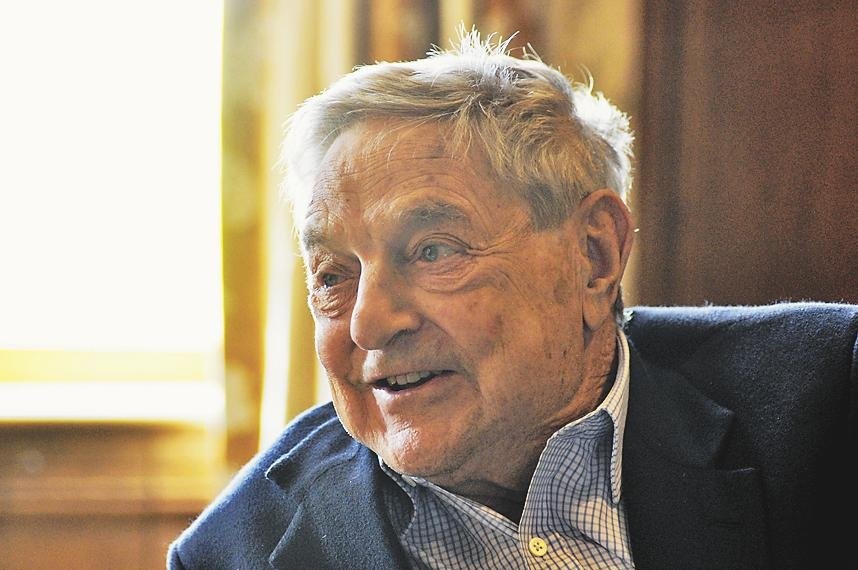
Grumpy about sitting for a photograph for The Chronicle, he warms when talking about his philanthropy. He isn’t touchy and clearly enjoys being challenged.
In his thick accent, he professes an ambivalence about many aspects of philanthropy, chief among them, its ability to reduce beneficiaries to supplicants who tell donors what they want to hear—before turning around and doing what they wanted to do in the first place.
Geoffrey Canada, president of Harlem Children’s Zone, likes to tell the story of his first meeting with Mr. Soros in the mid-1990s.
Then a leader of the Beacon School, in Harlem, Mr. Canada was expecting a phalanx of SUV’s; instead, he spied a lone white man walking up 144th Street in the predominately black neighborhood and figured it had to be the famed financial speculator.
At the time, Mr. Soros was trying to get to the bottom of the ties among poverty, education, and drugs. He bounced questions off the schoolchildren, like “Why do some kids decide to do drugs?” and “Why did you decide not to?”
“This was a guy in search of answers,” says Mr. Canada, who also serves as an Open Society trustee.
Independent Streak
Although his foundation often works on projects with other donors, Mr. Soros remains an individualist who deliberately sets himself apart from other philanthropists.
Take his decision not to sign the “Giving Pledge,” Bill and Melinda Gates and Warren Buffett’s effort to persuade other wealthy people to publicly commit at least half their money to charity.
Mr. Soros says he hasn’t signed because he believes it matters more how wealthy people give their money away, not whether they do it.
But the Giving Pledge is, after all, about rich people getting together to share lessons learned from their philanthropy.
When pressed, Mr. Soros concedes his decision is also due to “a personal quirk of mine,” an independent streak. “I don’t like to be put into classes,” the philanthropist says.
It’s not the kind of decision that surprises people who know him.
“He redefines independence,” says Leon Botstein, president of Bard College and an Open Society trustee. “He would make a great monarch, a great explorer.”
Political Activism
While Mr. Soros is his foundation’s biggest asset, he has also at times been a liability.
His 2004 decision to pour $27.5-million in personal contributions into political-action committees to unseat President George W. Bush, solidified his reputation in the conservative news-media as a left-wing billionaire trying to force a progressive agenda down the public’s throats.
That has complicated the work of the foundation, a fact that Mr. Soros is the first to admit.
“It’s a serious handicap,” he says.
But Mr. Soros’s view is that the “cause” he’s trying to advance—be it fighting to improve prison conditions in the former Soviet Union or trying to defeat Mr. Bush—takes precedence over his or the foundation’s reputation.
“I am willing to endanger my own standing and the standing of the foundations that I support for the sake of the objectives,” he says.
Others say the consequences of Mr. Soros’s actions have been harmful.
“His political activism has pushed American philanthropists in general closer to the edge of outright political engagement, and I don’t think that’s a good thing,” says Mr. Schambra of the Bradley Center.
‘A Learning Experience’
In general, Mr. Soros seems a man of few, if any, regrets.
He can be somewhat critical of his philanthropy; he remarks on the nearly billion dollars he spent in the former Soviet Union, to little effect, as being particularly disappointing.
But asked what he’d change if he had that $8-billion to spend all over again, he says: “I probably wouldn’t do it differently, because it was a learning experience.”
Mr. Soros says that learning experience has been a deeply rewarding one, motivating him to continue making big, stressful, and wildly successful financial bets.
“We all look for something that we value more than our own life,” says Mr. Soros. “If we can find it, we are better off, we feel more satisfied.”