September 18, 2019 | Read Time: 6 minutes
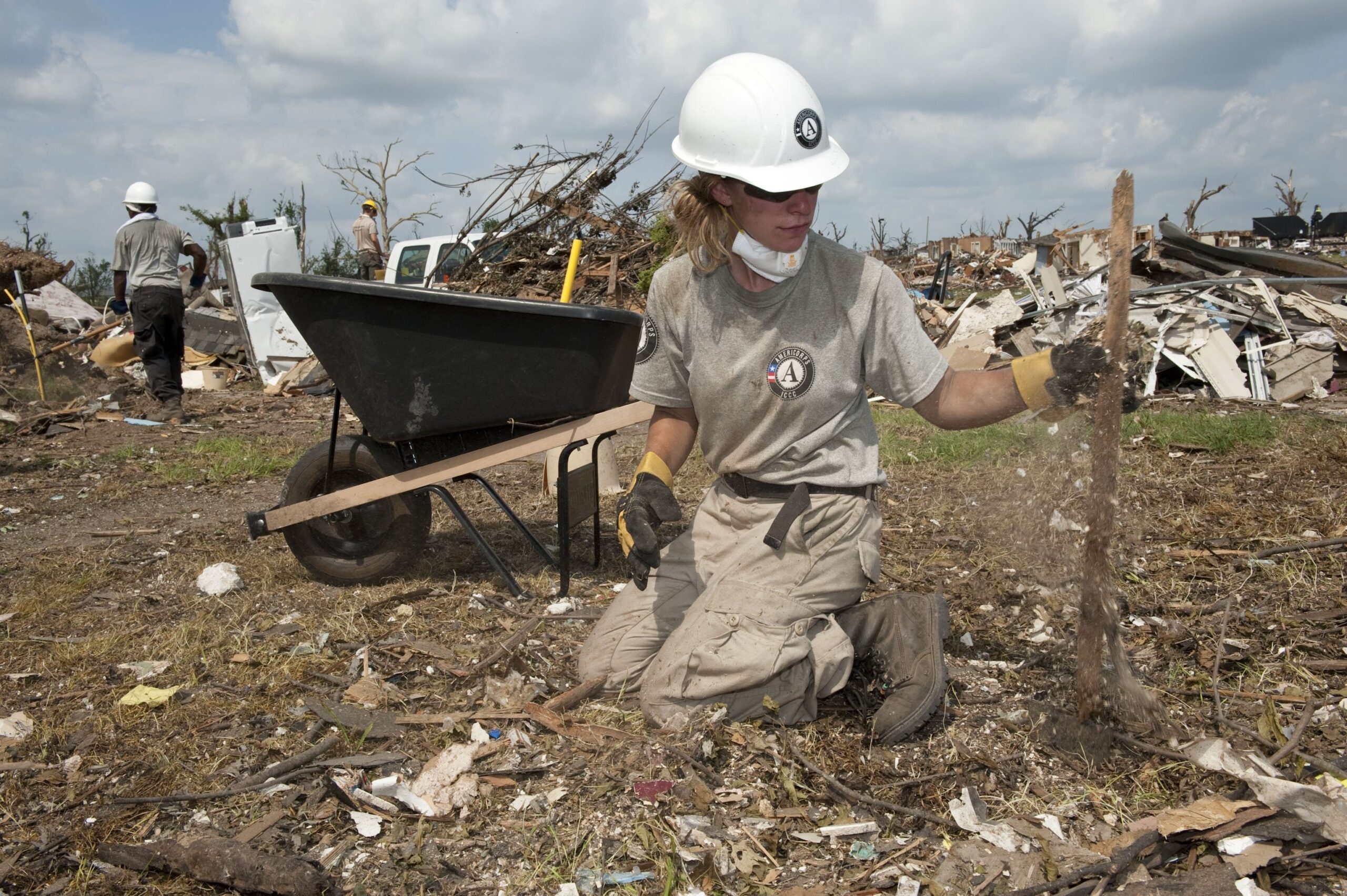
This month, AmeriCorps, the U.S. national service program, marks its 25th anniversary. Since President Clinton swore in the first participants, one million people have served. Over 5,000 organizations have used them to work on health care, education, homelessness, disaster relief, and many other issues.
Despite this record, the organization’s most notable accomplishment may be that it is still around at all. It was controversial when it was created, and Congress has repeatedly tried to eliminate the program, as has President Trump.
In 2020, not only is Trump likely to oppose national service but, so far, less than half of the Democratic candidates have embraced it. Only one — Elizabeth Warren – is in the top tier.
Contrast that with the 2008 election, when both John McCain and Barack Obama supported national service and participated in a high-profit national gathering to explain their plans.
Yet with the fraying of community ties becoming an issue in American politics, the time may be auspicious for reviving interest in AmeriCorps. But that will also require rethinking how AmeriCorps operates.
‘A Thousand Points of Light’
The idea of a program that would enlist young people in a variety of publicly useful tasks goes back at least to 19th-century writer, Edward Bellamy, who envisioned it as part of the utopia he described in his novel Looking Backward.
But AmeriCorps addressed a more immediate question: what to do about the seemingly growing hesitance of baby boomers and their children to join voluntary associations and participate in civic life?
In response, President George H.W. Bush, in his 1989 inaugural address, pledged to encourage “a thousand points of light,” his phrase for the nation’s community organizations “that are spread like stars … doing good.”
With support from Sen. Edward Kennedy, a Massachusetts Democrat, the Bush administration established a commission to look at what — besides recognizing exemplary organizations — the federal government could do.
After holding hearings and making exploratory grants to test ideas for a national service program, the commission submitted its report at the beginning of the Clinton administration, which shortly afterward submitted legislation to Congress to create AmeriCorps. (I was a member of the commission and later directed the agency that ran AmeriCorps.)
Concerns About Costs
The National and Community Service Trust Act of 1993 passed on essentially a party-line vote.
Republicans objected to the program’s cost as well as to the principle of “paying people to volunteer.” (AmeriCorps members were to receive a stipend for living expenses and an award on completing their service to help pay for past or future educational expenses.)
Groups representing veterans sought to ensure the program’s benefits were not as generous as those provided to former soldiers. Though more muted, some Democrats also worried that AmeriCorps members could be used to replace professional teachers and other trained service providers.
Determined efforts by Harris Wofford, the second head of the Corporation for National and Community Service (which oversees AmeriCorps), broadened the program’s political support. President George W. Bush also embraced it, first as a way of helping faith-based and community groups and after the terrorist attacks of 9/11 to assist “first responders” in national emergencies.
In 2009, as a tribute to an ailing Senator Kennedy, many Republicans joined Democrats to expand AmeriCorps, which had by then also developed influential grassroots backing among the many organizations with which it worked.
Small Numbers, Big Impact
Still, the program remains small. The 2009 bill authorized an increase to 250,000 members, but congressional appropriations have allowed only 75,000 annually to serve.
About half do so part-time, limiting their accomplishments and the impact AmeriCorps service has on them. (Surveys of past participants show they are more likely to vote and volunteer than their peers, but because they chose to enroll in the program, they may have been more inclined to do so in the first place.)
Although nearly two-thirds of the public say they support national service, AmeriCorps is far less well-known than the much smaller Peace Corps.
The public is also divided over whether to make it mandatory or leave it voluntary. Nearly 60 percent of adults under age 30 — those most likely to be affected — are against requiring a year of military or civilian service.
Healing Divisions
Yet as when AmeriCorps was developed, questions are again being raised about the health of American society, and especially the loss of civility in public affairs.
Sen. Mike Lee, a Utah Republican, for example, has been leading a multiyear study of the consequences of declining “social capital,” the relationships people form through their involvement in civic associations and other groups.
Another Republican, Sen. Ben Sasse of Nebraska, has called for refocusing American politics on the “rebirth” of community life, including by creating new organizations to do so.
A congressionally established Commission on Military, National, and Public Service is expected to finish its work next year and issue a final report on how to “inspire” more Americans to serve.
As AmeriCorps is currently configured, however, its ability to respond to these concerns is limited.
Currently, the program operates like other federal grant programs: Organizations compete against each other for support, and those that win can use the money they receive to recruit and pay national-service participants, as well as cover part of their own costs. At least in theory (if not always in practice), this has the advantage of identifying high-quality organizations that can engage AmeriCorps members productively and manage government money responsibly.
But it also curtails the number of groups involved and may compel those who want to serve to leave their communities to join groups with which they have had little previous (or possibly, future) affiliation.
An alternative version of the program could start by accepting applications directly from people who want to serve. After a lottery or other selection process, those chosen — a number determined by what Congress is willing to appropriate — could join any nonprofit that would put them to good use and met minimal standards (such as getting United Way support). They would receive their stipends from government (and not, as now, through the organization at which they serve).
Some AmeriCorps members might make bad decisions and have a poor service experience as a result. But others would benefit from the larger array of opportunities they had, including with groups that were meaningful to them and to which they could remain attached.
This individualized model builds on the strengths of America’s nonprofit sphere: its variety and roots in local communities.
Adding it to the existing program might not only make national service more popular but it might also do a better job of shaping better citizens and building stronger communities.
Leslie Lenkowsky is an Indiana University expert on philanthropy and public affairs and a regular contributor to these pages. He served as CEO of the Corporation for National and Community Service from 2001 to 2003.