November 13, 1997 | Read Time: 13 minutes
Billionaire financier’s approach, in which shareholders pick charities, is the model for proposed legislation
Warren E. Buffett, the Omaha billionaire, has long been a role model for anybody who wants to build a successful investment strategy. But now Congress is eyeing him as a model for the nation’s corporate grant makers — and is considering whether to force all public companies to follow his lead.
For the past 16 years, Mr. Buffett has given shareholders in his Berkshire Hathaway investment company the power to pick virtually all the
recipients of the corporation’s donations. The iconoclastic Mr. Buffett, who is worth an estimated $21-billion, says he doesn’t approve of the approach followed by most companies, which leave grant-making decisions in the hands of top managers and other employees.
The Buffett approach has so won over Rep. Paul Gillmor, an Ohio Republican, that he wants Congress to require all public companies to give shareholders a major say in deciding which charities should benefit from a corporation’s largesse. In a companion measure, he has also proposed that companies be required to disclose their major donations to shareholders — something that Berkshire Hathaway and many other major corporations now fail to do.
“It’s the shareholders that own the companies, and it’s their money,” says Representative Gillmor, who says he worries that too many big companies make grants that are not aligned with the charitable interests of their stockholders.
Mr. Buffett’s approach has won wide praise from his own stockholders — especially those who say that being given a voice in Berkshire Hathaway’s grant making has led them to think more deeply about philanthropy, and often to give more to charity than they did before.
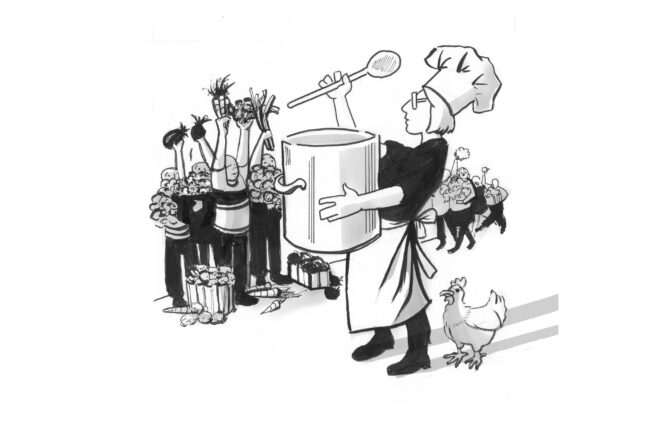
But many business leaders — and some non-profit officials — say it makes little sense to put new legal requirements on corporate grant makers. Some go so far as to predict that many companies would stop making charitable donations altogether if Congress forced them to give shareholders a say in philanthropic decisions.
Company leaders say they fear their grant making would be less effective if shareholders started scattering money to charities of all kinds — even those that might have missions that conflict with corporate goals. What’s more, they say, the cost of getting shareholders involved would make it far too expensive to support charity.
“It would be just completely impractical,” says Timothy J. McClimon, executive director of the AT&T Foundation. “We have millions of shareholders and make thousands of grants. It would be an administrative nightmare, a huge expense, and I think it would probably just make us give up making charitable contributions.”
Mr. McClimon says shareholders should view corporate giving just like any other management issue. “If you don’t like the management,” he says, “get rid of it.”
The Securities and Exchange Commission, the federal agency that monitors corporate transactions, is now studying the feasibility of Mr. Gillmor’s legislation and is expected to make a report to Congress this month that analyzes the proposals’ costs and benefits.
Congress is unlikely to vote on the corporate-giving bills this year. But the legislation, which the Congressman says he will promote again next year, has already stirred up a sharp debate over the role that stockholders should play in charitable giving at the country’s major corporations.
Even though Mr. Gillmor modeled the shareholder-involvement bill on Berkshire Hathaway’s approach, his legislation, H.R. 945, does not mention Mr. Buffett or his company by name. The bill says only that stockholders must be given the chance to participate in the designation of charitable contributions “on a basis proportional to the number of shares owned or controlled by such shareholder.”
Mr. Buffett, who is ranked by Forbes magazine as the nation’s second wealthiest man after Microsoft’s Bill Gates, has said he does not want to comment on Mr. Gillmor’s proposals, at least not until the Securities and Exchange Commission releases its report.
His rationale for turning corporate philanthropy on its head is no secret, however. In 1981, when he announced the plan to stockholders, he wrote to them, “What bothers me about ordinary corporate practice is the way gifts tend to be made based more on who does the asking and how corporate peers are responding than on an objective evaluation of the donee’s activities.”
”A common result,” he added, “is the use of the stockholder’s money to implement the charitable inclinations of the corporate manager, who usually is heavily influenced by specific social pressures on him.”
Mr. Buffett concluded that Berkshire Hathaway needed a different method of giving than other companies used.
“Just as I wouldn’t want you to implement your personal judgments by writing checks on my bank account for charities of your choice, I feel it inappropriate to write checks on your corporate ‘bank account’ for charities of my choice,” he wrote. “Your charitable preferences are as good as mine.”
Berkshire Hathaway has distributed more than $97-million to charity since the plan took effect. Its essentials have not changed in the 16 years it has operated.
People and institutions that in their own names own “Class A” Berkshire Hathaway stock, now valued at nearly $45,000 per share, are allowed to designate one to three charities or private foundations to receive $16 this year for each share of Berkshire Hathaway stock that they own.
The company then makes donations to the designated organizations by handing over cash or stock that the investment company holds and telling the organization which shareholder designated it — except when the shareholder wants to stay anonymous.
Since the money comes from the investment company, it gets to claim the charitable-contribution deductions, not the shareholders. However, the shareholders often receive a thank-you letter from the recipients of the donations.
Some charities have received a double benefit from Berkshire Hathaway’s program. Girls Incorporated of Omaha has been on both the receiving and giving end.
The charity takes in up to $500 a year from five or so shareholder gifts. But because an aunt of Mr. Buffett’s once gave Girls Incorporated three shares of Berkshire Hathaway stock, now worth more than $130,000, the charity itself each year is able to designate a recipient of the investment firm’s donations.
This fall, Girls Incorporated will choose an Omaha group, the All Our Kids Foundation, to receive its entire gift of $48. The foundation helps young people, including members of Girls Incorporated.
Though the $48 is not a large sum, “it’s an investment in a program that invests in the future of our girls,” says Norma Deeb, executive director of Girls Incorporated of Omaha. “Giving back to those who have been supportive of us is very special.”
Other Berkshire Hathaway shareholders also appreciate being able to make their own choices about corporate giving. Richard Holland, a retired Omaha advertising executive and a long-time friend of Mr. Buffett’s, says that he and his wife have designated the University of Nebraska at Omaha and Opera Omaha, among other non-profit organizations, for company donations.
Mr. Holland observed that some Berkshire Hathaway shareholders — including those with huge numbers of shares — have gotten an introduction to philanthropy courtesy of Mr. Buffett’s program.
“It’s kind of funny,” says Mr. Holland. “Some of the shareholders are people who never have been or had to be very charitable. And suddenly there’s somebody who says to them, ‘Well, you’ve got $50,000 you’ve got to give away!’ ”
If the Berkshire Hathaway program is a sign of what would happen nationwide if shareholders had more control over giving, it is clear that many of the causes that now have trouble winning business support would find their financial situations improved.
For example, Berkshire Hathaway’s 1993 annual report, which described the program’s charity recipients by category, lists places of worship as among the most-selected groups. “The contributions programs of publicly held companies almost never allow gifts to churches and synagogues, yet clearly these institutions are what many shareholders would like to support,” Mr. Buffett wrote in an accompanying letter to shareholders.
Berkshire Hathaway gifts also go to controversial groups and to organizations with competing missions. In 1993, 130 shareholder donations were sent to groups that support making abortions readily available for women, and 30 went to organizations (other than churches) that discourage or are opposed to abortion.
Mr. Buffett, who owns more than 40 per cent of Berkshire Hathaway stock, gives almost all of his corporate designations to his own Buffett Foundation, which has more than $22-million in assets.
Mr. Buffett has said that he and his wife will give the Buffett Foundation all of their company stock upon their deaths. That would make the fund the nation’s largest — outpacing the Ford Foundation, which has about $9.2-billion in assets.
Few people criticize the way the Berkshire Hathaway plan works for Mr. Buffett and his shareholders. But opinion is sharply divided about whether it could be expanded nationwide successfully.
Supporters of Representative Gillmor’s bill on shareholder designation say the legislation would do much to shore up problems in corporate giving.
Terrence Scanlon, president of the Capital Research Center, a philanthropy watchdog group that has long criticized companies for supporting organizations with “anti-business agendas,” says: “Warren Buffett’s policies of letting the shareholders decide which charities to support are an excellent model. Shareholders should have more control over the philanthropic activities of a company.”
Milton Friedman, the Nobel-laureate economist, also endorses the Gillmor bill. Mr. Friedman thinks that corporations should not be allowed to get tax deductions for charitable contributions or, for that matter, pay income taxes at all. But until that is changed, Mr. Friedman believes that shareholders benefit from a corporation’s gifts to charity only if the gifts go to organizations that stock owners support.
“The Berkshire Hathaway approach is a way of offsetting the defects in the tax system,” says Mr. Friedman. “I do not approve of Congress in general interfering with private activity, but this is a question of Congress having made a mistake and permitting the deductions in the first place.”
Many other influential business leaders strenuously disagree with the idea that the government should set corporate grant-making standards.
“By all means, let us publicize Warren Buffett’s plan as widely as possible, and let companies adopt it if such an approach is appropriate for them,” says William E. Simon, who was Secretary of the Treasury in the Nixon and Ford Administrations and is president of the John M. Olin Foundation. “But let’s not create another mandate from the federal government.”
William H. Gates, a Berkshire Hathaway shareholder who is the father of Bill Gates, commends Mr. Buffett’s approach and himself designates United Way as recipient of Berkshire Hathaway gifts.
But the elder Mr. Gates says the federal government should not require other companies to follow suit. “I am not sure that the notion that the company’s money belongs to the shareholders is the only reasonable analysis of the play-off between the rights of shareholders and the rights of management,” says Mr. Gates, a lawyer who oversees his son’s charitable foundation.
Perhaps nowhere is opposition to Mr. Gillmor’s proposal more heated than in the offices of the nation’s corporate grant makers.
Don M. Decker, vice-president of corporate services at the Dana Corporation, a Toledo, Ohio, manufacturing company, says: “I don’t understand why anyone would propose legislation that makes it more difficult for corporations to respond to community needs.
“One of the criticisms that government, among others, has laid at the corporate doorstep is that we are not responsive enough when it comes to charitable contributions. And then something like this comes along which makes it even more difficult to be responsive.”
In a letter to the Securities and Exchange Commission, Dorothy S. Ridings, president of the Council on Foundations, wrote that corporate members of her organization were concerned that “shareholders do not have the necessary knowledge and expertise in contribution matters to effectively make such decisions in a way that would continue to benefit both the company and the community.”
Gabriella Coleman, president of the Prudential Foundation, the charitable-giving arm of the Prudential Insurance Company of America, says: “The approach being suggested would benefit those charities that do the best job of advertising themselves. That’s not always the same organization that’s doing the grassroots work that needs to be done in our communities.”
Some grant makers worry that Mr. Gillmor’s legislation would undermine corporate efforts to focus on a particular cause — something more and more companies have been doing in recent years as they try to find ways to streamline their philanthropy to be more effective. A computer company, for example, could be thwarted in its attempts to promote education unless shareholders designated most of their money for such projects.
“If a company’s grants are spread out all over, with no strategy in place for where the giving is directed, the company will have a problem evaluating the impact of its grants,” says Dale Mitchell, executive director of the Delaware Valley Grantmakers in Philadelphia.
Congressman Gillmor says he understands such concerns and is willing to modify the legislation to avoid watering down corporate grant-making strategies unduly. For example, he says he would not expect a company with manufacturing plants in just two cities to be required by shareholders to give all its money outside the places where the plants are located. “There are some bugs to be worked out,” he concedes.
Some critics of the Gillmor proposal are worried not only about the effect on grant making but also about the cost of administering it.
Berkshire Hathaway “Class A” shareholders now number about 9,000, most of whom hang on to the stock for many years, making it relatively easy to keep track of who is involved in corporate-giving decisions. But that would not necessarily be the case at corporations with much larger numbers of shareholders, say many business executives.
The Gillmor plan also faces questions about who would be defined as a shareholder, says Robert G. Hagstrom, Jr., author of The Warren Buffett Way, an examination of Mr. Buffett’s investment strategy.
“When mutual funds and pension plans own the stock, there may be some confusion over who is the ultimate owner of the security to make the decision to give,” says Mr. Hagstrom, manager of a mutual fund that follows Mr. Buffett’s investment approach.
But, Mr. Hagstrom adds: ”What Warren has done is just really quite phenomenal. And it would be great to see it replicated in more ways. Is it feasible? Of course it is. Can it be done? Of course it can.”
Yet corporate grant makers in Mr. Gillmor’s home state are wary about the idea, according to Lynn Helbling Sirinek, executive director of the Donors Forum of Ohio.
Corporate donors do not want to bear greater burdens than they already do, she says. “Many of our corporate members,” she says, “feel that this is a solution looking for a problem.”