September 10, 1998 | Read Time: 7 minutes
Poverty and economic inequality in the United States are more pronounced now than at any time since the start of World War II. Meanwhile, charity is flourishing, and fighting hunger has become a national pastime.
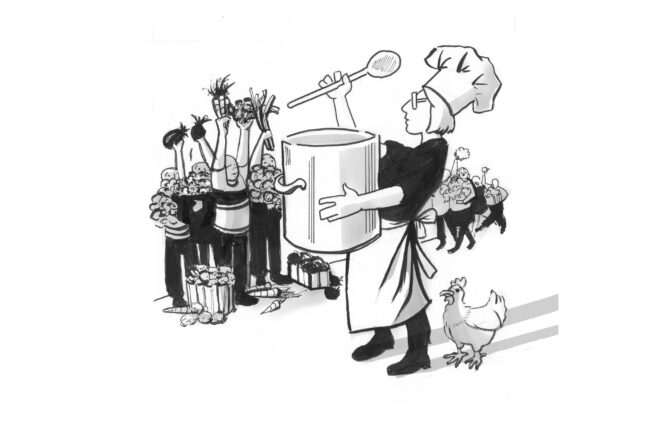
Over the course of the last two decades, tens of thousands of charitable emergency-food programs have opened their doors to help the hungry. Literally millions of Americans support those programs with contributions of food, money, time, and effort. People bring bags of rice and jars of peanut butter to collection points in the church sanctuary or the local library, or drop a can in the convenient barrel just outside the supermarket door. They stock the shelves or pack grocery bags at food pantries. They prepare and serve meals at soup kitchens and deliver sandwiches to encampments of homeless people. They organize canned-goods drives in their schools and Sunday schools, and send their youth groups and scout troops to help sort the proceeds at the food bank. They pick up leftovers from caterers and restaurants, from corporate dining rooms and campus cafeterias, and rush them in special thermal containers to soup kitchens and shelters. They “check out hunger” at their local supermarket counters and “dine out to help out” with their American Express cards. They “tee off against hunger” on their golf courses and “run against hunger” in their marathons. It is an outpouring of compassion, both organized and individual, that would be the envy of most societies in human history.
Unfortunately, this kindness comes with a price tag.
The growth of kindness and the intensification of poverty are intimately related. In one direction, the relationship is obvious. Visit nearly any soup kitchen or food pantry in America and you will find its staff and volunteers gearing up to cope with the sharp increases in need as the Personal Responsibility Act of 1996 — welfare “reform” — gradually takes effect. The cutbacks and reductions — along with declining real wages at the bottom of the jobs ladder and corporations’ growing reliance on layoffs and downsizing to increase profitability — are reducing people to destitution, sending them to the food lines, and causing the hunger to which kind-hearted people are responding.
It works the other way too, however, and that is less obvious. The resurgence of charity is at once a symptom and a cause of our society’s failure to face up to and deal with the erosion of equality. It is a symptom in that it stems, in part at least, from an abandonment of our hopes for the elimination of poverty. It signifies a retreat from the goals as well as the means that characterized the Great Society of the 1960s. It is symptomatic of a pervasive despair about actually solving problems that has turned us toward ways of managing them: damage control, rather than prevention.
More significantly, the proliferation of emergency-food programs contributes to our society’s failure to grapple in meaningful ways with poverty. This massive charitable endeavor serves to relieve pressure for more fundamental solutions. It works pervasively on the cultural level by acting as a sort of “moral safety valve.” Hunger makes us uncomfortable, especially in the context of visible abundance and pervasive waste of food. The emergency-food system relieves our discomfort by creating the illusion of effective action and offering us myriad ways of participating in it. It creates a culture of charity that normalizes destitution and legitimizes personal generosity as a response to major social and economic dislocation. It widens instead of narrows the gulf between the haves and have-nots by reproducing on a daily basis the socially desirable role of giver, and the stigmatized role of receiver. It promotes the substitution of gifts for rights.
The proliferation of charity operates at the political level, as well, by making it easier for government to shed its responsibility for the poor, reassuring policy makers and voters alike that no one will starve. By harnessing a wealth of volunteer effort and donations, it makes private programs appear to be cheaper and more cost-effective than government ones, thus reinforcing an ideology of volunteerism that obscures the fundamental destruction of rights. And because food programs are logistically demanding, their maintenance absorbs the attention and energy of many of the people most concerned about the poor, distracting them from the larger political issues. It is not an accident that government food assistance is eroded as our charitable responses to hunger multiply.
If emergency food were only a kindly add-on to the adequate and secure safety net of public provision that any industrial or post-industrial society needs, it would not be a problem. As a supplement to a robust array of constructive public provisions, emergency food would clearly be a net social gain, and we could all rejoice in the energy and compassion of the volunteers and the generosity of donors that make possible a kinder, gentler society.
If, however, charity food is substituted for adequate government provision, both in the benefits obtained by individuals and at the overall level of social policy, then it is time to take a closer look at the costs of kindness. It is time to understand the larger dynam ic by which we have allowed ourselves to be diverted from the task of eliminating hunger and reducing inequality.
And if such an examination reveals that emergency-food programs are inadvertently contributing to the creation of hunger and the intensification of inequality, then what can be done?
First, antipoverty advocates and emergency-food providers need to continue the work, already begun, of harnessing the existing network of kitchens and pantries, and the vast reservoir of compassion upon which it draws, toward more fundamental political change. There are obstacles. Some of those who support the current emergency food system through contributions of time, money, or food are people who want to avoid politics, or people who would not endorse a larger role for government or a redistribution of wealth. Many, however, would welcome a more adequate public safety net and an end to the steady, wearying escalation of demand for their gifts and services.
And because emergency food providers are in daily contact with the complex reality of need that politicians tend to oversimplify with a convenient rhetoric of laziness, they are especially well-positioned to educate people to see the bigger problems. They might begin with their own clients, volunteers, and donors, and move on to the corporate leaders and politicians who point with pride toward the flowering of volunteerism.
Second, emergency-food programs can take on the challenging task of transforming themselves from charitable to cooperative endeavors by sharing both the work and the decision-making with clients. Many emergency-food programs have taken the first step in this direction by inviting clients into the volunteer role, but there is a long way to go to move beyond the givers-versus-receivers dichotomy that underlies the whole notion of charity. Ideally, food programs might evolve into centers of community activity where people could meet and interact across the gulf of social class, and the divisions of race and ethnicity, as neighbors and fellow citizens to identify and pursue a common agenda.
Finally, emergency-food programs need to move beyond the hunger trap. Hunger is an emotionally compelling label that helps to mobilize compassion and secure much-needed resources. But it is also an oversimplification that diverts us from the underlying challenges of poverty and inequality. In a nation where farm policy revolves around the control of surpluses, where the Department of Agriculture estimates that a quarter of each year’s agricultural output goes to waste, and where the average citizen is trying to eat less and lose weight, hunger seems appealingly easy to solve.
But neither two-thirds of a century of public food-assistance programs nor two decades of expansion of private charitable projects have solved the problem, because hunger cannot be eliminated unless we address the broader problems of poverty — and poverty, in a rich society, is an inherently relative phenomenon. If we aim only to eliminate hunger from this overwhelmingly wealthy society, we are aiming too low. We need to redirect the energy, inventiveness, and good will that have made the emergency food system such a remarkable success story into an effective social movement for a just and inclusive society, one in which we all have a place at the table.
Janet Poppendieck is an associate professor of sociology and assistant dean for academic affairs and student opportunities in the School of Arts and Sciences at Hunter College of the City University of New York. This piece is adapted from her latest book, Sweet Charity: Emergency Food and the End of Entitlement, published by Viking last month.