
Funders Are Losing the Race to Govern AI. Here’s How They Can Catch Up.
Communities battling data centers and AI surveillance, have little chance of outlasting Big Tech’s political machine without philanthropy's help.

July 9, 2026 | Read Time: 6 minutes
County Board of Supervisors meetings rarely make national news. Yet increasingly, some of the most consequential decisions of the AI era are happening in these rooms.
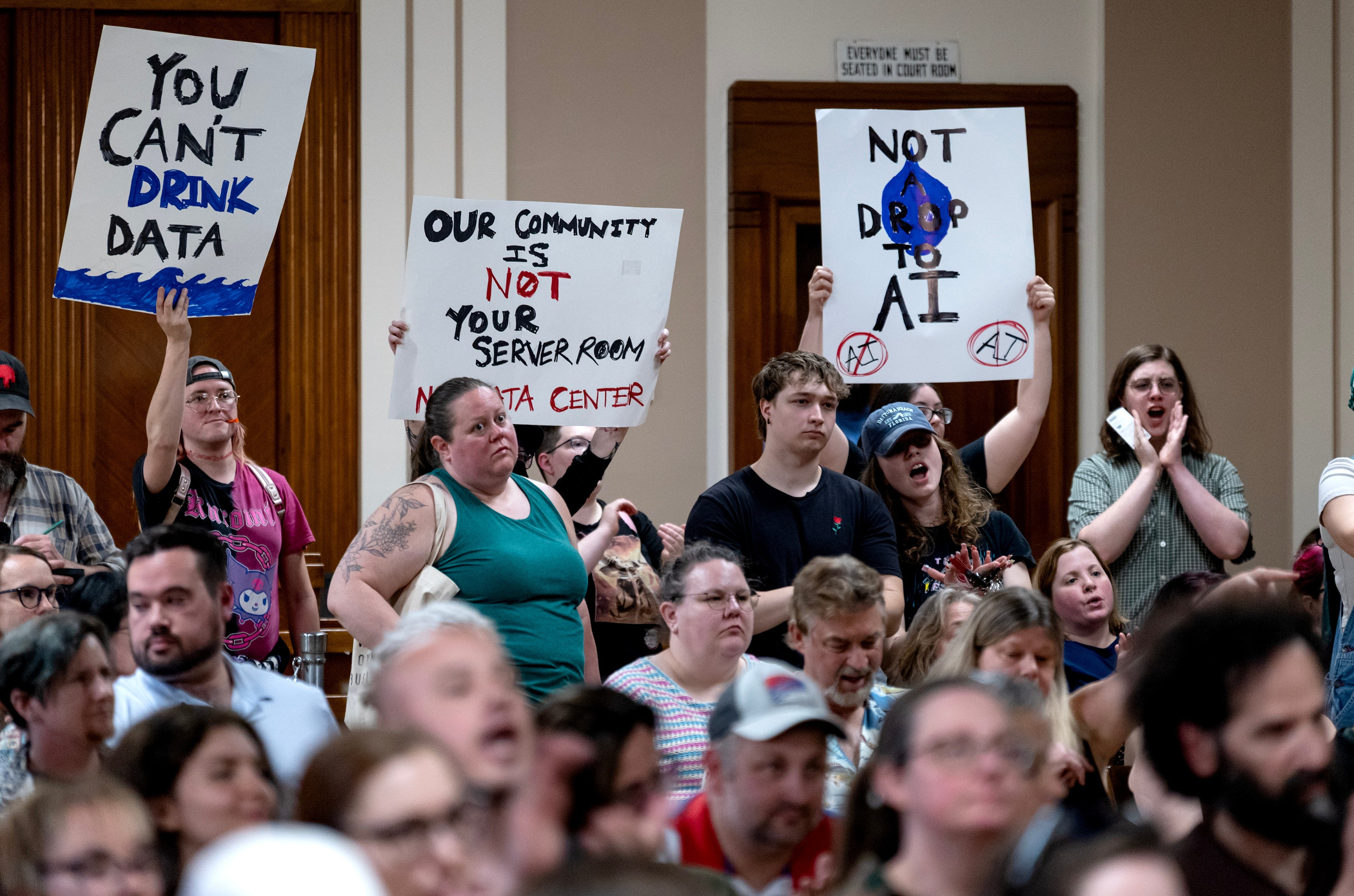
Consider Pima County, Ariz. Last year, residents mobilized to challenge the construction of a billion-dollar data center development that would have reshaped local water usage and energy demand in an already water-stressed desert region. Around the same time, the county rejected a $45 million contract extension for Axon Technologies, the surveillance giant best known for its body-worn cameras and AI-enabled policing tools.
Rather than isolated incidents, these were early signs of a much larger fight over who controls the infrastructure and enforcement systems of modern government.
Many of the most significant battles are taking place far outside of Washington, before federal oversight can catch up. They involve local permitting fights, surveillance litigation, procurement decisions, and state-level political contests that determine how AI systems are built, adopted, and normalized.
At its heart, AI is not merely a technology challenge — it is a struggle over power, infrastructure, and rights. Yet philanthropy continues to misdiagnose it as a technical transition and fund accordingly. Meanwhile, the political and material foundations of our future are being laid elsewhere. While foundations debate how to engage with AI, major tech companies are investing aggressively to shape the rules that will govern the technology. Their influence is being embedded in the institutions that decide who is surveilled, who is displaced, and who bears the environmental costs of digital infrastructure, all while affected communities are shut out of the conversation.
3 Ways Funders Get It Wrong
The following three patterns reveal the gap between where philanthropy is investing and where power is actually being built.
Accepting the myth of inevitability. We are told that AI will expand rapidly, that data centers will be built where they are sited, that policing will continue to expand surveillance, and that our role is simply to manage the consequences.
This narrative is powerful. It discourages resistance to an undemocratic AI future and narrows the field of imagination.
But communities across the country are proving that these outcomes are not predetermined. Counties are rejecting surveillance contracts. Data center moratoriums are being imposed. Legislatures are debating limits on policing technologies. Courts are confronting constitutional questions that will define digital rights.
In 2025, an estimated $156 billion in data center projects were blocked or delayed by communities that mobilized against them, according to Data Center Watch. The same is true in the criminal legal system, where attorneys backed by a small network of specialized legal nonprofits are beginning to interrupt the quiet normalization of AI tools before they become standard practice.
Take what recently happened in California when Axon quietly rolled out an AI tool called Draft One, which generates police reports from body-camera footage. Police departments used it without disclosure, and the reports gave no indication they were AI-generated. Defense lawyers across the state started asking questions. Their investigation revealed a system that did not preserve officer prompts or later edits, making meaningful scrutiny nearly impossible. Working with other defense attorneys and legal organizations, they pushed for reforms and ultimately helped secure statewide legislation governing police use of AI.
If philanthropy accepts inevitability, it funds adaptation. If it rejects it, it funds the advocacy and legal work that allow these systems to be contested in courts and legislatures.
Defining AI’s harms too narrowly. We are not in the midst of a second dot-com boom. We are closer to the arrival of the printing press or steam engine, when new tools both created industries and reordered entire systems of power.
For frontline Black, Indigenous, and low-income communities, AI expansion is already concrete. It is a data center a mile from home, a kitchen faucet that runs dry, or an electric bill that has increased by as much as 267 percent in five years. It is a police officer stopping a teenager outside his parents’ home and already knowing his name and his friends’ names, not from prior contact but from the quiet accumulation of data.
These harms are the digital continuation of older forms of exclusion — from surveillance that deepens racialized policing to AI redlining that reshapes who bears environmental, economic, and public health risk.
Philanthropy often defines the problems caused by AI too narrowly to capture these lived realities. Within foundations, the focus has centered on data security, equitable access, adoption, and bias mitigation. Those are real issues. But they do not fully account for the harms people are already experiencing.
Rather than a separate issue, AI is reshaping every issue the sector funds, including the environment, jobs, the arts, democracy, and the criminal legal system.
Siloed funding forces affected communities to fight fragmented battles against opponents with integrated political strategies. Big Tech is not siloed. It is building a political machine around the AI industry, financing campaigns, research, and legal strategies that will shape how surveillance and digital infrastructure are governed.
Philanthropy may not match corporate spending dollar for dollar, but it can decide whether those facing the greatest harm have the support to shape what comes next or whether the architecture of power will be set elsewhere.
Overlooking where AI’s terms are being set. The stakes are clearest in two arenas: the expansion of government enforcement power and the creation of AI infrastructure. Together, they will shape the rights and material conditions of people’s lives — yet funding for neither matches what is at stake.
The first arena encompasses the court cases, oversight battles, and organizing campaigns that will determine how AI is used by police, prosecutors, immigration authorities, and others.
In the past, surveillance activities by such actors were constrained as much by cost and logistics as by legal doctrine. Today, pervasive tracking is cheap, automated, and largely invisible. Efforts to investigate, explain, and formally challenge these systems fall to local court-appointed defense lawyers and the thin national infrastructure of legal nonprofits that specialize in emerging law enforcement technologies. If they don’t have the resources to do this work, the legal boundaries around surveillance will harden before they are meaningfully tested.
The second arena involves fights over whether and where data centers and other AI infrastructure are built. Without well-resourced grassroots organizations that can engage with technical and regulatory systems, challenging these efforts will be far more difficult.
What is being built right now will reallocate power and reshape our rights, our resources, and the conditions of our daily lives. The question is not whether this transformation will occur but who will shape its terms and whether communities get sacrificed in the name of digital growth.
Big Tech is investing to ensure that it does. But philanthropy can support a more just future by funding the political fights, not just the technical ones; working across sectors, not in silos; and investing within currently contested arenas with clear-eyed recognition of the political machine being built in opposition.
The outcome is not inevitable. But it will reflect who showed up and who was willing to fund the fight.