February 21, 2010 | Read Time: 8 minutes
Many fund raisers spend so much time collecting information and doing research on their wealthy donors that it almost seems like they are stalking potential supporters, say Bernard Ross and Clare Segal, two British nonprofit consultants.
Not surprisingly, donors sometimes get “a little freaked out” by the amount of personal and financial information fund raisers uncover, Mr. Ross says.
Instead of focusing so much on donors’ financial means and other research, what fund raisers really need to do is learn how people absorb information, how they prefer to communicate, and their decision-making style, say Mr. Ross and Ms. Segal in a new book they wrote.
The authors, co-founders of the Management Centre, a London consulting firm, say fund raisers are more likely to succeed if they understand the art and science of what influences big decisions—including the basics of psychological, neurological, and anthropological research about what people respond to and how they make choices.
It may be more important to watch how a donor communicates and absorbs information and then tailor a fund-raising pitch to that person’s style—even mimicking how often he or she blinks—than it is to know the value of his or her home or stock portfolio, the two authors say.
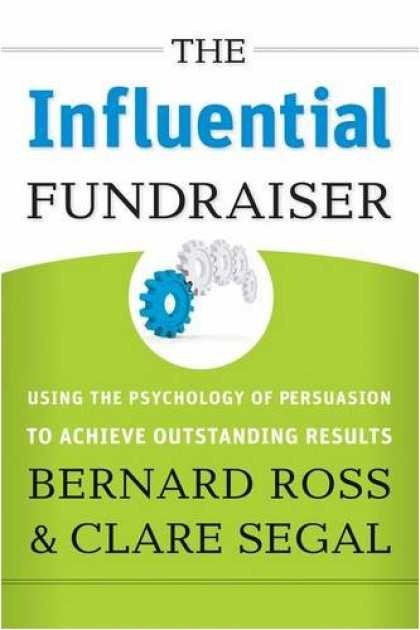
To help fund raisers understand more about how to succeed with donors, Mr. Ross and Ms. Segal distilled a wide swath of research into a book published last year by Jossey-Bass called The Influential Fundraiser. The book also relies on their collective half-century of experience in training and coaching nonprofit leaders worldwide, working in North America and five other continents, in countries as diverse as Australia and Zambia.
A Broad Focus
Mr. Ross and Ms. Segal say that they were persuaded by Jossey-Bass to focus on fund raising in the book—but they did not originally plan it that way. Instead, because they spend a big chunk of their time helping nonprofit executives become better leaders, they wanted to teach readers how to persuade others to adopt their point of view. In that sense, the book could just as easily have been called The Influential Boss, The Influential Politician, or even The Influential Salesman.
However, the book is not about manipulation, Mr. Ross and Ms. Segal say. They say their focus is on “helping others to understand, accept, and act on your point of view.” Donors, they write, “should never feel manipulated, You can help people choose to change their minds.”
Successful Strategies
Following are some of the key ideas Mr. Ross and Ms. Segal say fund raisers should keep in mind as they approach donors for substantial gifts.
Understand differences in communication styles. Donors will develop a good rapport with fund raisers and others who subtly match their body language, tone of voice, use of words, and even the rate at which they blink their eyes, the authors write.
Fund raisers should observe how each donor communicates with others and take note of how he or she likes to receive information, Mr. Ross and Ms. Segal say.
Donors have three basic preferences, they write: Some people organize thoughts and memories primarily in terms of what they see, such as the table decorations and lighting at a charity event. Others respond primarily to what they hear; they are most likely to remember words and other sounds such as what music was played at the event. And still others react more to sensations and feelings; they are more likely to remember the taste of food or how uncomfortable the seating was.
Kimberley MacKenzie, director of development at Ontario Nature, a Canadian environmental organization, says she has read The Influential Fundraiser twice and now watches donors carefully to see which category they fall into.
She noticed that one donor described how she listened to the birds outside her office, a sign that donor prefers to get information orally. In communications with that donor now, says Ms. MacKenzie, “I try to talk about my cause in that context.”
Ms. MacKenzie admits that the authors’ concepts have sometimes been difficult to apply. But she appreciates that they offer one way to meet donors’ increasing expectations for meaningful interactions on their own terms with charities they support. And meeting those expectations, she says, is much more effective than relying on decades-old fund-raising tactics that emphasize the charity’s needs, not the donor’s.
“Traditionally we look at the gift chart where you need so many prospects to get one donation of a certain amount,” she says. “You look at what level they give at, and then you put them into the chart. We cannot fit people into charts. They want to respond to us in different ways. I don’t want to sound like traditional fund raising doesn’t work, but I cannot imagine treating all my donors with the same strokes ever again.”
Tailor the request to the donor. In big fund-raising drives, charities develop “case statements” about why donors should support the endeavor. But Mr. Ross and Ms. Segal argue that most case statements use too much jargon and focus on internal needs rather than communicating to fit donors’ specific preferences. Case statements are also often too long and too set in stone, the authors say. Instead, they should be tailored to fit the interests and needs of the donor.
Get beyond misperceptions. Donors often apply their own “opinion-distorting filters” to what they see, hear, and experience, which can prevent them from supporting a cause, Mr. Ross and Ms. Segal write. For example, donors may ignore or belittle worthy accomplishments of a charity simply because the organization does not subscribe to their religious beliefs.
Or donors might decide an entire organization is incompetent simply because a new receptionist forgets their name. To deal with such misperceptions, the authors offer a set of gentle questions fund raisers can use to tactfully challenge each type of distorted view.
In the process, they say, fund raisers can clarify what donors really think and learn how to change a misperception.
Overcome objections. When a donor says no to a fund raiser, it rarely means that he or she will never make a gift, Mr. Ross and Ms. Segal write.
For example, a donor might say “I’m not comfortable with you soliciting this gift.”
What that might mean coming from a man in his 70s is that the donor doesn’t want to be asked for money from a 30-year-old woman, the authors say. The challenge for the fund raiser is to figure out who is the right person to ask for the money and not to give up on the gift.
The authors also advise fund raisers to scour their organizations and projects for weaknesses and flaws. That way, they can formulate answers to the “killer question” from donors. That question, they write, “is the one you have been dreading. It’s the flaw in your case you know exists. … It’s the challenge about your organization’s work that you hoped had been glossed over.”
When a donor asks the killer question, the authors admonish, “you have to have a response. It’s not acceptable to say, ‘I don’t deal with that area.’ From the donor’s standpoint, you are the organization.”
Help donors make decisions. When it comes to making a sizable investment, consumers and donors alike use four basic methods to decide whether to take on the new expense, according to Mr. Ross and Ms. Segal.
Some people make quick decisions about whether to make a big financial commitment based on their instincts. Others need to go through the particulars of a large expenditure several times, often comparing and contrasting it with other opportunities.
A third group of donors will want to sleep on any big decision but do not necessarily need to compare and contrast the opportunity with other possibilities. Still others require repeated reassurances and demonstrations, often raising a seemingly endless set of objections.
Fund raisers who can match their attitudes and actions to the donor’s decision-making style are more likely to win a gift, according to the authors.
For example, a fund raiser might relax when a donor says yes quickly, but that same donor may be just as easily persuaded to give to a competing cause when he or she is approached by another organization.
That means fund raisers should move quickly to make a formal agreement to avoid losing out on the gift, Mr. Ross and Ms. Segal say.
Not all of the authors’ ideas will appeal to every fund raiser. Some readers, for instance, will be skeptical of the authors’ advice to boost their self-confidence on the job by consulting a group of “mental mentors”—much as Hillary Clinton said she did as first lady, seeking advice from an imaginary Eleanor Roosevelt.
But most readers will find plenty of helpful approaches. Some fund raisers have already used the authors’ concepts to change the way they interact with potential supporters.
“I used to get in a room with a donor, and the old pattern was to sell, sell, sell,” says Jane Robinson, a fund raiser at the World Society for the Protection of Animals, in London. “Now I go in and ask them why they care about the work, and I really listen. Fund raising has become a complicated science, but it’s really about one person connecting with another.”