A quarter century on, 9/11 charities evolve to remain relevant
Most charities formed after September 11 have disappeared. The ones that lasted redefined whom they serve, and why.

By Ben Gose
Senior Editor
September 9, 2026 | Read Time: 7 minutes
When tragedy strikes, people want to help. High-profile disasters are often followed closely by the formation of charities — and at no time was that on greater display than in the aftermath of the September 11 terrorist attacks, when more than 300 new nonprofits were formed.
This Friday marks the 25th anniversary of the 9/11 attacks, which killed nearly 3,000 people. Even following high-profile tragedies, fundraising peaks in the weeks and months after the incident and ebbs over time. Most 9/11 charities are long gone.
The few that have survived — and in some cases thrived — have generally expanded their mission or figured out other ways to remain vital at a time when a third of the country has no direct recollection of the attacks.
- At 9/11 Day, the founders say they studied the fading engagement around December 7 and Pearl Harbor — and doubled down on volunteerism to connect with a new generation.
- At Tunnel to Towers Foundation, the charity expanded its mission in a complementary way by focusing on returning military veterans — and it’s become one of the nation’s top fundraisers as a result.
- At Sing for Hope, an arts group started by two students at the Julliard School in the wake of the 9/11 tragedy, timely advice from a veteran philanthropist and nonprofit entrepreneur set the charity up for long-term success.
Doug White, a nonprofit strategist and a former director of Columbia University’s fundraising-management program, says the Tocquevillian impulse to come together following tragedy is laudable but isn’t enough to sustain charities over the long term.
“When that particular intensity fades, what does the organization do?” he says. “Most of those that have not gone out of business have done a pretty good job of redefining or expanding their mission.”
A pivot leads to growth
9/11 Day was started in 2002 by David Paine and Jay Winuk, whose brother Glenn, a volunteer firefighter, died rescuing people in the World Trade Center.
The effort started small, as a way to maintain a volunteerism focus on September 11. The Points of Light Foundation and some corporation foundations supported service projects on the first anniversary, in 2002, but didn’t carry the effort forward. Paine and Winuk pushed to have September 11 designated as a day of service and remembrance, but the George W. Bush administration resisted the idea early on.
“We’re knocking on doors and saying, ‘Let’s turn 9/11 into a day of doing good and peace,’ which was contrary to the narrative that was underway — the war on terror,” Paine says. After legislation was passed in 2009, September 11 was finally named a National Day of Service and Remembrance, opening the door for the charity to receive federal funding.

For a decade or more, the charity served mostly as an advocate and marketer, highlighting volunteerism opportunities on September 11 coordinated by groups like Points of Light and the HandsOn Network.
“We wanted to keep the promise to never forget, but we knew that that would be impossible unless we redefined the day — and turned it into something that future generations would want to be part of,” Paine says. “Pearl Harbor is the lesson that if you focus just on remembrance alone, over time that becomes less and less relevant, and ultimately not relevant at all to future generations. Then it becomes a lesson in a history book.”
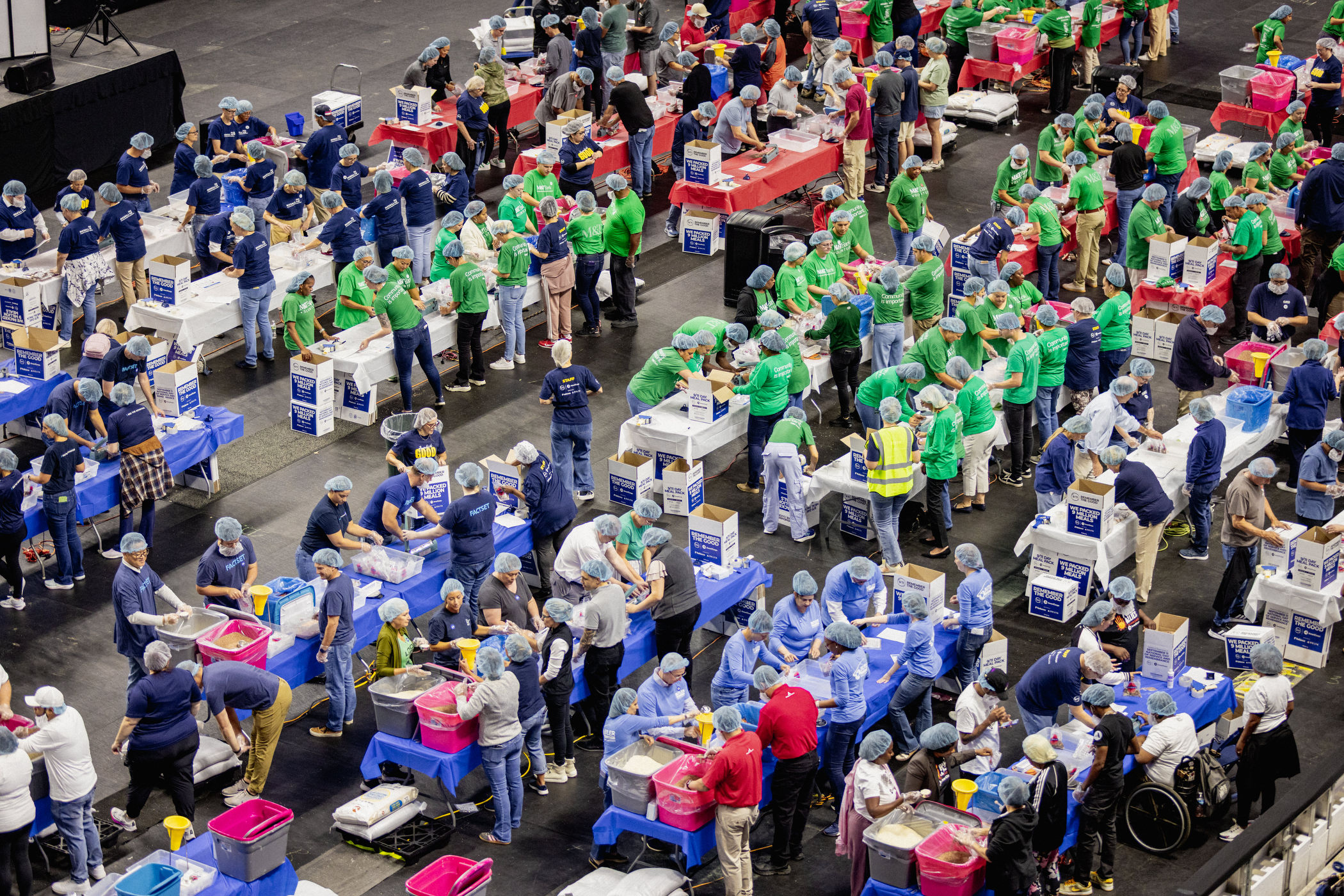
In 2016, the charity held its first meal-packing program in New York for seniors and families in need, which caught the eye of Citi Foundation president, Brandee McHale. The foundation awarded the charity a $250,000 capacity-building grant in 2017, which allowed 9/11 Day to hire its first development director.
This year, the charity will hold 51 meal-packing projects around the country. With the support of more than 600 corporate partners, the charity expects 60,000 volunteers to pack 20 million meals.
Federal support has also increased over time — including its biggest grant yet — a $7 million, two-year award from AmeriCorps tied to the 25th anniversary of 9/11. In August, 9/11 Day announced that it had re-awarded $3 million, nearly half the grant, to 200 charities and schools in 40 states for service days, donation drives, and community-improvement efforts.
A philanthropist urges change and expansion
Monica Yunus and Camille Zamora, the founders of Sing for Hope, were moved to use music as a way to help in the wake of 9/11. The two Julliard students organized fellow students to sing songs for surviving firefighters and their families at a firehouse near the campus.
“At that moment, we had the realization that we could actually serve through music,” Zamora says.

The students began sharing music in all sorts of public spaces, including schools and hospitals. In 2006, Eva Haller, a philanthropist and social-justice activist, encouraged the students to incorporate as a charity and think about expansion.
“She was the first person who really encouraged us to think systemswide,” Yunus says.
The charity raised $150,000 to $200,000 through grassroots fundraising in the first few years and hit $1 million by 2011. It now has 12 employees and a $4 million budget, including substantial earned income from contracts with NYC Health and Hospitals and Moynihan Train Hall. Sing for Hope is known for its artist-designed pianos, which it installs in public spaces, and it recently received a $5 million matching grant from the Arnhold Foundation to expand its music program in hospitals and medical centers.
From first responders to veterans and their families
One of the most successful fundraising organizations to emerge from 9/11 is the Tunnel to Towers Foundation. The charity, whose name honors a firefighter who died after running through a closed tunnel to reach the World Trade Center, remained fairly small for its first eight years, focusing primarily on firefighters and first-responders. It didn’t raise more than $150,000 until 2006, according to tax returns.
The charity broadened its mission around 2009, when it helped build a home for a returning veteran who was a quadruple amputee. Today, veterans are a core focus — the charity has delivered or is building 1,700 mortgage-free homes for injured veterans and first responders and for families of service members who died while on active duty, including entire “villages” (often former hotels) that provide housing and support services, according to the charity’s website.
In 2024, the nonprofit had contributions of $539.5 million, up from $7.3 million in 2014, according to its informational tax returns. In the latest edition of the Chronicle’s America’s Favorite Charities project, which shows cash fundraising of the country’s largest nonprofits, fundraising at Tunnel to Towers grew at nearly twice the rate of UNCF, the second fastest-growing group. The charity lists Fox News, the Home Depot Foundation, and GMC among its top supporters.
Tunnel to Towers declined interview requests from the Chronicle.
“They probably put a lot of people out of business because of the amount of money they bring in,” jokes John Feal, whose FealGood Foundation lobbies Congress to provide funding and health care to 9/11 responders and survivors.
Finding ways to connect and serve
Several other charities born after 9/11 remain active. Tuesday’s Children was founded to help the children who lost a parent on September 11. But even the youngest of that group are now working adults; in June, it rebranded as Tuesday’s Promise.
Voices of September 11th changed its name to Voices Center for Resilience in 2020. The change reflected the charity’s efforts to aid other communities affected by mass tragedies and disasters, in addition to its traditional role of helping 9/11 survivors and family members.
“The reality is the people that are affected have the same experience,” says Mary Fetchet, the charity’s founder and executive director. “It’s grief, loss, needing information, and needing support — on their timetable, not the government’s timetable.”
At the FealGood Foundation, revenues dipped to $277,000 in 2024, after averaging more than twice that from 2019 to 2022. But Feal, a retired construction worker who lost part of his foot at Ground Zero, says his group still has an important role. In the past year, FealGood and others successfully pressured the Trump administration and Congress to secure long-term funding for the World Trade Center Health Program, which monitors and treats 9/11-related conditions.
“It’s been 25 years, but for those who were directly impacted by 9/11, it’s the longest day in the history of days,” Feal says. “It just hasn’t ended for us. The FealGood Foundation goes as long as I go.”