A Religious Group Is Reclaiming America’s 250th From the Political Sideshow
As the 250th anniversary nears, a fast-growing network of clergy is treating the Declaration of Independence as a sacred text — and using it to coax their congregations back into civil conversation across political lines.

By David Wheeler
Contributor

June 17, 2026 | Read Time: 9 minutes
MCLEAN, VA.
Red, white, and blue helium balloons rise up on strings from circular tables in a community-center hall. Nearby, a long buffet table is laden with cookies, cupcakes, lemonade, and American-flag themed paper plates. One man plays a guitar, and the crowd sings “America the Beautiful.”
The event has a Fourth of July vibe, but it’s taking place in May. The guitar player is a rabbi, and the crowd is dotted with clergy from other faiths and members of their congregations. As part of the celebration of America’s 250th anniversary, about 75 people have come together to study what they regard as one of the “sacred texts” of American democracy: the Declaration of Independence.
Organized by a nonprofit called faith250, the event was part of a program launched on July 4, 2025, by a group of clergy concerned that serious reflection about the foundations of American democracy during the country’s 250th anniversary was being sidelined by the White House and replaced by such events as this week’s Ultimate Fighting Championship matches.
“I was two-and-a-half years old at the bicentennial,” says Michael Holzman, a rabbi at the Northern Virginia Hebrew Congregation and the group’s founder. “I didn’t want to lose this opportunity to celebrate America, just because the whole thing was going to turn into a political sideshow.”
As the precise date of America’s 250th anniversary approaches, the arguments over how best to celebrate it and what it even means to be an American are intensifying, with fault lines widening among political points of view. While democracy-strengthening organizations have sought to encourage civil discussions across the political spectrum, faith250, and a handful of other organizations, are stirring religious leaders and their congregations into the mix. Through faith250, those leaders build connections with one another and encourage their congregations to join carefully guided discussions that are intended not to create consensus, but to restart civil conversations and end the demonizing of those with a different point of view.

Religious leaders say it’s a critical time for such discussions. Ibrahim Anli, a member of the group’s steering committee and a Sunni Muslim, runs the Rumi Forum, which promotes interfaith dialogue and intercultural understanding. He says activities of this kind have increased since the 9/11 attacks and have helped strengthen connections across religions. But the divides today are much starker than they once were. “The fault lines run through congregations themselves,” he says. “People under the same roof of the same faith community are pitted against one another due to political differences.”
He believes faith250 can help to turn that tide and transform “religious communities from being victims of political polarization to being a social force to address it.”
Democracy’s Sacred Texts
Faith250 borrows the practice of the careful study of religious texts and applies it to what the leaders have selected as “sacred texts of democracy.” They include the song “America the Beautiful,” the Gettysburg Address, and What to the Slave is the Fourth of July?, the 1852 speech by Frederick Douglass. A movement that started out with a handful of mid-Atlantic congregations has spread, largely through informal clergy networks, to include more than 230 congregations nationwide, according to Holzman.
Faith leaders such as rabbis, pastors, and imams, are at the core of each official faith250 cluster, or local collection of places of worship. The clergy meet a few times, depending on availability and interest, to build relationships and to study some of the texts. Then they invite members of their congregations to participate in at least one discussion. The text is chosen ahead of time and discussion questions are crafted to invite reflective dialogue, rather than create “for” or “against” reactions. At the McLean meeting, the kickoff question for table discussions was, “Which ideal in the Declaration of Independence is the most important to your identity as an American?”
Discussion takes place at tables with 10 or fewer members. A table monitor, usually a faith leader, steers discussion, making sure all voices are heard. A “group covenant” lays out guidance: that everyone should speak from their own understanding with “I statements,” for example, and participants should avoid “hyperbole, filibuster, gestures, and name calling.” The goal of conversations, the covenant says, is to model the sort of discussion that “contributes to healthy citizenship” and not necessarily to change other people’s minds.
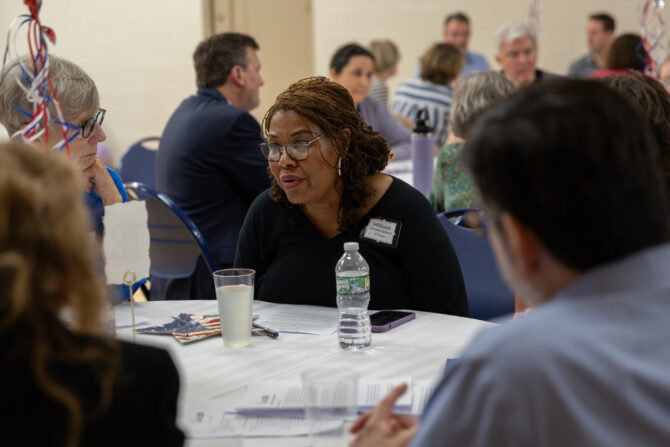
“It’s harder to be arguing when people are expressing their experiences, their stories, their values,” says Jen Feldman, a rabbi at Kehillah Synagogue in Chapel Hill, N.C. and one of the leaders of the faith250 Chapel Hill cluster. “We lean into compassionate, active listening to understand, not listening to develop your argument.”
Holzman says the character of the discussion, and not just its content, has been rewarding to him. Participants may worry that they will be mocked or shunned if they say something different from what they perceive to be the consensus, he says. But, in the end, he believes participants have been respected and treated with dignity, to the surprise of some. “That surprise has been the most rewarding part of this whole thing,” he says.
Given that participants may have very different experiences and perspectives, the materials can differ depending on the congregation’s interests and needs. For example, in many Black churches, the anniversary isn’t viewed as a cause for celebration, says Jerad Morey, the director of civic dialogue with the Minnesota Council of Churches. Instead, it is a reminder of ongoing injustice and the failure to live up to the country’s original promise, including the belief that “All men are created equal.” Using Douglass’s speech as a sacred text, he says, shows the organization’s interest in stimulating discussion around just that point.
Driving Subtle Change
One of the first changes that faith250 creates among its members, leaders say, is a better understanding of American civics. Political science is not usually taught in seminaries, leaders note. “I think most of what pastors, rabbis, and imams know about American civics is what they learned in ninth grade,” Holzman says.
Feldman sees studying democratic texts as a way to inspire participants to fight for the vision of America that is in documents such as the Declaration of Independence, even if those documents were flawed when they were written. (Another rabbi noted the Declaration of Independence, for example, refers to Native Americans as “merciless Indian savages.”)
An important aspect of faith250 is to foster conversation, says Morey, of the Minnesota Council of Churches. Community strength is based on the strength of relationships, and the strength of relationships is based on the quality of conversations, he says. He believes helping people have better conversations builds a broader and better democracy infrastructure.
At this moment when civil rights, including voting rights, are under threat, faith250 can be an important catalyst for understanding, says Vernon Walton, the senior pastor of First Baptist Church of Vienna, Va., a Black congregation. Members of his congregation and other African Americans can be apprehensive when invited into discussions such as those held by faith250. “You’re trying to determine whether or not people are ready to have the crucial, painful, hard conversations that these topics can lead to,” he says.
But he believes if one participant reframes their thoughts or becomes more empathetic about somebody else’s feelings, then faith250 has done its job. And that is better than doing nothing, he adds: “We can’t sit idly by and allow someone else to write the story of our democracy.”
Room for Improvement
The leaders of faith250 sought out both religious and racial diversity. To encourage broader participation, the group makes “microgrants” that can help under-resourced or understaffed faith communities, including minority-serving churches, to participate. The grants could, for example, pay for a meal at a church that didn’t have a catering budget.
Clusters in the mid-Atlantic counted Muslims, Baha’i, and Quakers among their participants. They would have liked a wider variety of faiths, such as Catholics and Hindus. But leaders were cheered by the strong participation of members of the Church of Jesus Christ of Latter-day Saints, or Mormons. “We want to have these conversations,” says Amy Harman, communication director of the Oakton, Va. stake, the Mormon equivalent of a Catholic diocese, who has attended faith250 events. “We want to be good citizens of our country, and we also want to have discussions around issues that I think some people are shying away from.”
She says she is troubled that topics and symbols, such as the American flag, which should be uniting Americans, are instead dividing them. “Things that didn’t used to be hot topics have become hot topics,” she says, “and I think that that’s really sad.”
In Chapel Hill, N.C., Meg Peery McLaughlin, co-pastor of the University Presbyterian Church, says the cluster that she was involved in was overwhelmingly white. She also would have loved to have more conservatives participating who disagree with her liberal views. “It wasn’t a bridge between people in the way I would have hoped it could be,” she says, “but that doesn’t mean it wasn’t worth it.” To continue outreach to African Americans, the cluster will join a Juneteenth celebration in a historically Black neighborhood.
Beyond July 4th
The faith250 clusters are finalizing plans for July Fourth celebrations and other events such as Juneteenth and beginning to think about next steps.
“We need one of these on every block,” says Rabbi Rick Jacobs, president of the Union for Reform Judaism, which represents roughly 900 synagogues, including Holzman’s. “So the only question is, how do we scale it up?”
The organization just released ideas for celebrating Thanksgiving with civics-oriented discussions. Some clusters have done community service, such as beach cleanups or highway cleanups, that give members time together in a different setting.
Holzman, the founder, says that he and others are working on a strategic plan to look at 2027 and beyond. “We’ve seen how deep the hunger is for this work,” he says, “and also how profoundly we’re getting results.”
The Commons is financed in part with philanthropic support from the Arthur M. Blank Family Foundation, Einhorn Collaborative, and the Walton Family Foundation. None of our supporters have any control over or input into story selection, reporting, or editing, and they do not review articles before publication. See more about the Chronicle, the grants, how our foundation-supported journalism works, and our gift-acceptance policy.