Foundations Rush to Support ‘AI Proof’ Jobs in the Trades
With an older generation of skilled workers retiring, foundations have committed more than a half billion dollars to train their replacements.

By Alex Daniels
Senior Editor, Foundations
July 6, 2026 | Read Time: 8 minutes
For three decades, the auto bays at Detroit’s Western High School sat dormant. Instead of serving as a hands-on classroom for students to learn how to adjust brakes and test a car’s alignment, they were used for storage. But thanks to a $5 million grant from Bloomberg Philanthropies and Ford Philanthropy, the philanthropic arm of the Ford Motor Company, the space will once again come to life, stocked with the newest automotive repair equipment and staffed with teachers.
Bloomberg’s half of the $5 million grant, part of a larger $90 million commitment the grant maker announced in June, is just the latest philanthropic investment toward creating jobs in the skilled trades, in-demand professions that have been called AI-proof by workforce experts.
At Western High and another Detroit school that also received part of the grant, educators hope to graduate 300 fully certified auto technicians by 2028, up from the current capacity of 85. Those students should have ample employment opportunities. Ford expects that some 350,000 positions in the field will need to be filled in the next two years. And by receiving training as part of their high school education, they won’t have to pay the approximately $60,000 price tag for training outside of the school.
“This is not a fluff certification,” said Dana Hughes, the school system’s director of career and technical education. “It’s real. They will be able to walk out of the program and go to a dealership and be able to work as a technician.”
The Detroit mechanic programs are part of a “breathtaking” amount of recent interest among foundations in the skilled trades, according to Robin Kramer, managing director of the Smidt Foundation, a family foundation created by Eric Smidt, a co-founder of Harbor Freight tools. Over the past several years, grant makers have committed more than a half-billion dollars to training programs, equipment, transportation to classes, and other support payments to aspiring electricians, mechanics, carpenters, welders, and other skilled blue collar workers.
Other big donors to the cause include the BlackRock Foundation, which in March committed $100 million, and the Family and Workers Fund, a $140 million collaborative fund that has paid out $100 million over the past six years, $42 million of which has gone to support new jobs building infrastructure.
Big box retail chains have also been active. The Home Depot Foundation is in the midst of a $50 million commitment to train workers, and the Lowe’s Foundation in April expanded a previous commitment to $250 million.
Responding to a Changing Labor Market and AI
The sudden interest from so many grant makers has been driven by a few factors, including new technology, trends in higher education, and shifting dynamics in the labor market. Older workers are aging out of their jobs, and there aren’t enough skilled replacements to take their place. But the need for them has galloped ahead. The Biden-era Infrastructure Investment and Jobs Act, as well as the fast-paced growth of AI, has helped to jumpstart massive infrastructure projects and helped to create a demand for skilled workers to build roads, bridges, buildings, data centers, and improvements to the electricity grid. That has left companies scrounging for skilled labor.
Layered on top of that basic supply-and-demand imbalance is the havoc artificial intelligence is wreaking on the job market. AI tools are dramatically reshaping the employment picture for some more vulnerable jobs, including computer coders, financial analysts, and some creative roles. But a person who knows how to wield a wrench or wire a house can have a durable career, said the Smidt Foundation’s Kramer.
It’s taken philanthropy a long time to understand that, Kramer said. A decade ago she helped start the Skilled Trade Funder Kitchen Table, an informal group of donors interested in the subject. About 10 others joined in.
“It was honestly kind of lonely,” she said.
Now, that group has grown to more than 90 members. In addition to the batch of corporate foundations that have a business interest in growing the field, such as hardware stores and tool companies, other types of donors have joined, including the Career Technical Education Foundation Sonoma County, the Richard M. Fairbanks and Circle of Service foundations, as well as the All Within My Hands Foundation, which is the charitable arm of the heavy metal band Metallica.
The new interest, Kramer said, also comes from a cultural shift. For decades after World War II, veterans took advantage of the G.I. Bill, making a college degree accessible to a greater number of people. As more people attended, it became a more common aspiration backed by government policies, and the percentage of Americans attending college ballooned. The trades, Kramer said, were stigmatized.
Now, large majorities of people from both political parties support increasing funding for high school programs that train workers in the trades, according to a University of Chicago study funded by the Smidt foundation.
Despite Support Training Programs Have Challenges
Among some conservatives the interest in the skilled trades has been spurred by a rising distrust of colleges and universities, said Esther Larson Lenger, vice president of strategic giving at the Philanthropy Roundtable, a network of conservative donors and grant makers. Some see those institutions as too ideological, she said, and others don’t want to contribute to a system that saddles graduates with student debt.
Skilled trades certification programs offer students access to relatively high-paying jobs, she said, and allow people to make valuable contributions to their communities.
“There has been a real focus on, ‘Get the four-year degree,’ but that’s not necessarily a formula for everyone,” she said.
President Trump weighed in on the matter in an executive order in March 2025, in which he set a goal of getting 1 million people into skilled trades jobs within five years. But the cause has been embraced by people of various viewpoints.
The Families and Workers Fund, which has gotten support from progressive grant makers that include the Ford and Open Society foundations and the Schmidt Family Foundation, has made raising safety standards a cornerstone of its skilled trades funding. It sees the creation of thousands of new jobs as an opportunity to give workers more sway in policy debates.
But these funders are stepping into a field that has some challenges, particularly when it comes to completion rates for these programs. The retention rate for skilled trades apprenticeships is under 35 percent, according to a 2021 U.S. Department of Labor study.
Often people don’t stick with it because they can’t afford transportation to and from the training site, they need child care, or they lack the money for tools and equipment, said Jenny Weissbourd, the Families and Workers Fund’s managing director of programs. To help people clear those obstacles, the fund is working with the Sheet Metal Occupational Health Institute Trust, a group created by sheet metal workers and contractors, to provide services that address those needs. Test efforts are underway in six states.
Philanthropy won’t necessarily need to support these efforts for the long haul, according to Weissbourd and other workforce experts. By involving unions, state and local governments, and businesses in training efforts, philanthropy can help generate streams of funding that don’t rely on gifts.
“When you bring these different sets of dollars to the table and prove something works and drives better outcomes for workers and for companies, there’s a better pathway to long-term sustainable capital,” she said.
Philanthropy Is Filling an Important Gap
Foundations related to tool companies and retailers have long backed these programs in part because they align with their business goals. Now that same incentive is drawing in a surprising and deep-pocketed funder: investing giant BlackRock.
For years, the BlackRock Foundation’s mission to help people become more financially literate has dovetailed with the investment giant’s commercial side. Now its $100 million commitment to the trades is an evolution of that approach, according to Claire Chamberlain, the foundation’s president.
In 2024 BlackRock acquired Global Infrastructure Partners, an investing group with about $170 billion in assets under management dedicated to bets on data centers, alternative energy sources, transportation, and water systems.
It will take a lot of skilled workers to complete the projects BlackRock’s commercial side has invested in, Chamberlain said.
“When you look at the skilled trades that are needed to build not just the digital infrastructure, but the ports and the roads and the electrical grid systems that are required, there’s a pretty serious mismatch in the labor supply and demand,” she said.
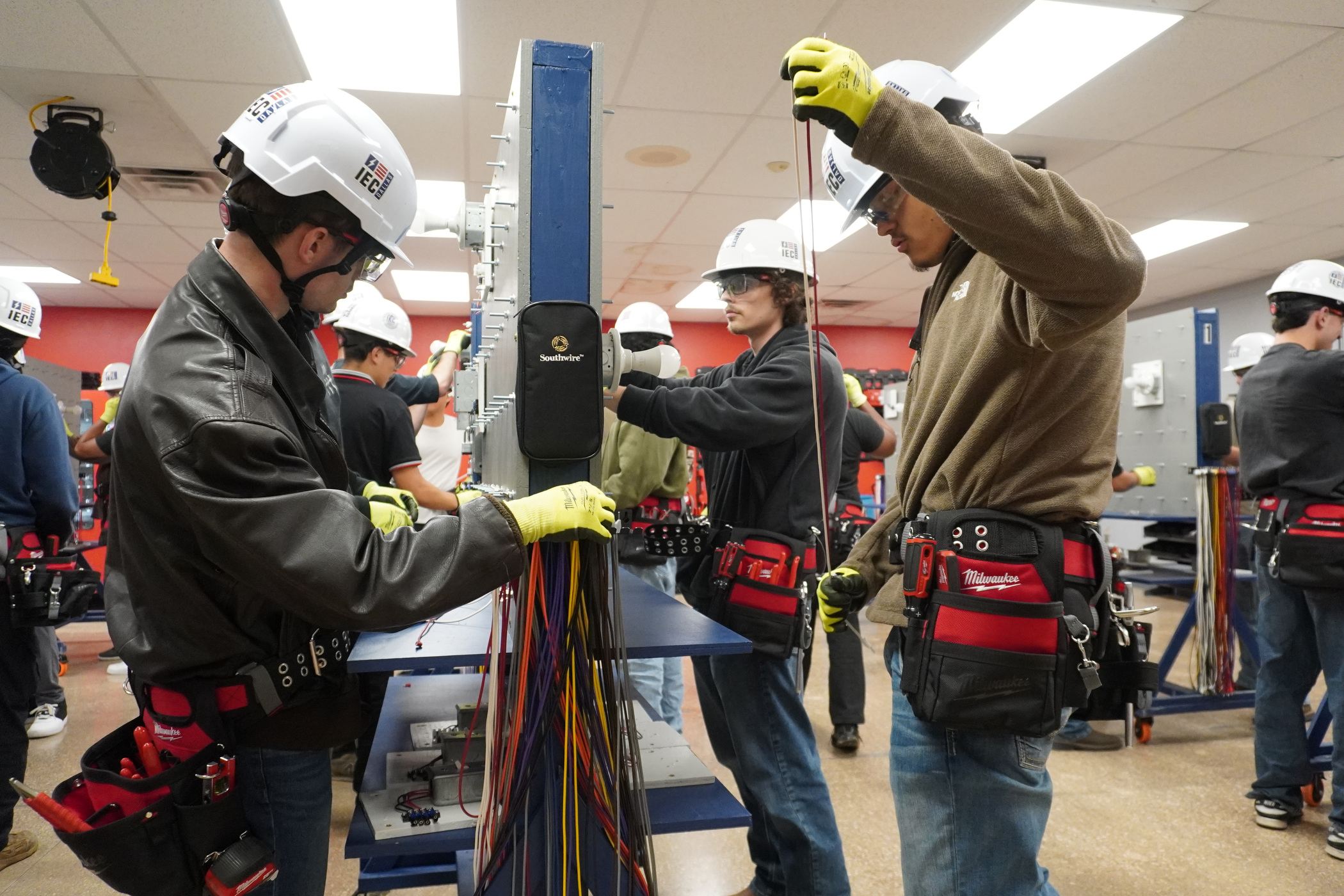
In May the first $30 million grants from the BlackRock Foundation’s $100 million Future Builders program went to an effort to certify 10,000 electrical technicians in Texas. The recipients included the Dallas branch of the Independent Electrical Contractors trade group, the International Brotherhood of Electrical Workers union, and Texas State Technical College.
So far, about 170 people have completed a class funded by BlackRock to become certified journeyman electricians — eligible to earn about $40 an hour, said Erin Stewart, executive director of the IEC Dallas. She expects to train a total of 1,500 over the next three years.
In addition to the journeyman certification, BlackRock is footing the bill for pretraining sessions for people curious about becoming apprentice electricians. Once they complete that program, they are paired with an IEC contractor to continue their apprenticeship while earning a wage.
The goal of what BlackRock Foundation’s Chamberlain calls “apprenticeship bootcamps,” is to get people acquainted with the rigors and mental challenges of the job. That way, she said, there are likely to be fewer dropouts later on in the training.
Without the help of philanthropy, clearing the backlog of building projects will come at a cost, Chamberlain said.
“Absent the philanthropic piece, it’ll just take longer,” she said. “Projects will be slower to come online, they will potentially cost more, and you’ll have less people getting access to these good jobs.”
Correction: A previous version of this article identified the Smidt Foundation as a funder of the Families and Workers Fund. It did not fund the group; the Schmidt Family Foundation did.