GitLab hosts nonprofit AI demo day to woo investors to innovation fund
Investing in commercial uses of AI far outstrips investing for social good. The GitLab Foundation wants to change that.

By Alex Daniels
Senior Editor, Foundations

September 15, 2026 | Read Time: 6 minutes
The GitLab Foundation is hoping to get more grant makers to help nonprofits develop AI tools that will boost their impact. To that end, it recently gathered more than 200 foundation program officers and technology experts to learn about the advances nonprofits have made.
Kavitta Ghai, co-founder of AI company Nectir, told the crowd how an AI platform she developed could have helped her as a young student. She created an AI tool to help students navigate the process of transferring from a community college to a four-year college that ensures that all of their credits will count. Transferring credits can be so time-consuming that students’ financial aid can run out as they wait, Ghai said. She estimates that the process cost her $8,000 for courses that she completed but did not count toward her degree.
“My life would’ve been completely different had I had access to technology like this,” she said in an interview with the Chronicle. The tool will be in use throughout the California community college system next year.
Nectir helped develop the platform for the Foundation for California Community Colleges, one of 15 organizations that this year received a total of $4 million from the GitLab Foundation’s AI for Economic Opportunity Fund. The fund was created three years ago with a $10 million commitment from the GitLab Foundation, the Ballmer Group, and the Annie E. Casey Foundation. In addition to the financial support, grantees received technical support from OpenAI.
Ghai and the 14 other grantees from this year’s round of funding gathered in Washington, D.C., earlier this month to showcase their progress. In attendance were the Annie E. Casey, Gates, and Rockefeller foundations, philanthropist Melanie French Gates’s Pivotal Ventures, the Walton Family Foundation, and other grant makers.
GitLab’s president, Ellie Bertani, has already seen some interest from grant makers. The 26 previous recipients of grants from the fund have received $30 million in additional grants from other funders, she said.
There is growing interest among philanthropies in supporting AI-related efforts. The Gates Foundation, for instance, ended a nearly decade-long anti-poverty program last year, choosing to put the bulk of its economic mobility support behind an independent investment group called NextLadder, which scouts out promising uses of AI. And the Patrick J. McGovern Foundation’s mission is to harness AI and data science for good.
Despite that interest, philanthropic support pales in comparison with the investments in AI businesses. Less than 1 percent of the hundreds of billions in AI investments have supported efforts to make a social impact, Bertani said, citing figures from a World Economic Forum report.
“Many promising concepts go unfunded or get stuck in the pilot phase because we don’t move quickly enough or apply enough risk capital in this space,” she told the group at the demonstration.
Funding and technical support get results
The grantees who joined Ghai in Washington made the case for using AI in efforts to improve health care, strengthen the work force, and improve access to public benefits. Other recipients of the funding include the National Domestic Workers Alliance, which is testing the use of AI to provide coaching and legal support for domestic workers, and the Community Economic Defense Project, which is using the technology to help prevent people from being evicted from their homes.
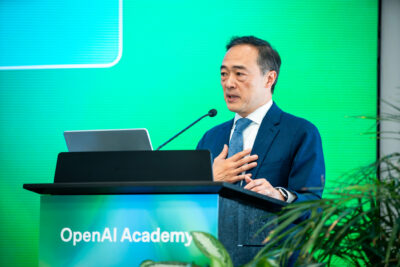
Each organization was provided technical assistance from OpenAI. The technology company has filed for an initial public offering, which could bring with it a windfall for philanthropy. Its associated foundation’s estimated $180 billion in assets is based on its 26 percent equity stake in the company.
Chan Park, OpenAI’s head of U.S. and Canada policy and partnerships, spoke at the GitLab Forum, highlighting some of the ways the company has worked to improve AI adoption among nonprofits, including holding workshops called “nonprofit jams” to introduce charitable organizations to the technology.
With the company’s IPO pending, many are eagerly waiting to see if some of the resulting assets will be steered toward nonprofits working with AI. In August the foundation announced it was launching AI for Civil Society and Philanthropy, a division that will help nonprofits and others use AI to solve some of society’s biggest challenges. Park did not make a formal announcement about future investments, but he did suggest more support was needed.
“There’s real potential here for AI to make an incredibly important, powerful difference in people’s lives in so many different ways,” he told the crowd. “The speed of funding, the speed with which we need to move, that’s all incredibly important.”
Big gains are possible with the right AI investment
AI tools are not a magic wand for anything that ails a nonprofit. Sometimes developing a new AI tool can even temporarily hinder a nonprofit’s work, said Elizabeth Nash, senior associate for data and tools and measurement at the Annie E. Casey Foundation. There is a lot of momentum behind the use of AI for social good, she said. But before embarking on a new plan, it is important to determine how doing so will affect an organization’s ability to complete work in the short term and what the benefits will be over the long haul.
Nash, who serves as an adviser to Opportunity AI, a network of leaders focused on using the technology for economic mobility, attended the demonstration to get a better sense of how nonprofits were making that trade-off. “The idea was to figure out if slowing down to build tools like this penciled out,” she said. “In some cases, it may slow down their work to then make it faster. And so we wanted to explore that notion.”
According to Bertaini’s projections, by using AI to transform their operations, organizations that presented at the demonstration will generate about $1.4 billion in additional lifetime earnings for individuals. That huge impact is the result of just a $4 million investment.
The majority of nonprofit organizations that are in the early stages of using AI are applying it to fairly mundane tasks, Bertani said, like managing their email or assisting their research. Bertaini said AI’s promise runs quite a bit deeper.
The fund focuses on projects that are designed to radically change a nonprofit’s business model. For a nonprofit to be investment-ready, it needs to have some familiarity with the tools, and it helps to understand that while the “sexy” parts of AI — chatbots and the like — naturally draw people, those features are impossible without significant investment into back-end technology systems that are fully integrated.
“We had a very strong viewpoint from early on that we would not do AI literacy grant making,” Bertaini said. “ We don’t do AI training, we don’t do AI literacy. We do AI implementation projects in nonprofits that affect a lot of people.”