Protest or Riot? Foundations Navigate Legal Landmines
As the White House attempts to draw a clear line connecting anti-Trump protesters and progressive foundations, grant makers face existential threats.

By Alex Daniels
Senior Reporter
November 3, 2025 | Read Time: 8 minutes
- Legal experts see an increase in attempts to blur the lines that separate peaceful protest, civil disobedience, and lawless riot.
- Nonprofit and foundation leaders are navigating what constitutes liability for protests, as well as threats to tax-exempt status.
- One nonprofit lawyer said many of her foundation clients have expressed a desire to follow the model of philanthropist MacKenzie Scott and support nonprofits' general operations with a minimum of paperwork.
For the Bread & Roses Community Fund, protest is a key method of pushing for social change. Grantees of the $14 million fund have taken to the streets, held signs, chanted slogans, and rallied for various causes since it was created five decades ago.
Putting feet on the ground has helped pave the way for notable policy developments, according to Patrice Green, Bread & Roses’s co-chair, including the creation of Philadelphia’s housing trust fund and stopping the expansion of a large oil refinery in the city.
Protesting, she said, is an essential tool that organizers can use to enact change.
“The reality is: We require both the inside work of policy change and the outside pressure of people having their voices heard,” she said.
While freedom of speech is enshrined in the Bill of Rights, breaking the law is not protected speech. The Trump administration has attempted to stiffen prosecution of protesters and change the rules governing lawful protest, to make it more risky for grant makers like Bread & Roses to support direct action.
As mass protests began forming in cities where the U.S. Immigration and Customs Enforcement agency began carrying out deportations early in the Trump administration, the White House has painted participants as a lawless mob funded by deep-pocketed philanthropists.
To fight politically-motivated violence and what it calls “domestic terrorism,” the administration has announced plans to prosecute organizations that financially support groups that have organized protests.
Bread & Roses’s website describes civil disobedience — illegal acts that are not protected by the First Amendment — as a crucial part of community organizing, along with hosting town halls and educating community members. And Green insisted that the fund does not encourage grantees to break the law. Instead, she said the site’s reference to civil disobedience, the “good trouble” famously described by civil rights icon John Lewis, is used as an example of what has worked historically to achieve social change.
Green is one of many leaders across the nonprofit world who is navigating the lines between peaceful protest, civil disobedience, and lawless riot.
100 Bills to Curtail Right to Protest
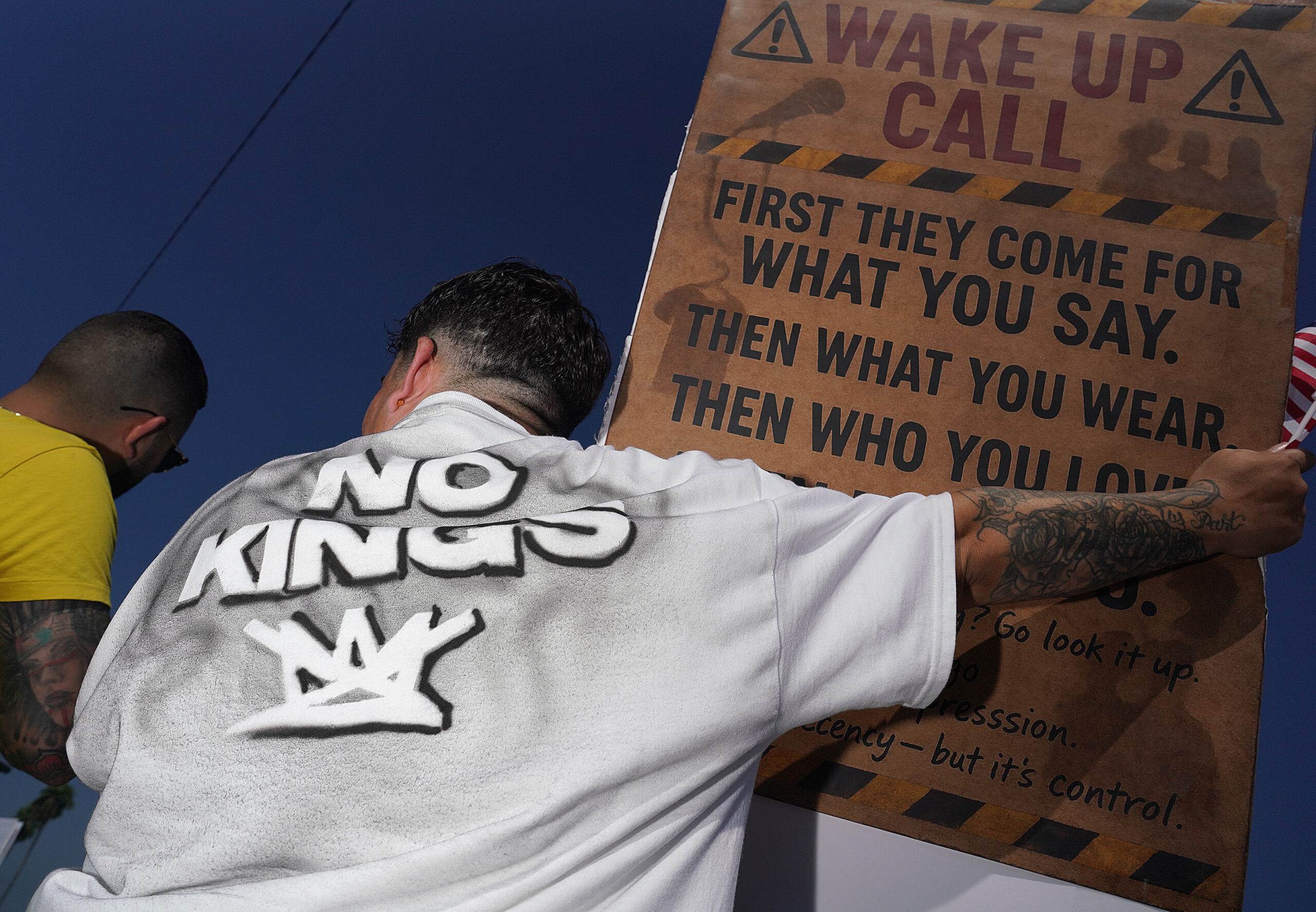
Trump made his distaste for protests against his administration clear when this summer he called those protesting against ICE raids “paid insurrectionists.” Later he claimed that the October 18 “No Kings” protests across the country were funded by philanthropist George Soros and other “radical left lunatics,” and produced an AI- generated video of him flying a fighter jet appearing to dump excrement on protesters.
A few weeks earlier, following the killing of conservative activist Charlie Kirk in September, Trump directed law enforcement agencies and the Internal Revenue Service to use a wide set of tactics to identify and punish nonprofits he believes support unlawful protest and political violence, including, according to reports, Soros’s Open Society Foundations.
Those methods include using anti-racketeering laws to develop cases against foundations even when there doesn’t appear to be a direct causal tie between a grant and an act of civil disobedience, and redefining “terrorism” to include domestic activities as a way to terminate the tax-exempt status of certain groups.
In July, Republican Sen. Ted Cruz introduced a bill titled the Stop Financial Underwriting of Nefarious Demonstrations and Extremist Riots, or STOP FUNDERs Act, which would allow for criminal charges and threats of asset forfeiture to be brought against organizations that fund or coordinate protests that turn violent.
“Every American has the right to freedom of speech and peaceful protest, but not to commit violence,” Cruz said in a statement when he introduced the bill. “Domestic NGOs and foreign adversaries fund and use riots in the United States to undermine the security and prosperity of Americans.”
In addition to Cruz’s bill, dozens of other pieces of legislation have been proposed at both the state and federal level this year. According to a report by the Advancement Project, a civil rights nonprofit, more than 100 bills aiming to curtail the right to protest or adding enforcement powers against protesters have been introduced this year.
About two dozen pending and enacted laws relate to the legality of traffic interference by protestors; others would make it a crime to protest while wearing a mask, and 12 enacted or pending bills in several states increase protest-related offenses from misdemeanors to felonies, according to the report.
“There’s an attempt to consolidate power by this administration to repress the voice of the people,” said Carmen Daugherty, the Advancement Project’s deputy executive director.
Nonprofit Liability and Tax-Exempt Status
The courts have tended to regard charities’ work as protected speech, according to Robert Post, a constitutional scholar at Yale University Law School. According to Post, it would be difficult for a foundation that preaches the benefits of protest to be held liable for the actions of an employee of a nonprofit grantee who breaks the law during a protest.
For prosecutors to have a case against a grant maker for fomenting violence at a protest, the grant maker would have to be on the scene, essentially telling participants to storm the ramparts at the moment of conflict, Post said, referencing the 1969 U.S. Supreme Court Case Brandenburg v. Ohio.
In the Brandenburg case, the court found that a fiery rally speech by a Ku Klux Klan leader was protected by the First Amendment because his rhetoric was unlikely to induce “imminent lawless action.”
“Imminent means you’re about to break the law,” Post said, “like you’re standing outside the Capitol and you say, ‘Storm the Capitol.'”
While grant makers that support protest movements can do so under the protection of the Constitution, they risk losing their tax status if they directly support unlawful activity. In an oft-cited 1975 IRS ruling, an anti-war organization was denied nonprofit status because a major part of its activity was to organize traffic blockades that caused disruptions on federal property.
The fact that the organization said a substantial part of its work was to encourage civil disobedience led to its application being denied.
“The intentional nature of this encouragement precludes the possibility that the organization might unfairly fail to qualify for exemption due to an isolated or inadvertent violation of a regulatory statute,” the ruling reads. “Its activities demonstrate an illegal purpose which is inconsistent with charitable ends.”
A nonprofit’s intention is key in determining responsibility for illegal acts committed at an event it organizes, said Kevin Goldberg, vice president at the Freedom Forum, a nonpartisan First Amendment advocacy group. There has to be a very clear goal expressed by the organizer of a protest that they want a specific illegal result, which he said, would put a nonprofit’s tax exempt status at risk.
And if a few unruly protesters trespass or destroy property during the march?
“If it is clear you are advocating for a purpose, and then a few people come in and spoil it, you are not responsible for all the bad apples,” he said.
Following the MacKenzie Scott Model
The Trump administration’s aggressive approach has many of Ellis Carter’s family-foundation clients worrying about whether they will get an unwelcome call from federal agents.
Carter, an Arizona lawyer who specializes in nonprofit law, said that many of her foundation clients have expressed a desire to follow the model of philanthropist MacKenzie Scott and support nonprofits’ general operations with a minimum of paperwork.
The desire to provide general operating support so grantees can have maximum flexibility in how they use foundation grants is laudable, Carter said. If a grant maker supports a nonprofit’s general mission rather than a specific project, it can make it nearly impossible to attribute responsibility for an illegal act that is committed during a protest organized by the grantee to the funder, she said.
But she suggests that foundations use air-tight grant agreements with grantees, which include promises that all funded activity will be legal, absolves the funder of any responsibility for criminal activity that came in connection with the grant, and requires the grantee provide regular updates to the grant maker of its work.
“A lot of family foundations really don’t want to have grant agreements,” she said. “They just want to write checks. In this environment, that is a very dangerous approach.”
Like the Bread & Roses Community Fund, Protect Democracy, a nonprofit created in 2016 to battle creeping authoritarianism in America, touts the virtues of civil disobedience. It created a coalition called the Faithful Fight project, which aimed to mobilize religious leaders to strengthen democracy.
The Faithful Fight’s website includes a toolkit with information on the practice of civil disobedience to draw attention to laws that protesters believe are unfair or immoral. The toolkit advises readers that they may suffer the consequences of any illegal actions they take.
Earlier this month, a U.S. District Court judge temporarily barred federal law enforcement from using physical force and carrying riot control weapons in response to a lawsuit brought by various faith leaders. Protect Democracy is part of a team of lawyers representing the plaintiffs, who argued that federal law enforcement officers had violently suppressed their freedom of speech when breaking up anti-ICE protests.
To help clergy prepare for protests, Protect Democracy provides information on the church’s involvement in past civil disobedience actions to provide historical context, said Corey Dukes, the nonprofit’s advocacy team leader.
Said Dukes: “We tell people: ‘Do not violate the law. Do not create violence in the streets.’”