How DC Central Kitchen Keeps Expanding While Other Nonprofits Shrink
For nearly four decades, the nonprofit has turned food into a tool for economic mobility — training thousands for careers, feeding up to 17,000 people daily, and building a model nonprofits nationwide now look to replicate.

By Stephanie Beasley
Senior Writer and Fellowship Director
July 8, 2026 | Read Time: 12 minutes
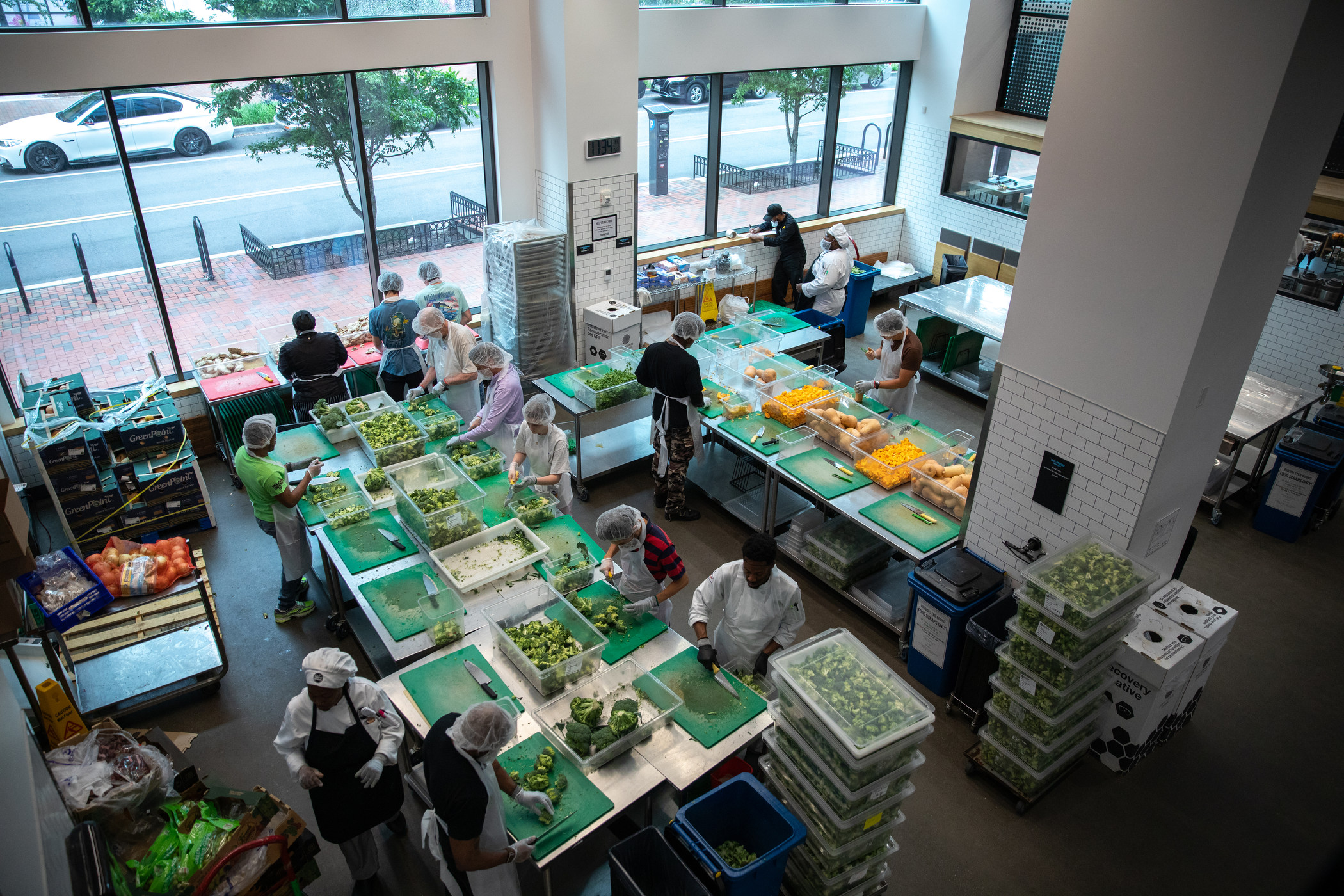
WASHINGTON – When nonprofit leaders from around the country want to understand how to feed people and help them gain financial independence, they often end up at DC Central Kitchen’s headquarters in Buzzard Point, a trendy neighborhood overlooking the Anacostia River, waiting for a tour from Beverley Wheeler.
Wheeler, the organization’s chief knowledge officer, gives roughly 100 of these tours a year to community kitchen operators from as far away as Europe. She also hosts food pantries considering ways to create fresh produce programs — and policy advocates trying to understand how the nonprofit has kept growing over three decades while others contract. To all, she emphasizes the same point: It’s not about food.
“Our mission is to use food as a tool to strengthen bodies, empower minds, and build community,” says Wheeler, whose team manages external partnerships and collects impact data. “We have not moved from that mission in 37 years.”
Today, that clarity of purpose is being tested. With ingredient costs up 35 percent or more and revenue streams thinning, DC Central Kitchen is under pressure. Its answer — as always — is to do more, not less.
After all, scaling back isn’t really an option. DC Central Kitchen serves up to 12,000 fresh meals daily to public, private, and charter schools, including 24 under a contract with D.C. Public Schools. The district set its purchase price in 2023, so DCCK has borne nearly all cost increases since then. Meanwhile, declining enrollment and attendance in some schools means fewer meals served — and less revenue for the organization.
“We can’t just cut back,” CEO Mike Curtin says, adding that the meals his group provides during school hours often make up the bulk of students’ nutrition for the day. “We can’t say, ‘Sorry, kids, we’re not giving you lunch.’”
Over more than three decades, DC Central Kitchen has consistently turned financial pressure into expansion. It launched a school meals program during the Great Recession, built a corner store produce distribution network that became a national model, and trained 2,500 graduates, including formerly incarcerated people, for careers in food service. Those lessons are part of what has made it a destination for other nonprofits looking to learn. And now they’re critical for how the organization confronts new challenges.
Rather than depending on philanthropy alone, DC Central Kitchen blends donated dollars with revenue earned through its culinary job training program, catering operations, cafes, and food delivery services. The diversified funding model acts as a financial cushion, giving the organization room to lean into crises rather than retreat from them. It also frees DCCK to think beyond the immediate problem of hunger and invest in long-term economic mobility in ways that purely grant-dependent organizations rarely can. The result is a cycle that reinforces itself: An organization that demonstrates it can grow and sustain itself is one that donors want to fund.
Case in point: The model drew in the Paul M. Angell Family Foundation more than a decade ago. The Chicago-based foundation made its first grant of $30,000 to the culinary job training program in 2012. By 2017, it was pairing program support with general operating grants to help the nonprofit hire mental health and social support staff. Today, it provides multiyear commitments. The most recent was a $450,000 grant paid out over three years.
DC Central Kitchen’s work to “remove barriers and open new pathways to progress” is not easy to do, says Kim Van Horn, the foundation’s CEO. “It requires significant and sustained resources.”
Today, the organization has roughly $43 million in total assets and more than $40 million in annual revenue. It also has a roster of major donors that includes the J. Willard and Alice S. Marriott Foundation, which has contributed $21.3 million over the past 20 years; Michael Klein, who has donated $20.3 million since 2018; MacKenzie Scott, who gave $15 million in 2024; José Andrés’s Longer Tables Fund, which has contributed $3.5 million since 2020; and Craig Newmark, who has donated more than $3.5 million over the past decade.
Sharing Knowledge
The group’s success is so well known that it has become a proud clearinghouse for other groups struggling to meet needs in their own communities. Over the past two years, Wheeler has worked with 58 organizations and social entrepreneurs who were in the process of designing, starting, or augmenting their own models.
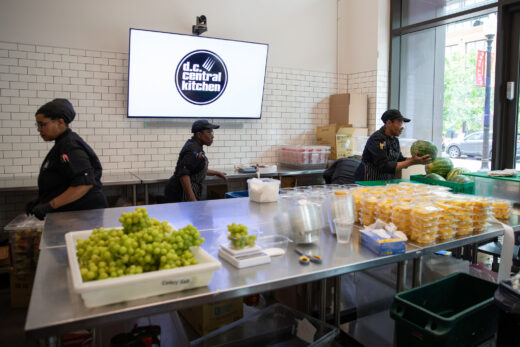
Wheeler offers her time and advice to groups for free. DC Central Kitchen also has an open-source Building Healthy Corners best practices guide on its website that has had nearly 2,400 views since it was posted in October 2025. And at biennial conferences for Catalyst Kitchens, a national network of community kitchens, DCCK serves as a “model member” for newer nonprofits seeking guidance.
“We’re the OGs, and they ask us a lot of questions,” Wheeler says.
When staff from Dutchess Outreach, a hunger relief group based in Poughkeepsie, N.Y., visited DC Central Kitchen in 2025, Wheeler and her team spent a significant amount of time sharing DCCK’s philosophy, according to Renee Fillette-Miccio, executive director of Dutchess Outreach.
“I was struck not only by the innovation of the model but by the generosity with which they shared their knowledge and experience,” Fillette says.
She says the visit prompted Dutchess Outreach to focus more heavily on work-force development and expanding meal service partnerships with local entities. The group recently renovated its community kitchen to include a classroom that will support a program inspired by DC Central Kitchen’s culinary job training initiative. Dutchess Outreach also now has a contract to prepare meals for residents of the Dutchess County emergency shelter and is exploring how it can distribute meals in partnership with schools, child-care providers, health-care organizations, and senior programs.
“I often talk about the influence DC Central Kitchen has had on our thinking,” Fillette says. “It’s important for people to see that examples of excellence exist and that those ideas can be adapted and replicated elsewhere.”
How a Nightclub Manager Reimagined Hunger
In many ways, Terrance Pardlow, a 33 year-old facilities worker at DC Central Kitchen, represents the best of what the group has to offer.
Two years ago, he was out of work. Then his sister, who had gone through DCCK’s culinary training program, encouraged him to try applying for a position there. He came late on the third day of his trial period and was sent home. He came back and told a staff member who asked if he really wanted to be there, “This is kind of my last chance to actually do something productive.”
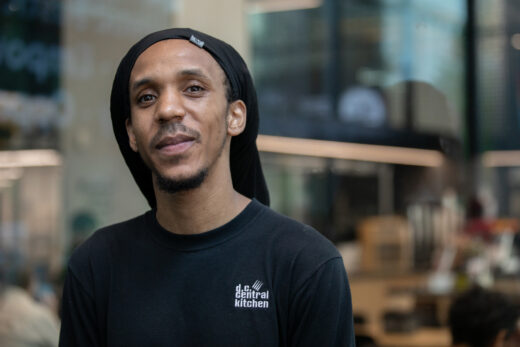
It stuck. Today, he walks into DC Central Kitchen’s new, spacious headquarters with an understanding of its holistic mission.
“They say they feed 16,000 meals, but actually it’s more,” Pardlow says. “Because if you count my family and basically what I went through and where I came from, I’m able to survive and feed my family now because of them. My sister has a job here. I have a job here. And that changed our lives for the better.”
Recently, DC Central Kitchen hit another milestone, serving 17,000 meals daily.
When the organization first opened in an old dentist’s office in 1989, founder Robert Egger had people like Pardlow in mind. He framed it not as a food charity but as an engine of economic opportunity.
Egger created a new, innovative model by building partnerships with local restaurants to retrieve food that would otherwise be discarded. Then the group mass-produced meals that other groups could serve to people in need. And it would help people who were formerly incarcerated, people without stable housing, single mothers, and others who may have been written off, find jobs.
Turning Crises Into Opportunities
Nonprofits across the U.S. often turn to DC Central Kitchen because it has been able to pull off something unusual: treat every crisis as an opportunity to expand its reach.
When the Great Recession hit in 2008 and donations began to dry up, DCCK didn’t cut programs; it started a new one. The organization launched what would become its Healthy School Food program, betting that it would both feed kids and generate revenue. It started with a single school contract. Today, it serves up to 12,000 meals daily across 30 schools.
In 2011, it secured a $300,000 grant from the district to pilot a program to sell fresh food from local farmers to D.C. corner stores in low-income communities. The Healthy Corners program now partners with 50 stores throughout the D.C. region, making it a national model.
In 2018, DCCK launched a program offering up to $5 in additional produce to SNAP recipients who used their benefits to buy groceries at Healthy Corners stores. Sales of produce items surged 172% almost immediately, and participating stores added an average of 17 new produce varieties within a year.
And since 2023, its school meals program has grown from 18 to 30 schools, and the annual number of graduates from the job training program spiked from 79 people to 178.
The group also has an influential collaboration with George Washington University that touches nearly every corner of the university — from biological sciences to human services, business, and arts programs, says Amy Cohen, assistant vice provost and executive director of GW’s Honey W. Nashman Center for Civic Engagement and Public Service.
The group’s whole-system approach to treating food insecurity has pushed GW students to think about social problems differently, Cohen says. They come to see the issue as inextricably linked to housing, poverty, and work-force development.
“DC Central Kitchen is an example we point to of an organization that has grown because it lived its values and developed something bigger, ” she says.
Adjusting to Today’s Challenges
Today, DCCK has more than 300 employees who make a living wage and receive health care. It maintains partnerships with about 40 farms and food hubs, and it has added 120 staff positions in the past three years alone. Rising inflation has pushed DCCK to lean harder on revenue from its three cafes and partnerships with local food retailers. That revenue jumped 45 percent last quarter and is projected to generate $300,000 total in additional annual revenue this year, says chief development officer Alexander Moore. Sales from the Healthy Corners program also have increased from 390,000 units of food to 475,000.

The organization is adjusting food service contracts to account for higher costs and has added a summer school meals contract. To trim expenses, it has improved scheduling efficiency by sharing overtime data across departments and renegotiated vendor contracts for services like printing and credit card processing. It is also transparent with funders about current shortfalls. In May, it launched an appeal to fill a $300,000 budget gap and has so far raised $282,000.
Longer-term pressures continue to mount. DC’s unemployment rate has climbed 41 percent since December 2024, and a record number of restaurants closed last year. In response, DCCK is expanding the range of food sector careers it trains students for, exploring meal distribution tied to the health-care sector and weighing new retail ventures.
“Our belief is that by offering compelling, updated solutions to real problems on top of our track record of successfully taking on past crises, we’ll inspire more support than if we scaled back services and tried to muddle through financially,” Moore says. “So far, that belief has been justified, and we have a donor community that consistently expects and affirms our bias toward action.”
From the Basement Up
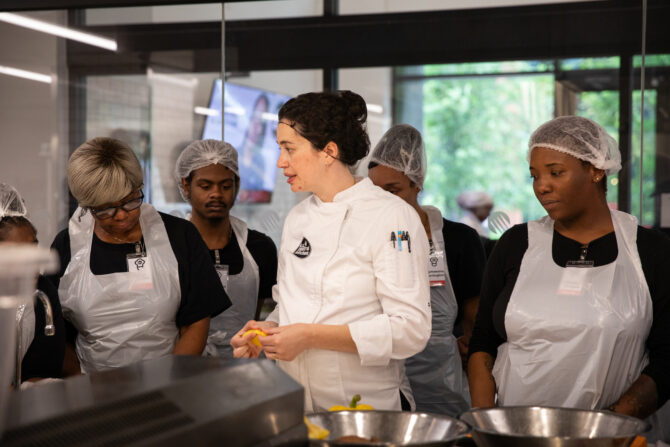
The organization’s new home tells its own story. Three years ago, DC Central Kitchen left the windowless basement of the district’s Federal City Shelter. Where the old space was cramped, its new headquarters in Buzzard Point is open and airy. High ceilings have been soundproofed to keep the noise of the café, meal prep, and training kitchens downstairs from drifting up to the offices above. Next to its in-house recording studio, a plaque bearing a quote from longtime donor Craig Newmark captures something essential about the organization’s posture toward the world: “Get Loud — Stay Loud.”
Curtin, the CEO, acknowledges the new building is an aesthetic upgrade, but he’s also adamant about its utility. More space means more meals, more training capacity, and more room to expand its ability to help solve problems.
But the core principle is the same as it was in 1989. All operations — from meal delivery services to mission to partnerships with universities and farmers — aim to address the root causes of food insecurity and to help people find jobs and a way out of poverty, he says.
“Is it a drop in the bucket? You bet. But that bucket is never going to be the same,” he says.
Wheeler, for her part, keeps giving tours.
“We’re not a pantry. We’re not a food kitchen. We’re not a shelter,” she says. “All those things are entirely necessary. It’s just not who we are. And we’ve known that for 37 years.”
Reporting for this article was underwritten by a Lilly Endowment grant to enhance public understanding of philanthropy. The Chronicle is solely responsible for the content. See more about the Chronicle, the grant, how our foundation-supported journalism works, and our gift-acceptance policy.